CEFR Levels Explained: A1 to C2 in Plain English
A1 to C2 describe what you can do in English, not how many words you know. Here's each level in practical terms, how long they typically take, and how to find yours.
On this page
The CEFR — the Common European Framework of Reference for Languages — is a scale published by the Council of Europe that describes language ability in six levels: A1, A2, B1, B2, C1 and C2. The levels are grouped into three bands: A is a basic user, B an independent user, and C a proficient user.
The key idea is that each level describes what you can do with the language — order a meal, follow a meeting, argue a point — rather than how much grammar you've studied. That's why the same scale works for English, Spanish or Armenian, and why schools, employers and exam boards around the world use it.
The six levels at a glance
| Level | Name | In practice, you can… |
|---|---|---|
| A1 | Beginner | Use familiar everyday phrases, introduce yourself and answer simple questions — if the other person speaks slowly and helps. |
| A2 | Elementary | Handle simple, routine exchanges: shopping, directions, basic information about yourself, your family and your job. |
| B1 | Intermediate | Understand the main points of clear speech on familiar topics, cope with most travel situations and talk about experiences, plans and opinions in simple connected language. |
| B2 | Upper-intermediate | Follow the main ideas of complex discussions, talk with reasonable fluency and spontaneity without strain on either side, and explain a viewpoint with pros and cons. |
| C1 | Advanced | Understand long, demanding texts and implied meaning, and express yourself fluently and flexibly at work, in study and socially without much searching for words. |
| C2 | Proficient | Understand virtually everything with ease, summarise complex sources and express fine shades of meaning precisely, even in difficult situations. |
These are plain-English summaries of the official descriptions, which you can read on the Council of Europe's CEFR pages.
Each level, in real situations
A1 — Beginner
You can say who you are, where you're from and what you do, ask someone's name and understand simple signs and forms. Conversations work only when the other person slows down and rephrases. A typical A1 sentence: "I am from Yerevan. I work in a bank."
A2 — Elementary
You can get through predictable situations — buying a train ticket, asking where the pharmacy is, describing your daily routine — using short sentences and memorised phrases. You understand slow, clear speech about everyday topics but lose the thread when people talk naturally among themselves.
B1 — Intermediate
This is the point where English starts to feel usable. You can explain a problem to a hotel receptionist, tell a story about something that happened last weekend and say why you prefer one option over another. You still pause to find words and make mistakes, but people understand you. Most adult learners spend a long time here; it's often called the intermediate plateau.
B2 — Upper-intermediate
At B2 you can take part in a work meeting, follow a podcast on a familiar topic and argue your side of a discussion with reasons. You can correct many of your own mistakes. B2 is a common entry requirement for university courses taught in English and for many international jobs.
C1 — Advanced
At C1 you can choose your words for effect: soften criticism, sound more formal or casual as needed, and pick up what people imply rather than say. You can write a clear, well-organised report and deal with unexpected questions without freezing.
C2 — Proficient
C2 is close to the ease of a highly educated speaker. You understand almost anything, including fast speech, wordplay and specialist texts, and you can express subtle differences in meaning precisely. Most learners never need C2; it tends to matter for specialist academic, legal or translation work.
What the levels don't tell you
A single level is a simplification. Most people have an uneven profile — for example, B2 reading but B1 speaking, because they read a lot but rarely talk. The framework itself describes skills separately for exactly this reason.
The scale also has finer steps. The Council of Europe's 2020 Companion Volume describes "plus" levels such as A2+, B1+ and B2+, plus a Pre-A1 stage, which is why you'll sometimes see courses labelled B1+ or "strong B2". And the CEFR is not a test: it's the yardstick that tests and courses are mapped to.
How long does each level take?
There's no fixed answer, but Cambridge English gives a widely used guideline in guided learning hours — hours of lessons and supervised study, counted from complete beginner:
| Level | Approximate guided learning hours (cumulative) |
|---|---|
| A2 | 180–200 |
| B1 | 350–400 |
| B2 | 500–600 |
| C1 | 700–800 |
| C2 | 1,000–1,200 |
That's roughly 200 hours to move up one level. Cambridge stresses that these figures are a guideline only — your background, age, how intensively you study and how much English you use outside lessons all change the picture (source). If you want to move faster, what matters most is regular, focused practice; our guide on how to learn English efficiently covers what that looks like day to day.
Is B2 fluent?
It depends what you mean by fluent. If fluent means speaking smoothly enough that conversation flows without strain, B2 is where that starts: you can keep up, get your point across and recover when you're stuck, though you'll still make mistakes and search for words on unfamiliar topics. If fluent means effortless and precise, that's closer to C1.
Fluency is also a skill you can train separately from your level. Plenty of B1 learners speak fluently within their range, and plenty of C1 readers freeze in conversation. Our guide to speaking fluently explains how to work on it directly.
How to find your level
There are three practical ways, from quickest to most reliable:
- Self-assessment. Read the descriptions above, or the more detailed "can-do" statements on the Council of Europe site, and be honest about which ones you can do comfortably, not just on a good day.
- A free online placement test. Useful for a rough estimate. Most only test grammar and vocabulary, so they tend to overestimate speaking and underestimate listening.
- An official exam. Cambridge English exams are designed around specific levels — A2 Key, B1 Preliminary, B2 First, C1 Advanced and C2 Proficiency — and other recognised exams, such as IELTS, report scores that are mapped to CEFR ranges. Choose this route if you need proof of level for a job, visa or university.
CEFR levels and Fluentra's courses
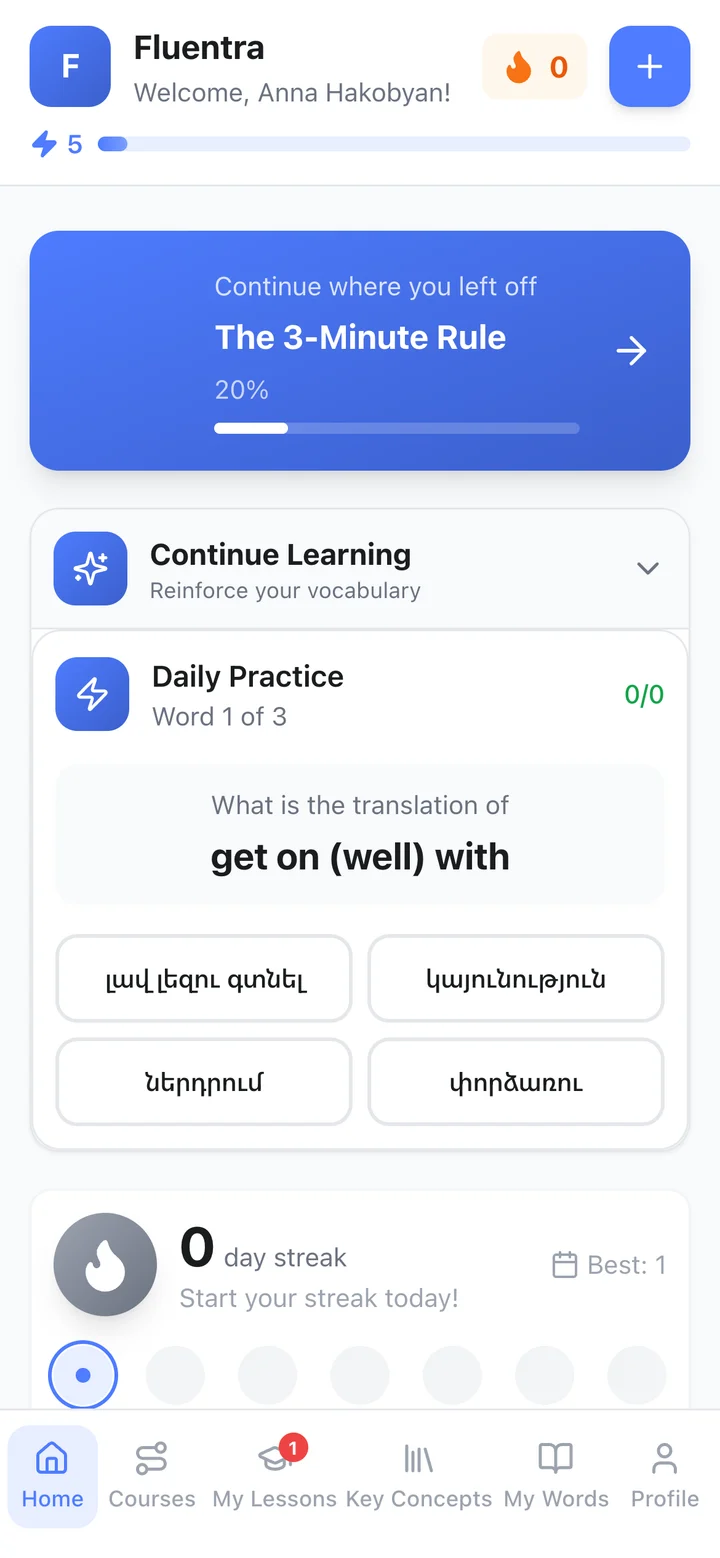
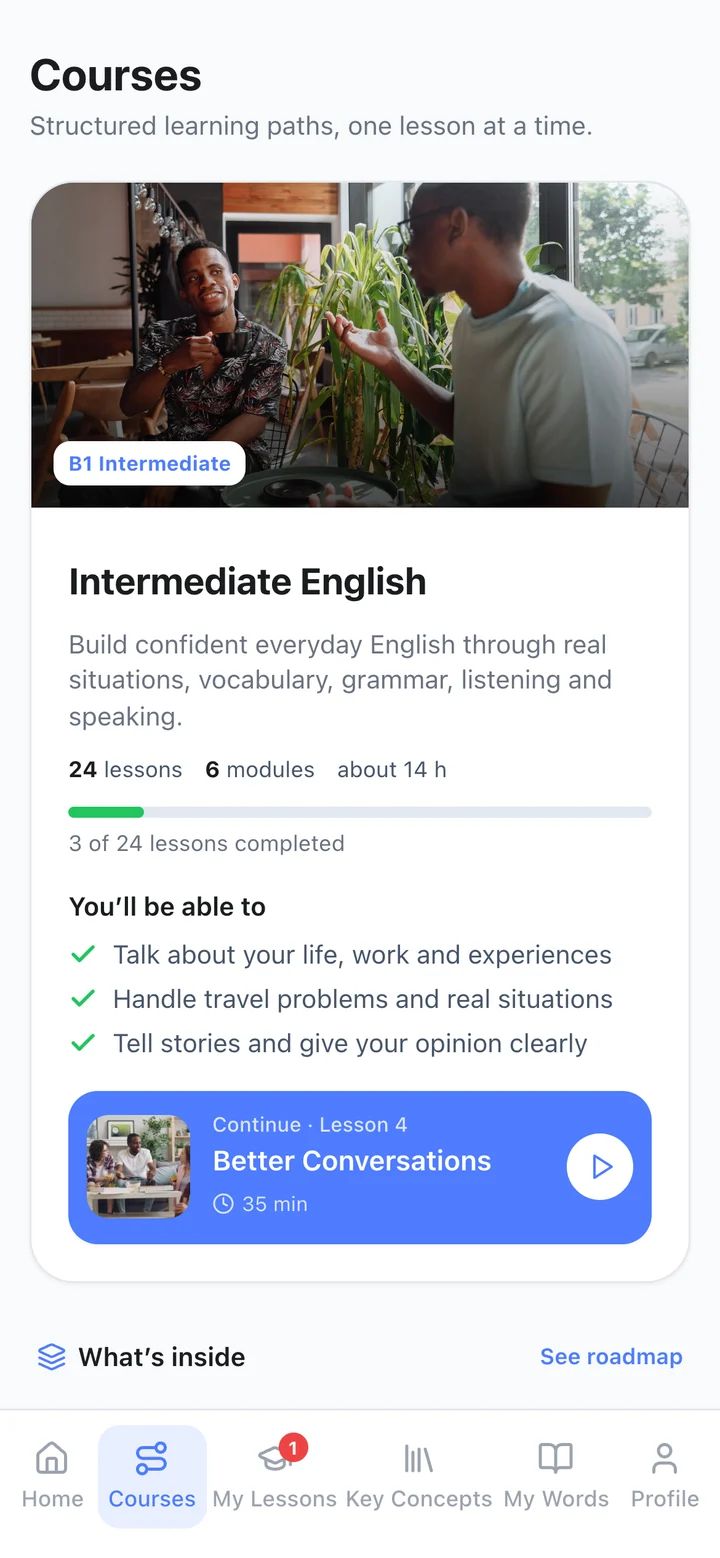
Fluentra currently has courses for B1, B2 and C1. Each has 24 lessons in six modules, and every lesson ends with a real-life task:
- Intermediate English (B1) — everyday communication; work, study and goals; travel and real situations; stories and experiences; opinions and the world; independent English. About 14 hours of lessons.
- Upper-Intermediate English (B2) — confident communication; working life; problems and solutions; society and ideas; people and culture; independent B2. About 16 hours.
- Advanced English (C1) — precision and nuance; professional influence; argument and evidence; language and society; complex interpersonal communication; mastery. About 18 hours.
There's no A1, A2 or C2 course at the moment. A rule of thumb for choosing: if you can tell a simple story about your week but often get stuck explaining why, start with B1. If you can discuss familiar topics comfortably but want to sound more natural and handle work situations, start with B2. If you're comfortable in most conversations and want precision and nuance, start with C1. Lesson hours are only part of the time it takes to move up a level — the guided-hours figures above include practice and review as well.
Questions people ask
What does CEFR stand for?
The Common European Framework of Reference for Languages, published by the Council of Europe. It describes language ability on six levels from A1 to C2.
Is C1 hard to reach?
C1 takes sustained work: Cambridge's guideline is roughly 700–800 guided learning hours from beginner, about 200 more than B2. Many learners find the jump from B2 to C1 the slowest, because progress depends on precision and range rather than new grammar.
What's the difference between C1 and C2?
At C1 you can use English flexibly and effectively in almost any situation. At C2 you do so with near-complete ease and precision, including subtle differences in meaning, fast speech and specialist texts.
Does the US use the CEFR?
The CEFR is used most widely in Europe and by international exams and employers. In the United States, language proficiency is often described with the ACTFL scale instead, though many international organisations there use CEFR levels too.