How to Speak English Fluently: A 30-Day Practice Plan
You understand English but freeze when you speak. That gap is normal, and it closes with the right kind of practice. Here's what builds fluency, and a plan for the next 30 days.
On this page
Speaking fluently doesn't mean speaking without mistakes, with a perfect accent or with impressive vocabulary. It means speaking smoothly enough that the conversation keeps moving: you find words fast enough, you don't stop after every sentence, and when you get stuck you can get around it.
That's good news, because fluency is a skill you can train directly — separately from grammar and vocabulary — and you can train most of it on your own. (If you're wondering how fluency relates to levels: conversation that flows without strain on familiar topics is roughly what the CEFR describes at B2 — see CEFR levels explained.)
Fluency, accuracy and why the order matters
Teachers often split speaking into fluency (how smoothly you speak) and accuracy (how correct it is). You need both, but trying to maximise both at the same time is what makes many learners freeze: every sentence gets checked for mistakes before it's allowed out, so very little gets said.
A more useful approach is to practise them separately. In fluency practice, keep talking and accept mistakes. In accuracy practice — listening back to a recording, doing an exercise, comparing with a model answer — fix them. Over time the two meet.
Why you freeze when you speak
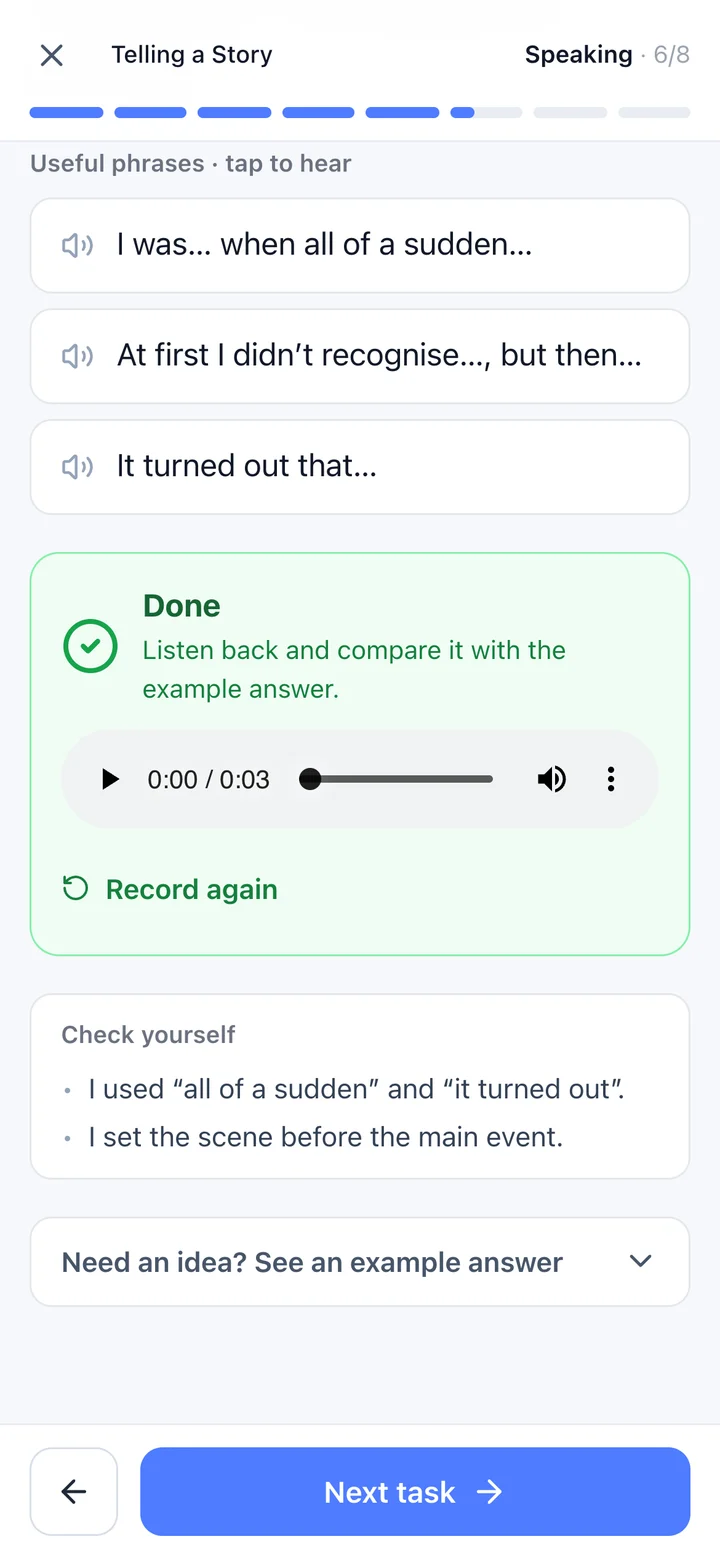
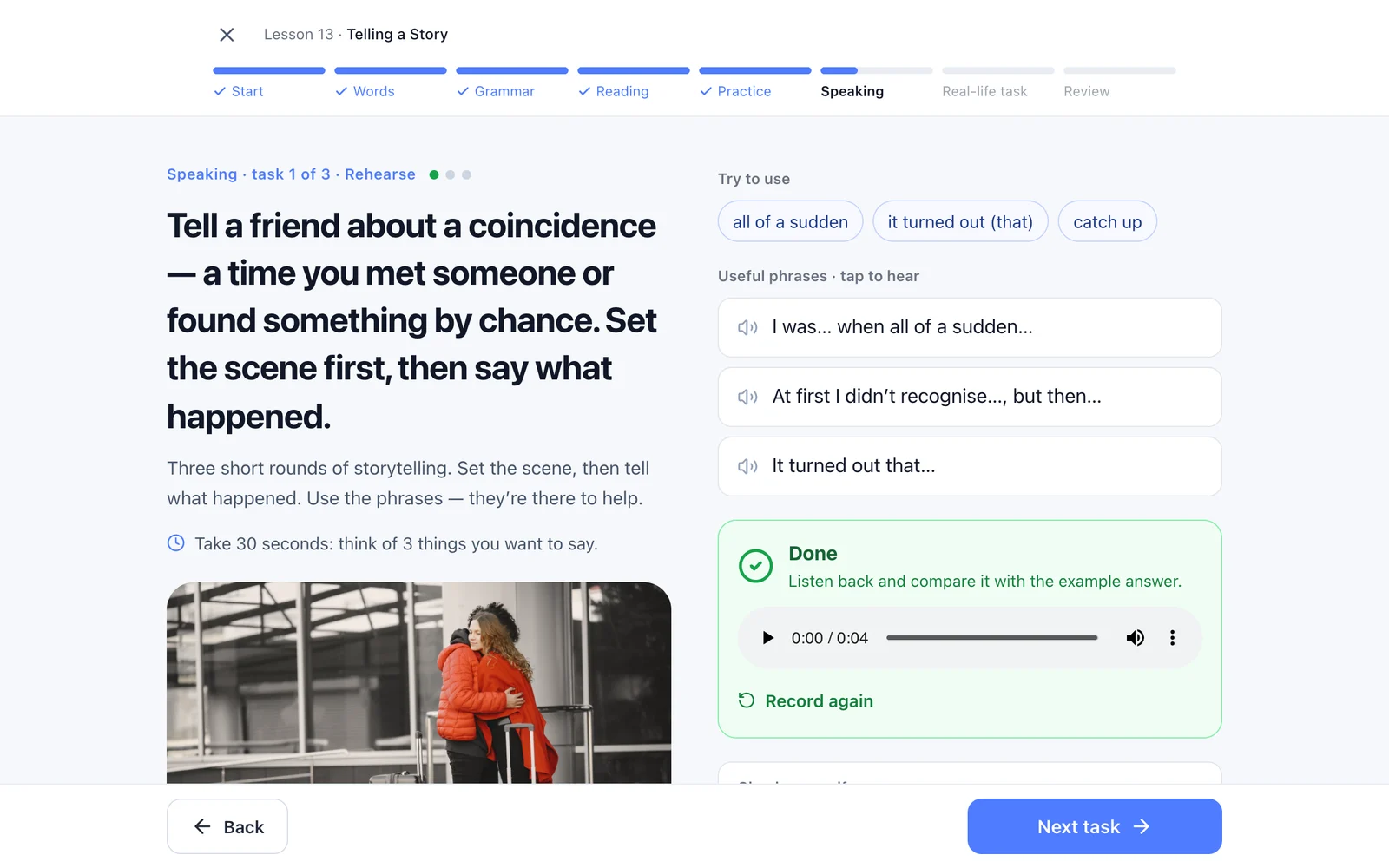
You're building every sentence from scratch. If you know words but not ready-made phrases, each sentence is a construction project. Fluent speakers rely heavily on ready-made chunks — to be honest, it turned out that, I'm not sure, but I think — and only build the bits in between.
You're translating in your head. Going from your language to English for every sentence doubles the work and makes your English sound like a translation.
You haven't spoken enough. Many learners have read and listened for years but spoken for only a few hours in total. Understanding and speaking use different muscles; the second one needs its own practice time.
You're afraid of mistakes. Fear makes you hesitate, hesitating makes you more nervous, and so on. Low-pressure practice — alone, recorded, repeated — breaks the loop.
What actually builds fluency
Learn and reuse chunks
When you meet a useful phrase, learn it whole and use it out loud the same day in a sentence about your own life. "It turned out that the meeting was cancelled." "It turned out that my flat was closer to the station than I thought." The more often a phrase leaves your mouth, the faster it comes next time.
Repeat the same talk, faster each time
Pick a topic you know well — your job, your hometown, a trip — and talk about it for four minutes. Then tell the same story in three minutes, then in two. Language teachers call this the 4/3/2 activity. Because the content stays the same, your attention moves to saying it more smoothly, and words that were slow the first time come out faster by the third.
Record yourself and listen back
Recording turns speaking into something you can improve. Listen for where you stopped, which words you searched for and which mistakes kept coming back. Look up the two or three things you needed most, then record the same answer again. The second version is almost always noticeably better — and that's the practice working.
Think aloud in English
Describe what you're doing while you cook, plan your day aloud, comment on the news in your head. It feels odd at first, but it's thousands of small speaking reps with no audience, and it's the most direct way to stop translating.
Have real conversations — when you're ready
Solo practice builds speed and confidence; conversation adds the unpredictability of another person. When you can talk for two minutes on a familiar topic without stopping, add a conversation partner, a language exchange or a tutor. You don't need one to start — here are 12 ways to practise speaking alone.
Phrases that buy you time
Fluent speakers don't always know what to say next — they just have ways to fill the gap. Learning a handful of these makes you sound more fluent immediately, because pauses stop sounding like breakdowns:
"Let me think…" · "That's a good question." · "How can I put it…" · "Well, the thing is…"
When you can't find a word"It's a kind of…" · "What's the word… it's the thing you use to…" · "I don't know the exact word, but…"
When you want to correct yourself"Sorry, I mean…" · "Or rather…" · "Let me say that again."
Describing a word you can't remember is a real skill, not a failure. Native speakers do it all the time.
A 30-day plan
Twenty minutes a day is enough. Each week builds on the last.
Week 1 — Collect your phrases
Choose three topics you'll talk about often (work, free time, where you live). For each, collect 10–15 phrases you'd actually say, from lessons, podcasts or articles. Every day, say five of them aloud in sentences about yourself, and record one 60-second answer: "Tell me about your work."
Week 2 — Talk to yourself every day
Spend 10 minutes thinking aloud — narrating your day, planning tomorrow, explaining your opinion on something you read. Add shadowing: play 30 seconds of a podcast or video, then repeat it at the same time as the speaker, copying their rhythm. Record one answer a day and listen back once.
Week 3 — Retell and repeat
Each day, read or watch something short, then retell it aloud with the 4/3/2 method: four minutes, three minutes, two minutes. Record the last version. On the final day of the week, compare it with your week 1 recording.
Week 4 — Add pressure, gently
Answer questions you haven't prepared for — pick random ones from a list and give yourself 10 seconds to think before you start. Practise one real situation you'll meet (a meeting, a phone call, small talk) by playing both sides. If you can, book one conversation with a person — a friend, an exchange partner or a tutor — and use your phrases.
How to know you're getting more fluent
Use your recordings. Compare the first and the last week and listen for:
- Longer runs — how long you speak before a real stop.
- Fewer silent pauses, and more filled ones ("well", "let me think").
- More chunks — phrases you've learned, used naturally.
- Faster recovery when you don't know a word.
You'll still make mistakes. That's fine: fluency first, then accuracy. To fit this plan into a wider routine with vocabulary review and listening, see how to learn English efficiently.
Mistakes that hold people back
Only speaking in lessons. One hour a week isn't enough speaking time. Daily solo practice fills the gap.
Memorising whole speeches. Memorise phrases, not paragraphs, so you can recombine them.
Correcting every sentence mid-flow. Save corrections for when you listen back.
Chasing a "perfect" accent. Being clear matters far more than sounding native. Work on the sounds that cause misunderstandings, not on hiding where you're from.
Questions people ask
Can I become fluent without living in an English-speaking country?
Yes. What matters is how much you listen to and speak English, not where you live. Daily speaking practice — even alone — plus regular listening gets most of the benefit of immersion.
Can I learn to speak fluently without a teacher?
You can build most of your fluency alone: phrases, retelling, recording yourself and thinking aloud all work without a teacher. A conversation partner or tutor is useful later for real-time practice and feedback, but it isn't required to start.
How long does it take to speak English fluently?
It depends on your level and how much you speak, so measure it rather than guess: record yourself today and again after a month of daily practice, and compare. Conversation that flows without strain on most familiar topics usually matches B2 level.
Do I need a native accent to be fluent?
No. Fluency is about speaking smoothly and being understood. A clear accent from your own language is completely normal — focus on the sounds that cause misunderstandings rather than on sounding native.