How to Practise English Speaking Alone: 12 Methods That Work
You don't need a conversation partner to get better at speaking. You need to speak — often, out loud, and in a way you can learn from. Here are 12 ways to do it alone.
On this page
The biggest obstacle to speaking better isn't the lack of a partner. It's the lack of speaking time. Most learners speak English for a few minutes a week, and nobody gets faster at anything with that little practice. The methods below let you speak every day, on your own, in a way that actually improves your English — not just fills time.
What solo practice can and can't do
Practising alone is excellent for speed, confidence and range: getting words out faster, using new phrases until they feel natural, talking about more topics without freezing. You can also find and fix your own repeated mistakes, especially if you record yourself.
What it can't fully replace is real-time interaction — reacting to someone else's questions, interruptions and accents. So the best approach is to do most of your practice alone and add conversations when you can. But don't wait for a partner to start. Everything below works today.
12 ways to practise speaking on your own
1. Narrate what you're doing
While you cook, walk or get ready, describe it aloud in English. "I'm making coffee. I usually have it without sugar, but today I need something stronger." It's low-stakes practice for everyday vocabulary, and you'll quickly notice which ordinary words you don't know — write them down and look them up later.
2. Play both sides of a conversation
Pick a situation you'll actually face — ordering in a restaurant, a job interview, calling to change a booking — and act out both people. Change your voice for the other person if it helps. This prepares you for real exchanges far better than reading dialogues.
3. Shadow a speaker
Play a short clip of natural English — 20 to 30 seconds from a podcast or video — and speak at the same time as the speaker, copying their rhythm, stress and intonation. Repeat the same clip several times. Shadowing trains your mouth to produce English at natural speed and improves pronunciation without any special equipment.
4. Record yourself and listen back
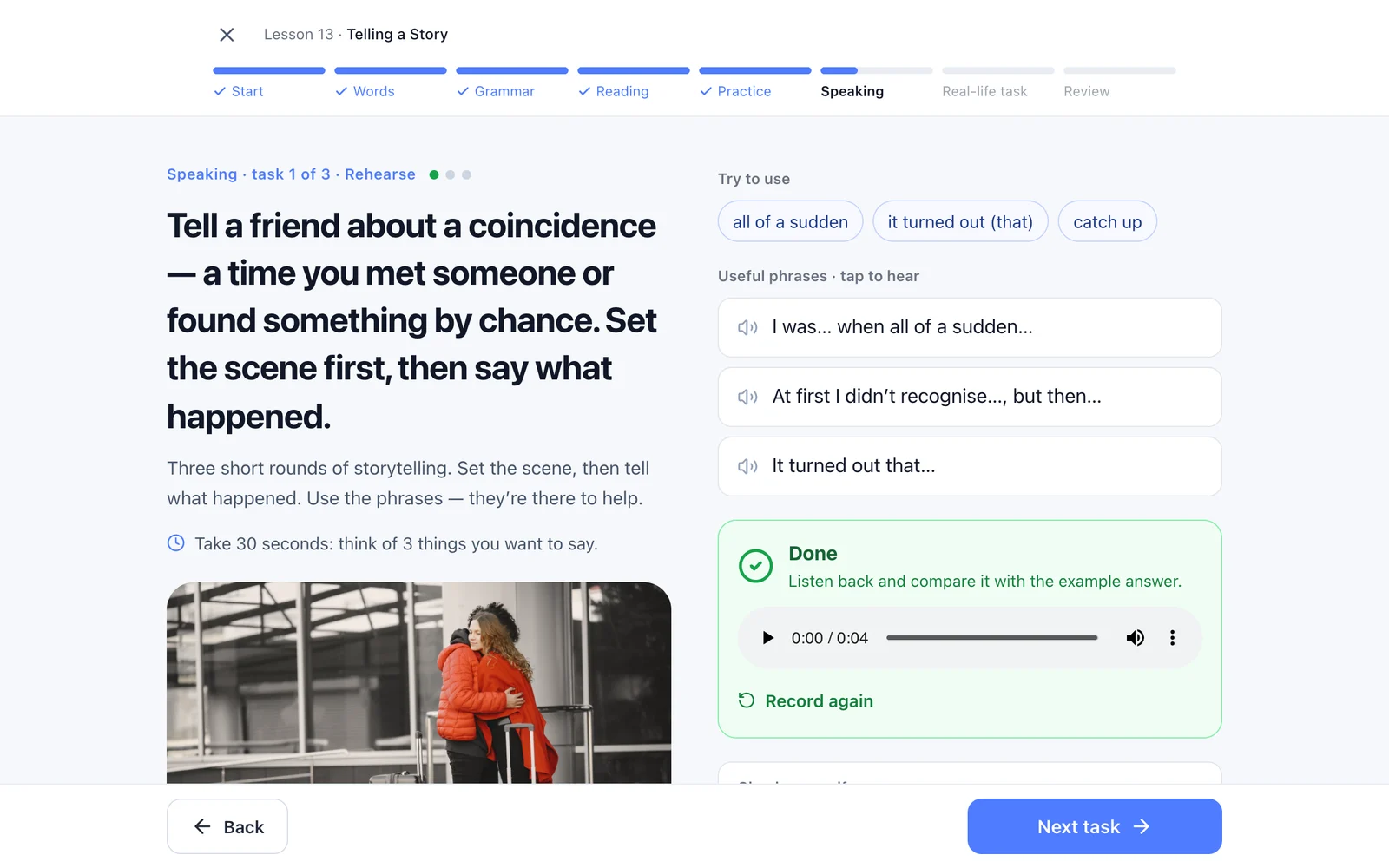
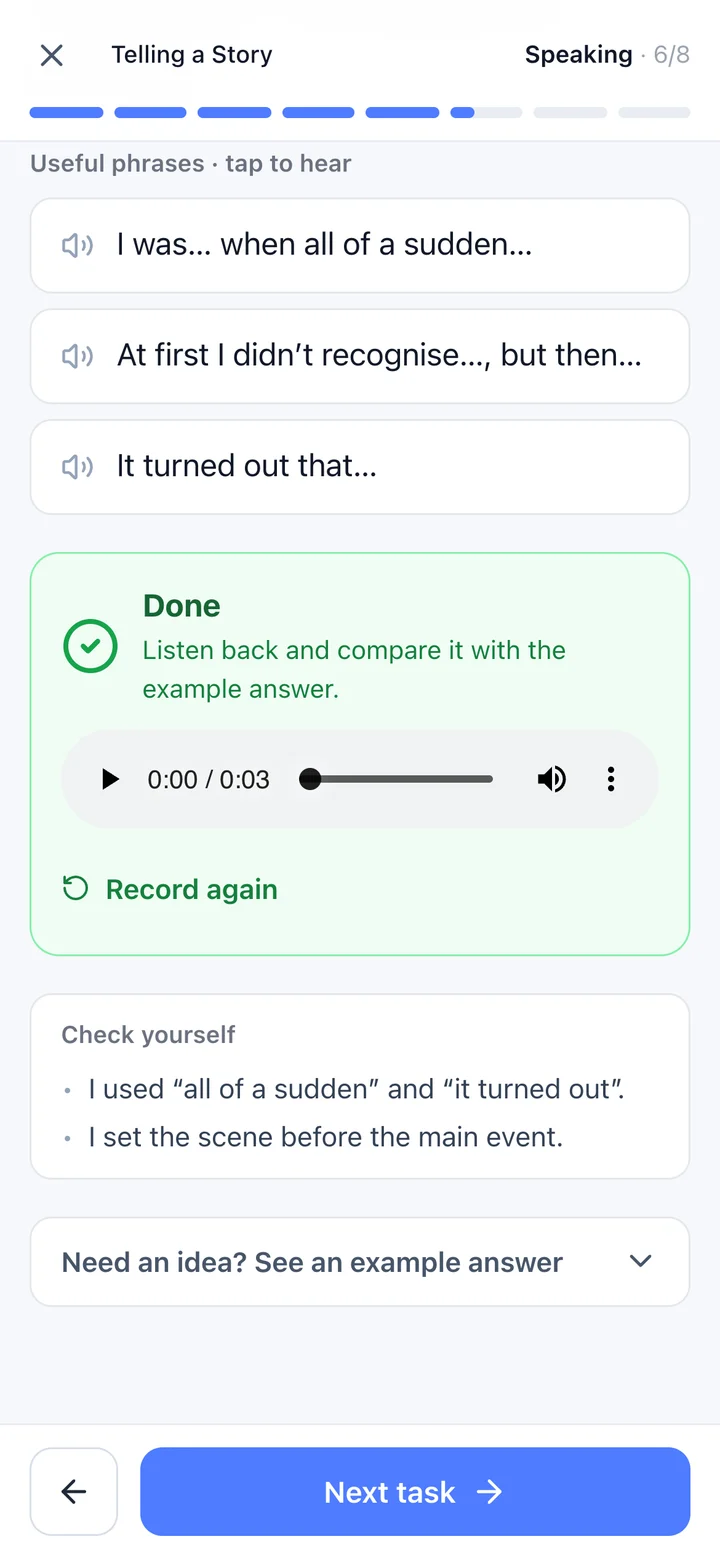
Answer a question in one or two minutes and record it on your phone. Listen once for flow (where did you stop?) and once for accuracy (which mistakes kept coming back?). Look up the two things you needed most, then record the answer again. Comparing the two versions is one of the most effective things you can do alone.
5. Retell what you read or watched
After an article, a video or a chapter, summarise it aloud: what happened, why it mattered, what you think. Then do it again more briefly. Retelling forces you to use the new words you just met, which is how they move from "I recognise it" to "I can use it".
6. Repeat one talk in less time
Talk about a familiar topic for four minutes. Then give the same talk in three minutes, then in two. Because you already know what you want to say, each round becomes smoother and faster. Teachers call this the 4/3/2 activity, and it works just as well alone.
7. Answer real questions out loud
Keep a list of conversation questions and answer one or two every day without preparing. Mix easy and harder ones:
What does a normal working day look like for you? · What's something you changed your mind about recently? · Describe a place you'd love to show a visitor. · What's a skill you'd like to learn, and why?
8. Describe pictures
Open any photo — from the news, your gallery, a travel site — and describe it for one minute: who's there, what's happening, what might happen next. It trains you to talk about things you didn't plan, which is a big part of real conversation.
9. Read aloud with a purpose
Reading aloud on its own doesn't build fluency much, because the words are given to you. It becomes useful when you have a target: copy the rhythm of a recording you've just listened to, or practise the sounds you find difficult. Then look away from the text and say the main idea in your own words.
10. Explain something you know well
Teach an imaginary listener how to do something — make your favourite dish, use a tool at work, get around your city. Explaining step by step makes you use sequencing words (first, after that, once you've…) and the specific vocabulary of a topic you care about.
11. Compare yourself with a model answer
Find an example answer to a question — in a coursebook, an exam guide or a lesson — but don't read it first. Answer the question yourself, record it, then read or listen to the model. Note one or two phrases it used that you didn't, and use them in a second attempt.
12. Keep a speaking log
Once a week, record the same kind of task — for example, a two-minute answer to "Tell me about your week" — and keep the recordings. Listening back after a month is the best motivation there is, because progress you can't feel day to day becomes obvious.
A simple weekly plan
Fifteen to twenty minutes a day is enough to make a difference. Here's one way to combine the methods:
| Day | Practice |
|---|---|
| Monday | Narrate your morning (5 min) · answer one question and record it (5 min) |
| Tuesday | Shadow one clip (5 min) · retell what it was about (5 min) |
| Wednesday | 4/3/2 on a familiar topic (10 min) |
| Thursday | Play both sides of a situation you'll face soon (10 min) |
| Friday | Answer a question, compare with a model answer, record again (10 min) |
| Weekend | Weekly log recording (3 min) · listen to last week's |
How to check that it's working
Use your recordings, not your feelings. Every few weeks, compare an old recording with a new one on the same task. You're looking for longer stretches without stopping, fewer long silences, new phrases you now use naturally and quicker recovery when you're missing a word. If those are moving, your practice is working — even if it doesn't feel like it.
For a structured version of this — phrases, techniques and a week-by-week progression — see our 30-day plan for speaking fluently.
When to add a conversation partner
When you can talk for a couple of minutes on familiar topics without stopping, real conversations will give you the most new value: different accents, unexpected questions and feedback on how you come across. A friend who speaks English, a language exchange or an online tutor all work. Keep your daily solo practice going alongside — it's what makes those conversations easier.
And if speaking is only one part of your plan, our guide to learning English efficiently shows how to fit it into a daily routine.
Questions people ask
Can you really learn to speak English alone?
You can build a large part of your speaking skills alone — speed, confidence, vocabulary in use and many of your own mistakes. Real conversations add something solo practice can't, so add them when you can, but solo practice is the foundation.
How long should I practise speaking each day?
Fifteen to twenty minutes of focused speaking every day is a solid target. Consistency matters more than long sessions — and comparing recordings every few weeks shows you whether it's working.
Is talking to yourself in English actually useful?
Yes, if you do it regularly. Narrating, thinking aloud and playing both sides of a conversation give you many short speaking repetitions and help you stop translating from your own language.
Can I practise speaking with an AI chatbot?
An AI chatbot can act as a patient conversation partner, which some learners find helpful. Treat its corrections with care, keep your own recordings so you can hear your progress, and use it alongside — not instead of — the methods above.