How to Learn English Fast: A Realistic Plan for Faster Progress
Nobody learns English in a week. But you can learn it much faster than most people do — by studying in a way that wastes less time. Here's how.
On this page
- What "fast" can realistically mean
- Step 1: Know your level and choose one goal
- Step 2: Build a routine you can keep
- Step 3: Learn phrases, not just words
- Step 4: Review on a schedule so words stay
- Step 5: Speak from the first week
- Step 6: Get lots of English you can understand
- Step 7: Check your progress every month
- What slows most people down
- A sample week
- A quick checklist
- How Fluentra fits in
The honest answer first: there's no method that makes English quick. Moving up one level takes most adults a few hundred hours of practice. What you can change is how much each hour gives you back. People who seem to learn fast usually aren't studying more — they're studying in a way that wastes less: one clear goal, a little practice every day, and methods that make them use the language rather than just read about it.
This guide is a plan for exactly that. It works whether you study alone or with a teacher.
What "fast" can realistically mean
Cambridge English estimates that it takes roughly 200 guided learning hours to move up one CEFR level — for example from B1 to B2 — and stresses that this varies a lot from person to person. (Our guide to CEFR levels has the full table.) At 30 minutes a day, 200 hours is more than a year; at an hour and a half a day, it's around four or five months.
So "fast" doesn't mean fluent in a month. It means:
- noticing real progress within a few weeks — understanding more, speaking with fewer pauses;
- moving up a level in months rather than years;
- never losing the ground you've gained.
That last point matters more than it sounds. Most slow progress isn't slow learning — it's forgetting. A routine that protects what you've learned is the biggest speed-up there is.
Step 1: Know your level and choose one goal
Studying "English" in general is slow, because everything feels equally important. Pick one goal for the next three months and let it decide what you practise. A good goal is concrete and tied to a situation:
"Take part in my team's weekly meeting without preparing every sentence."
"Hold a 15-minute conversation about my work and interests."
"Understand a podcast on a familiar topic without subtitles."
Then check your level honestly, with a placement test or the level descriptions, so you study material that's slightly above where you are rather than far above it.
Step 2: Build a routine you can keep
Thirty minutes every day beats three hours on Sunday. Short daily sessions keep vocabulary fresh, and consistency is easier to protect than enthusiasm. Choose the version that fits your real week, not your ideal one:
| Time | What to do |
|---|---|
| 20 minutes | 5 min review of saved words · 10 min one listening or reading text · 5 min speaking aloud about it |
| 45 minutes | 10 min review · 15 min a lesson or text with new language · 10 min practice exercises · 10 min speaking (record yourself) |
| 90 minutes | 15 min review · 30 min a full lesson · 15 min extra listening or reading · 15 min speaking · 15 min writing a short message or summary |
Put it at the same time every day and attach it to something you already do — the commute, lunch, the first coffee. On busy days, do the five-minute review and nothing else. Keeping the habit alive is what counts.
Step 3: Learn phrases, not just words
Single words are hard to use. Phrases are ready to use. Instead of learning decision, learn make a decision, a tough decision and I haven't decided yet. Instead of meet, learn bump into someone — the way people actually describe meeting by chance.
When you find a useful phrase, write down the whole sentence it came in, not just the phrase. You're learning how English is put together, and the sentence keeps the meaning clear when you review it later.
Step 4: Review on a schedule so words stay
New words fade quickly unless you meet them again. The fix is simple: review each new word a few times, with growing gaps — for example the next day, a few days later, a week later and a month later. Each review takes seconds, and each time the word becomes easier to recall.
Keep the reviews active. Don't just reread the list; cover the meaning and try to recall it, or say a sentence with the word before you check. Recalling is what makes memory stick.
Step 5: Speak from the first week
Many learners wait until they "know enough" to speak. That moment never arrives, because speaking is its own skill and only improves with practice. Start now, even if it's just you talking to yourself about your day. Record a one-minute answer to a simple question, listen back, then record it again a little better.
You don't need a partner for this. Our guide to practising speaking alone has 12 methods that work, and how to speak English fluently explains how to turn that practice into smoother, faster speech.
Step 6: Get lots of English you can understand
You learn most from English that is mostly clear with a few new bits — not from texts where you look up every third word. Choose podcasts, videos, articles and series you can mostly follow without help. That way you pick up new language from context and get used to natural speed.
Mix in some active work: replay a short section and write down exactly what you hear, or read a paragraph aloud after listening to it.
Step 7: Check your progress every month
Progress is hard to feel day to day, which is when people give up. Make it visible. Once a month, record yourself answering the same question — "Tell me about your job and what you'd like to change about it" — and compare it with last month's recording. Note how long you can talk without stopping, and which words you now use that you didn't before.
What slows most people down
Studying only grammar. Knowing the rules for the present perfect doesn't make you use it in conversation. Grammar sticks when you meet it in real sentences and then use it.
Collecting resources instead of using them. Ten apps, five courses and a pile of bookmarked videos feel productive. One course you actually finish beats all of them.
Waiting to feel ready to speak. Every week you don't speak, the gap between what you understand and what you can say gets wider.
Learning without reviewing. Without review, half of each session is spent relearning what you forgot.
Starting too hard. Material far above your level is slow and discouraging. Slightly above is where learning happens fastest.
A sample week
Here's what a 45-minute routine might look like for an intermediate learner whose goal is to speak more confidently at work:
| Day | Focus |
|---|---|
| Monday | New lesson (vocabulary + reading) · save 8–10 phrases · speak for 2 minutes about the topic |
| Tuesday | Review phrases · practice exercises · record a 1-minute answer using 3 new phrases |
| Wednesday | Review · a podcast episode on a work topic · shadow 2 minutes of it |
| Thursday | New lesson · save phrases · write a short email using them |
| Friday | Review · retell Thursday's reading aloud, three times, each time faster |
| Weekend | Something you enjoy in English (a series, a match, a game) · 5-minute review only |
A quick checklist
- One goal for the next three months, written down.
- A daily slot, even if it's only 20 minutes.
- New words saved as whole phrases, with the sentence they came from.
- A short review every day before anything new.
- Speaking aloud every day — recorded at least once a week.
- A monthly recording to compare your progress.
How Fluentra fits in
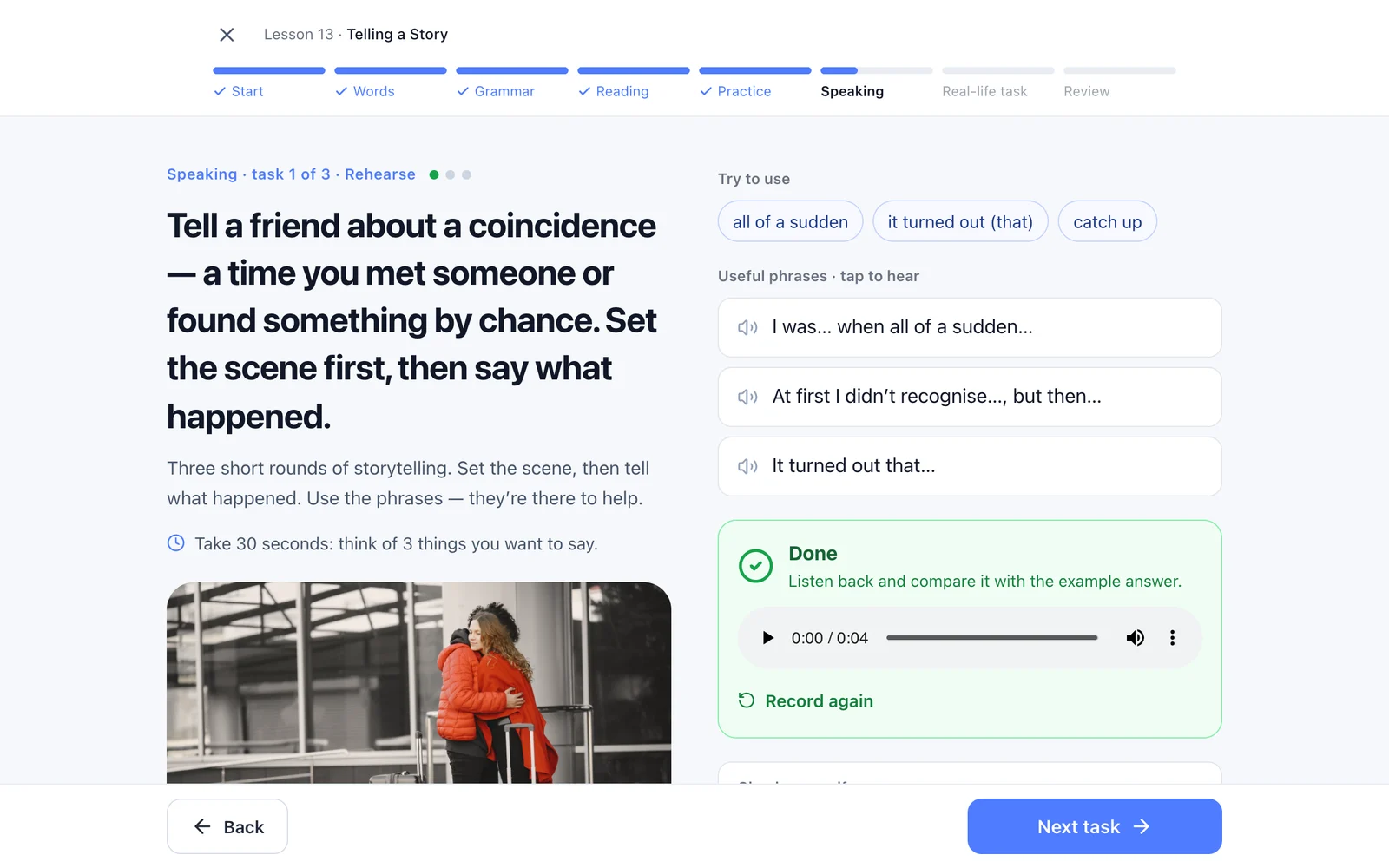
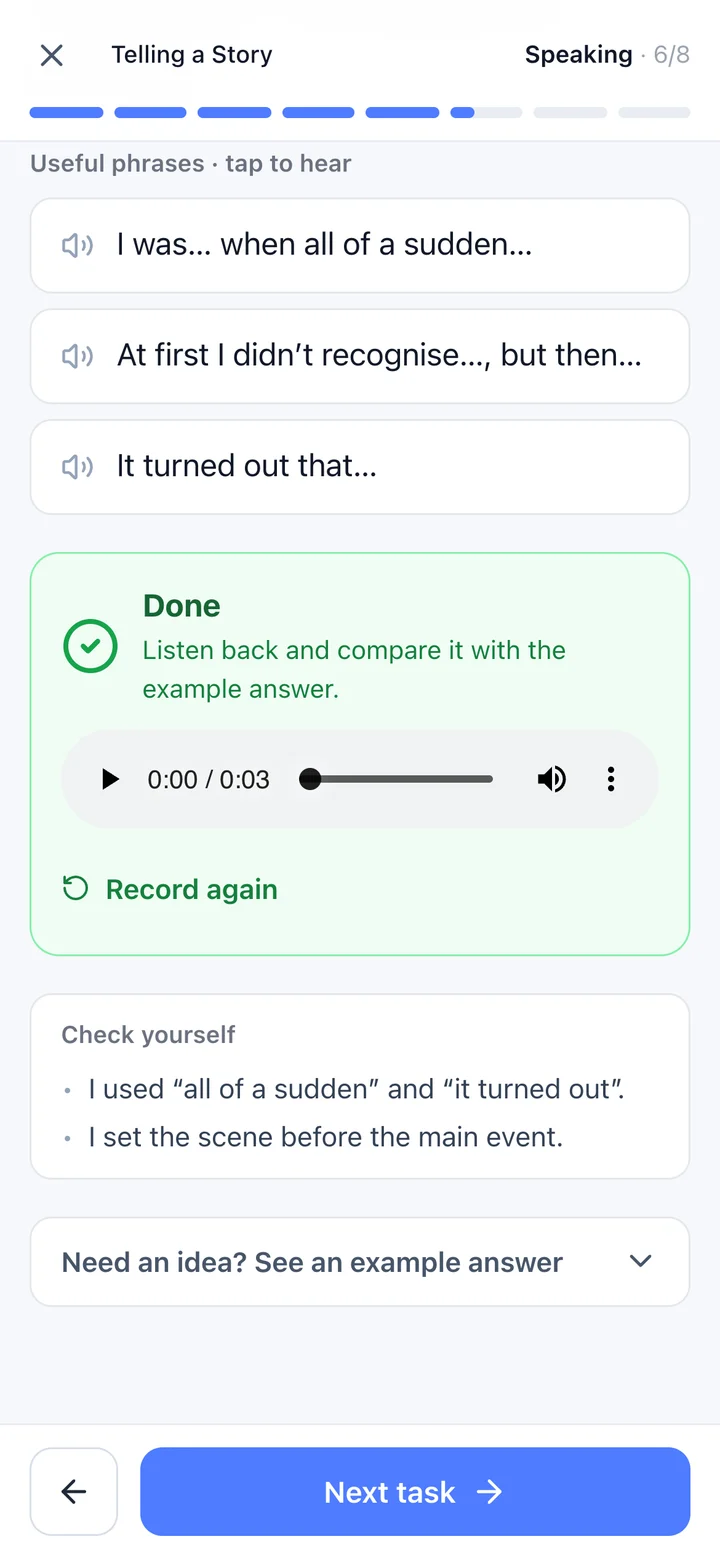
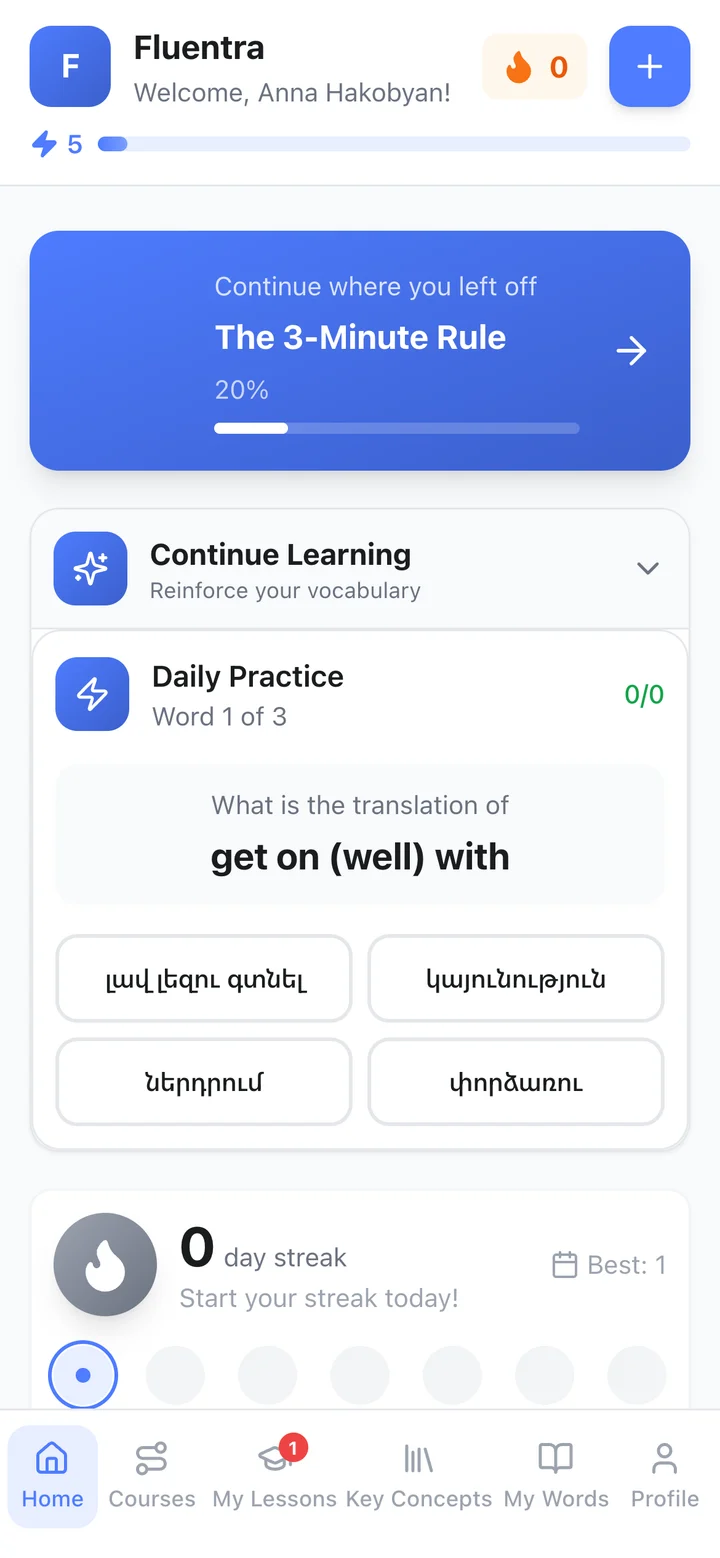
Fluentra is built around this kind of routine. You can save any word or phrase to My Words with its audio, example and a translation into your language, and daily practice quizzes you on the words you haven't learned yet, so review takes a few minutes. Speaking tasks let you record yourself and compare with an example answer.
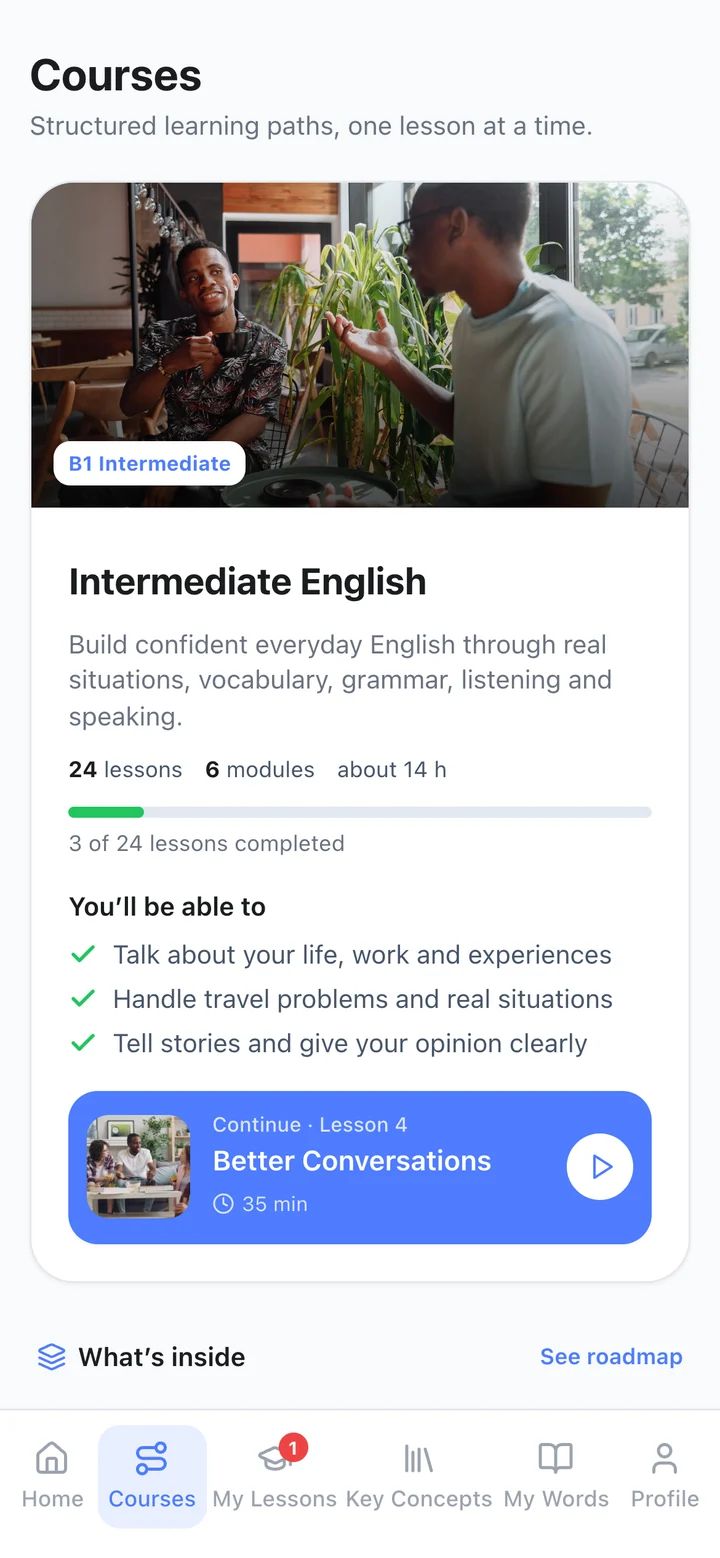
If you're at intermediate level or above, the B1, B2 and C1 courses give you a structured lesson for each step — words, grammar, reading, practice, speaking and a real-life task — so you don't have to plan what to study next. There isn't a beginner course yet, so if you're starting from zero, use Fluentra for vocabulary and review alongside beginner material.
Questions people ask
Can I learn English in 30 days?
Not from scratch. In 30 days of consistent practice you can make noticeable progress — understand more, speak with fewer pauses and learn a few hundred useful phrases — but moving up a full level usually takes several months. Cambridge English's guideline is roughly 200 guided learning hours per CEFR level.
Can I learn English by myself?
Yes. Courses, reading, listening and recording yourself speaking all work without a teacher. What's harder alone is real-time conversation, so add a conversation partner, a language exchange or a tutor once you're comfortable speaking — but don't wait for one to start practising.
How many hours a day should I study English?
As many as you can keep up every day. For most working adults that's 20–60 minutes. A short daily habit usually beats long, irregular sessions, because review keeps what you've learned from fading.
What's the fastest way to improve speaking?
Speak every day, even alone: answer questions aloud, record yourself, listen back and try again. Learning phrases rather than single words also makes speaking faster, because you have ready-made pieces to use.