Conditional Sentences in English: Zero, First, Second and Third
If it rains, we'll stay in. If I won the lottery, I'd travel. If I'd known, I would have called. Here's how each type of if-sentence works — and how to choose the right one.
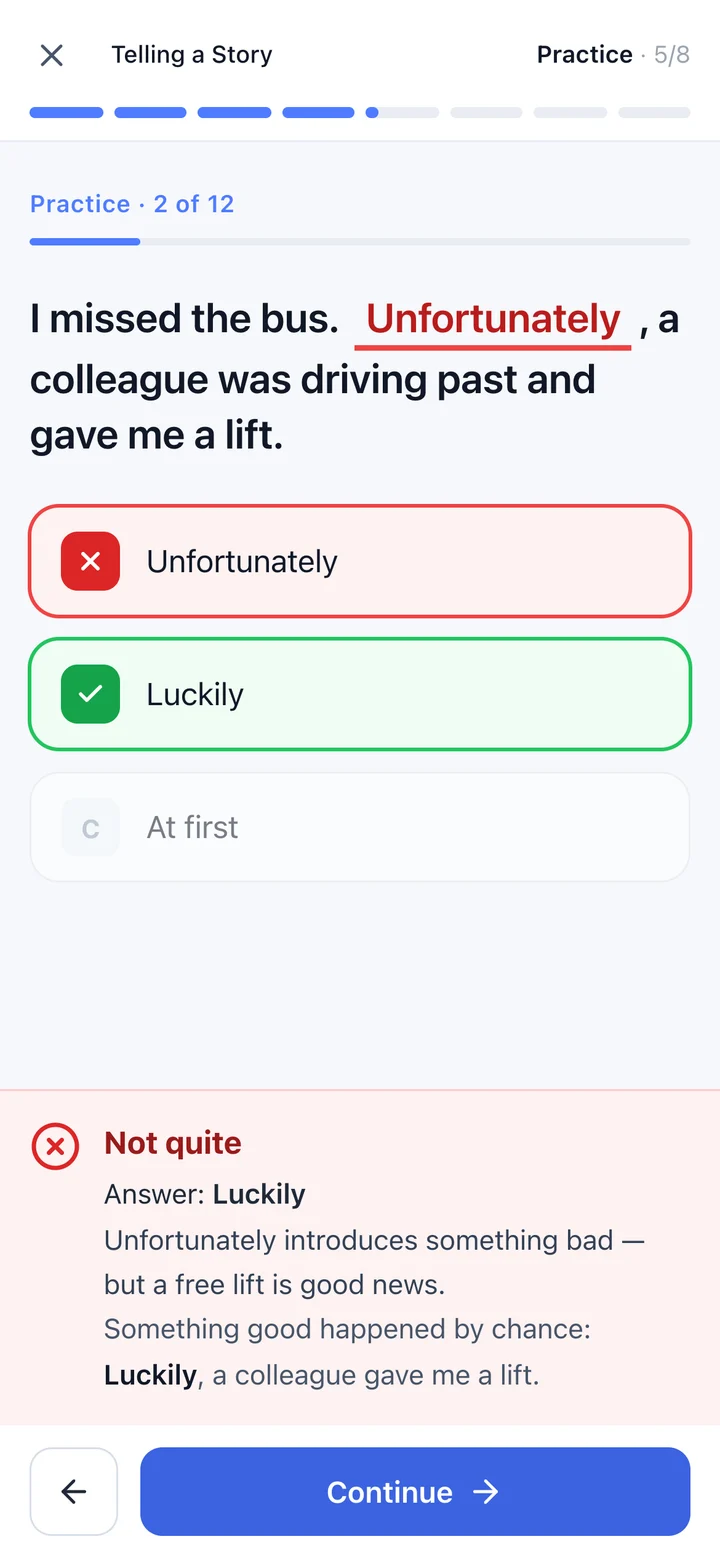
Practice that explains: every wrong answer comes with the right one and the reason.
On this page
A conditional sentence has two parts: a condition (usually starting with if) and a result. If it rains, we'll stay at home. English has four main types, traditionally numbered zero to three, and the choice between them depends on one question: is the situation real, possible or imagined — and is it about the present, the future or the past?
Here's each type, how to form it, and how to choose.
The four types at a glance
| Type | If-clause | Result clause | Used for |
|---|---|---|---|
| Zero | present simple | present simple | facts and things that are always true |
| First | present simple | will + verb | real, likely situations in the future |
| Second | past simple | would + verb | imagined or unlikely situations, now or in the future |
| Third | past perfect | would have + past participle | imagined situations in the past (it didn't happen) |
When the if-clause comes first, put a comma after it: If you're tired, go to bed. When the result comes first, no comma: Go to bed if you're tired. The meaning doesn't change.
Zero conditional: facts
If + present simple, present simple. For things that are always true — science, rules, habits. If means almost the same as when or whenever.
If you heat ice, it melts.
If I drink coffee after six, I don't sleep well.
First conditional: real possibilities
If + present simple, will + verb. For a situation that could really happen in the future, and its likely result.
If it rains tomorrow, we'll stay at home.
If you don't hurry, you'll miss the bus.
What will you do if they say no?
A very common mistake happens here: no will in the if-clause, even though it's about the future.
If I see her, I'll tell her. ✓ · If I will see her, I'll tell her. ✗
(There are exceptions — polite requests like If you'll wait here a moment, I'll get the manager — but in ordinary conditions, leave will out.)
The result can also use can, may, might or an instruction: If you finish early, you can go home. If you see Tom, tell him to call me.
Second conditional: imagined situations
If + past simple, would + verb. For situations that aren't true now, or are unlikely in the future. The past form doesn't mean past time — it signals "imagined".
If I had more time, I'd learn to paint. (I don't have more time.)
If I won the lottery, I'd buy a house by the sea. (Very unlikely.)
What would you do if you lost your job?
With be, use were for every person in careful English — especially in the fixed phrase for advice:
If I were you, I'd take the job.
(If I was is common in informal speech, but If I were you is the standard form and the safe choice in exams.)
First or second? It depends how likely it is
The same idea can be first or second conditional — the choice shows what you think:
If I get the job, I'll move to Berlin. → I think it's possible.
If I got the job, I'd move to Berlin. → I don't really expect it.
Third conditional: the past that didn't happen
If + past perfect, would have + past participle. For imagining a different past — often regrets, criticism or relief.
If I had left earlier, I would have caught the train. (I didn't leave early; I missed it.)
If you'd told me, I would have helped. (You didn't tell me.)
We wouldn't have met if she hadn't moved to Lisbon.
In speech, would have usually sounds like would've /ˈwʊdəv/ — and if you'd here means if you had. If the past perfect is new to you, start with how the past perfect works.
Mixed conditionals
Sometimes the condition and the result are at different times. The most common mix: an imagined past condition with a present result.
If I had studied medicine, I'd be a doctor now.
If we hadn't missed the flight, we'd be on the beach right now.
Other words for "if"
- unless = if … not: I won't go unless you come too. (= if you don't come)
- as long as / provided that = only if: You can borrow the car as long as you're careful.
- when — for things you're sure will happen: When I get home, I'll call you. (Compare If I get home before ten… — not sure.)
- in case — not the same as if! It means "as a precaution": Take an umbrella in case it rains. (Take it now, because it might rain.)
Common mistakes
- Will in the if-clause:
If it will rain, we'll stay in.→ If it rains, we'll stay in. - Would in the if-clause:
If I would have more money, I'd travel.→ If I had more money, I'd travel. - Mixing up second and third:
If I knew yesterday, I would have come.→ If I had known, I would have come. - "Would have" with the wrong verb form:
I would have went.→ I would have gone. - "Would of": it sounds the same as would've, but in writing it's always would have.
How to get comfortable with conditionals
Conditionals are easiest to learn by using them about your own life. Each day, say three sentences out loud: one first conditional about tomorrow (If I finish work early, I'll…), one second conditional about a dream (If I could live anywhere, I'd…), one third conditional about the past (If I hadn't…, I wouldn't have…). Speaking them, not just reading them, is what makes them automatic — the same principle behind practising speaking on your own.
Quick check
Put the verbs in the correct form. Answers are below.
- If you ___ (mix) red and blue, you get purple.
- If it ___ (be) sunny tomorrow, we ___ (go) to the beach.
- If I ___ (be) you, I ___ (not / sign) that contract.
- If she ___ (study) harder, she ___ (pass) the exam last year.
- I'll be in meetings all day, so I won't call you ___ there's an emergency. (if / unless)
1 mix (zero — a fact) · 2 is … will go (first — real possibility; are going to go also works) · 3 were … wouldn't sign (second — advice; was in informal speech) · 4 had studied … would have passed (third — the past) · 5 unless (= I'll only call if there's an emergency)
Questions people ask
How many types of conditionals are there in English?
Four main types — zero (facts), first (real future possibilities), second (imagined present or unlikely future) and third (imagined past) — plus mixed conditionals, which combine a past condition with a present result or the other way round.
Can I use will after if?
Not in normal conditions about the future: say 'If it rains, we'll stay in', not 'If it will rain'. Use the present simple in the if-clause and will in the result.
Is 'If I was you' wrong?
It's common in informal speech, but 'If I were you' is the standard form, especially for advice. Use 'were' in writing and exams.
What's the difference between the first and second conditional?
How likely you think it is. 'If I get the job, I'll move' — you think it's possible. 'If I got the job, I'd move' — you're imagining it and don't really expect it.