Phrasal Verbs: Meaning, Examples and 60 Common Ones to Learn
Give up, look after, run out of — phrasal verbs are everywhere in spoken English. Here's how they work, the 60 you'll hear most, and how to make them stick.
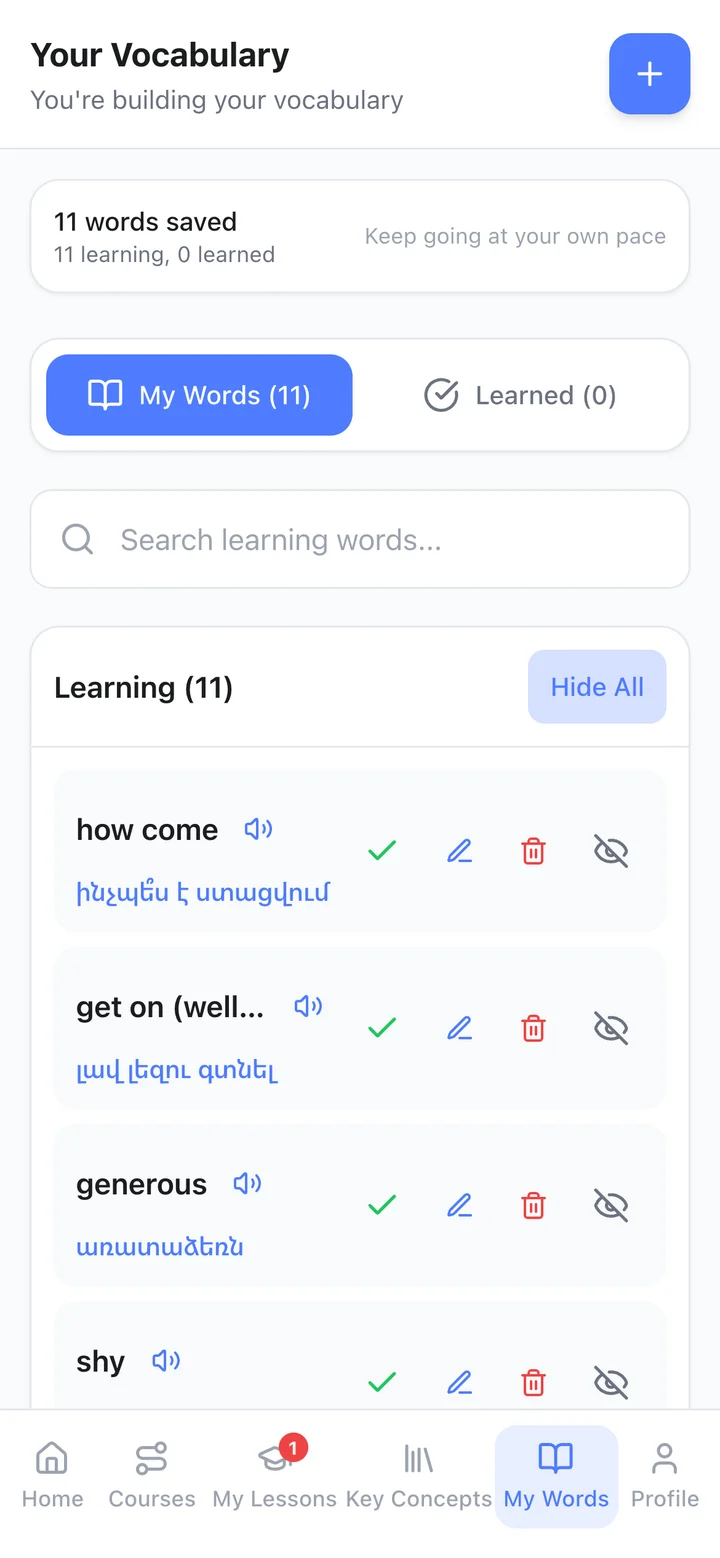
Saved phrases in My Words — a phrasal verb is easier to remember with its translation and an example.
On this page
A phrasal verb is a verb plus one or two small words — usually up, down, out, off, on, in, away, back or over — that together make a new meaning. Give means one thing; give up means to stop trying. Look is easy; look after (take care of) and look up (find information) are not.
You hear phrasal verbs constantly in everyday conversation, which is one reason learners who are comfortable with textbook English can still get lost when people talk. The good news: you don't need hundreds. A few dozen common ones will take you a long way, and the grammar follows a few simple patterns.
What makes a phrasal verb
A phrasal verb has two parts: the verb and a particle (a small adverb or preposition). Some have two particles. The meaning can be:
- Literal — you can guess it from the parts: sit down, go out, come back.
- Partly guessable — the particle adds an idea such as "completely": eat up (eat all of it), use up, clean up.
- Idiomatic — the meaning is new and has to be learned: give up (stop trying), put off (postpone), turn down (refuse an offer).
The idiomatic ones cause most of the trouble, so they deserve most of your attention.
Take off your shoes. (remove) · The plane took off at six. (left the ground) · Her business really took off last year. (became successful quickly)
The grammar: separable or not?
This is the part that causes real mistakes. Phrasal verbs that take an object come in two kinds.
Separable phrasal verbs
The object can go after the particle or between the verb and the particle:
Turn off the TV. ✓ · Turn the TV off. ✓
Fill in the form. ✓ · Fill the form in. ✓
But when the object is a pronoun (it, them, her, him, me), it must go in the middle:
Turn it off. ✓ · Turn off it. ✗
Pick them up at five. ✓ · Pick up them at five. ✗
Inseparable phrasal verbs
The object always goes after the whole phrasal verb, even when it's a pronoun:
I look after my sister's kids on Fridays. → I look after them. ✓ · I look them after. ✗
She ran into an old friend. → She ran into him. ✓
Three-word phrasal verbs
Verbs with two particles almost always keep the object at the end: look forward to the weekend, get on with your neighbours, run out of milk, cut down on sugar, put up with the noise.
There's no reliable rule from the meaning, so learn each phrasal verb with an example that shows where the object goes: turn something off, look after someone. A good dictionary marks them the same way. If you only remember one thing, remember the pronoun rule — it's the mistake people notice.
60 common phrasal verbs, by topic
It's easier to learn them by situation than from an alphabetical list: the verbs you need for one situation tend to come up together.
Daily life
| Phrasal verb | Meaning | Example |
|---|---|---|
| get up | leave your bed | I get up at seven on weekdays. |
| wake up | stop sleeping | The noise woke me up at three. |
| put on | start wearing | Put a coat on — it's cold. |
| take off | remove (clothes) | Please take your shoes off. |
| turn on / off | start / stop a machine | Can you turn the light off? |
| turn up / down | make louder / quieter | Turn the music down, please. |
| clean up | make a place tidy | Let's clean up before the guests arrive. |
| throw away | put in the bin | Don't throw that box away. |
| run out of | have none left | We've run out of coffee. |
| eat out | eat at a restaurant | We usually eat out on Fridays. |
Work and study
| Phrasal verb | Meaning | Example |
|---|---|---|
| fill in / out | complete a form | Fill in the form and sign it. |
| hand in | give work to a teacher or boss | Hand your essays in by Friday. |
| look up | find information | I looked the word up in a dictionary. |
| find out | discover a fact | Did you find out why the meeting was cancelled? |
| figure out | understand, solve | I can't figure out how this new app works. |
| carry on | continue | Carry on — I didn't mean to interrupt. |
| put off | postpone | They put the launch off until May. |
| set up | start, organise | She set up her own company in 2021. |
| take on | accept work or responsibility | I can't take on another project right now. |
| catch up (on) | reach the same level, do work you missed | I need to catch up on my emails. |
People and relationships
| Phrasal verb | Meaning | Example |
|---|---|---|
| get on (with) | have a good relationship | I get on really well with my manager. |
| look after | take care of | Could you look after my cat this weekend? |
| grow up | become an adult | I grew up in a small town. |
| bring up | raise a child; mention a topic | She was brought up by her grandparents. |
| take after | look or behave like an older family member | He takes after his father. |
| fall out (with) | stop being friends after an argument | They fell out over money. |
| make up | become friends again | We argued, but we made up the next day. |
| let down | disappoint | I promised to help — I can't let her down. |
| count on | depend on, trust | You can always count on Maria. |
| show up | arrive (often late or unexpectedly) | He showed up an hour late. |
Problems and changes
| Phrasal verb | Meaning | Example |
|---|---|---|
| give up | stop trying; stop a habit | Don't give up — you're nearly there. |
| break down | stop working (a machine) | Our car broke down on the motorway. |
| sort out | solve, organise | I'll sort the problem out tomorrow. |
| deal with | handle a problem or person | She deals with customer complaints. |
| put up with | accept something unpleasant | I can't put up with this noise any longer. |
| cut down on | use or do less of | I'm trying to cut down on sugar. |
| come up with | think of an idea | We came up with a better plan. |
| work out | end well; find a solution; exercise | It all worked out in the end. |
| turn out | end in a particular way | The party turned out to be great fun. |
| get over | recover from | It took me weeks to get over the flu. |
Travel and moving around
| Phrasal verb | Meaning | Example |
|---|---|---|
| check in / out | register when you arrive (hotel, airport) / pay and leave (hotel) | We checked out at eleven. |
| set off | start a journey | We set off early to avoid the traffic. |
| get on / off | enter / leave a bus, train or plane | Get off at the next stop. |
| pick up | collect someone or something | I'll pick you up at the station. |
| drop off | take someone somewhere and leave them | Can you drop me off at work? |
| get in | arrive (a train, bus or plane) | Our train got in at ten. |
| get back | return | When did you get back from Rome? |
| look around | visit a place and look at it | We spent the afternoon looking around the old town. |
| come across | find by chance | I came across a lovely café near the river. |
| hold on | wait a moment | Hold on, I'll check the timetable. |
Talking and communicating
| Phrasal verb | Meaning | Example |
|---|---|---|
| call back | return a phone call | Can I call you back in ten minutes? |
| hang up | end a phone call | She hung up before I could explain. |
| speak up | speak louder | Could you speak up a bit? I can't hear you. |
| point out | draw attention to | He pointed out a mistake in my report. |
| go on | continue; happen | Go on, I'm listening. · What's going on? |
| sum up | give the main points briefly | To sum up, the plan saves time and money. |
| turn down | refuse an offer | She turned down the job in London. |
| look forward to | feel happy about something that's going to happen | I'm looking forward to seeing you. |
| get across | make someone understand | I'm not sure I got my point across. |
| talk over | discuss before deciding | Let's talk it over at lunch. |
How to learn phrasal verbs so they stick
Learn them in a sentence, never alone. "Put off = postpone" is easy to forget. "They put the meeting off until Monday" shows the meaning, the object position and a typical situation at once.
Make it about your life. For each new phrasal verb, say one true sentence out loud: "I always put off doing my taxes." Sentences about your own life are easier to remember than textbook examples, and saying them aloud trains you to use the verb, not just recognise it — the same idea behind building fluency with ready-made chunks.
Group them by situation. Learn five travel phrasal verbs before a trip, five work ones before a meeting. They'll come back together when you need them.
Notice them when you read and listen. Once you start looking, you'll find phrasal verbs in every podcast and series. When one surprises you, save it with the sentence it came in.
Review a little and often. Look at your saved phrasal verbs again after a day, then a few days, then a week. Short, spaced reviews beat one long session — more on that in how to learn English fast.
Common mistakes with phrasal verbs
- Putting a pronoun after the particle:
Turn off it.→ Turn it off. - Separating an inseparable verb:
I look my sister after.→ I look after my sister. - Dropping the last particle:
I'm looking forward the trip.→ looking forward to the trip. Note that to here is a preposition, so it's followed by -ing: looking forward to seeing you. - Mixing up particles: look for (search) ≠ look after (take care of) ≠ look up (find information).
- Using them in very formal writing: phrasal verbs are normal in emails and conversation, but in formal reports a one-word verb often sounds better: postpone instead of put off, discover instead of find out.
Quick check
Choose the correct option. Answers are below.
- My plants need water every day. Could you ___ while I'm away? (look after them / look them after)
- I'm trying to ___ coffee — two cups a day is my limit. (cut down / cut down on)
- She offered me the job, but I ___ because of the salary. (turned it down / turned down it)
- We ___ milk, so I'll buy some on the way home. (have run out of / have run out)
- Can you ___ at the airport on Sunday? (pick me up / pick up me)
1 look after them (inseparable) · 2 cut down on (three-word verb + object) · 3 turned it down (pronoun in the middle) · 4 have run out of (run out of + the thing) · 5 pick me up (pronoun in the middle)
Questions people ask
How many phrasal verbs do I need to know?
There are thousands, but a few dozen of the most common ones — like the 60 in this article — will take you a long way in everyday conversation. Learn those well, with an example each, before worrying about rarer ones.
How do I know if a phrasal verb is separable?
You can't tell from the meaning, so learn each one with an example that shows the object position: 'turn something off' (separable) or 'look after someone' (inseparable). Dictionaries mark them the same way. Three-word phrasal verbs almost always keep the object at the end.
Are phrasal verbs informal?
Most are neutral and fine in emails and conversation. In very formal writing a single-word verb often sounds better — 'postpone' for 'put off', 'discover' for 'find out' — but you'll still see phrasal verbs everywhere.
What's the difference between a phrasal verb and a verb with a preposition?
With a phrasal verb, the verb and particle make a new meaning together (give up = stop trying). With a verb + preposition, each word keeps its normal meaning (look at the picture). In practice, learning both as fixed chunks is what matters.