Active and Passive Voice: Rules, Examples and When to Use Each
“Someone stole my bike” or “My bike was stolen”? Both are correct. The difference is what you put first — and knowing when to choose each one makes your English sound natural.
On this page
- Active vs passive: the difference
- How to form the passive
- The passive in every tense
- Changing active to passive, step by step
- When to use the passive
- When the active is better
- Verbs that can't be passive
- Verbs with two objects
- Questions and negatives in the passive
- The get-passive
- Common mistakes
- Where it fits in your learning
- Exercise: active to passive
Every sentence with an object can be said two ways. In the active voice, the subject does the action: The chef cooks the meal. In the passive voice, the subject receives the action: The meal is cooked (by the chef).
Neither is "better". They put a different thing at the start of the sentence, and that changes what the sentence is about. This guide shows how to form the passive in every tense, the rules for changing active to passive, and — the part most guides skip — when the passive is the natural choice and when it just makes your writing heavy.
Active vs passive: the difference
| Active | Passive |
|---|---|
| Someone stole my bike. | My bike was stolen. |
| Millions of people watch the show. | The show is watched by millions of people. |
| The company will announce the results tomorrow. | The results will be announced tomorrow. |
In each passive sentence, the thing that was the object of the active sentence has moved to the front and become the subject. The person who did the action either disappears or comes at the end after by.
How to form the passive
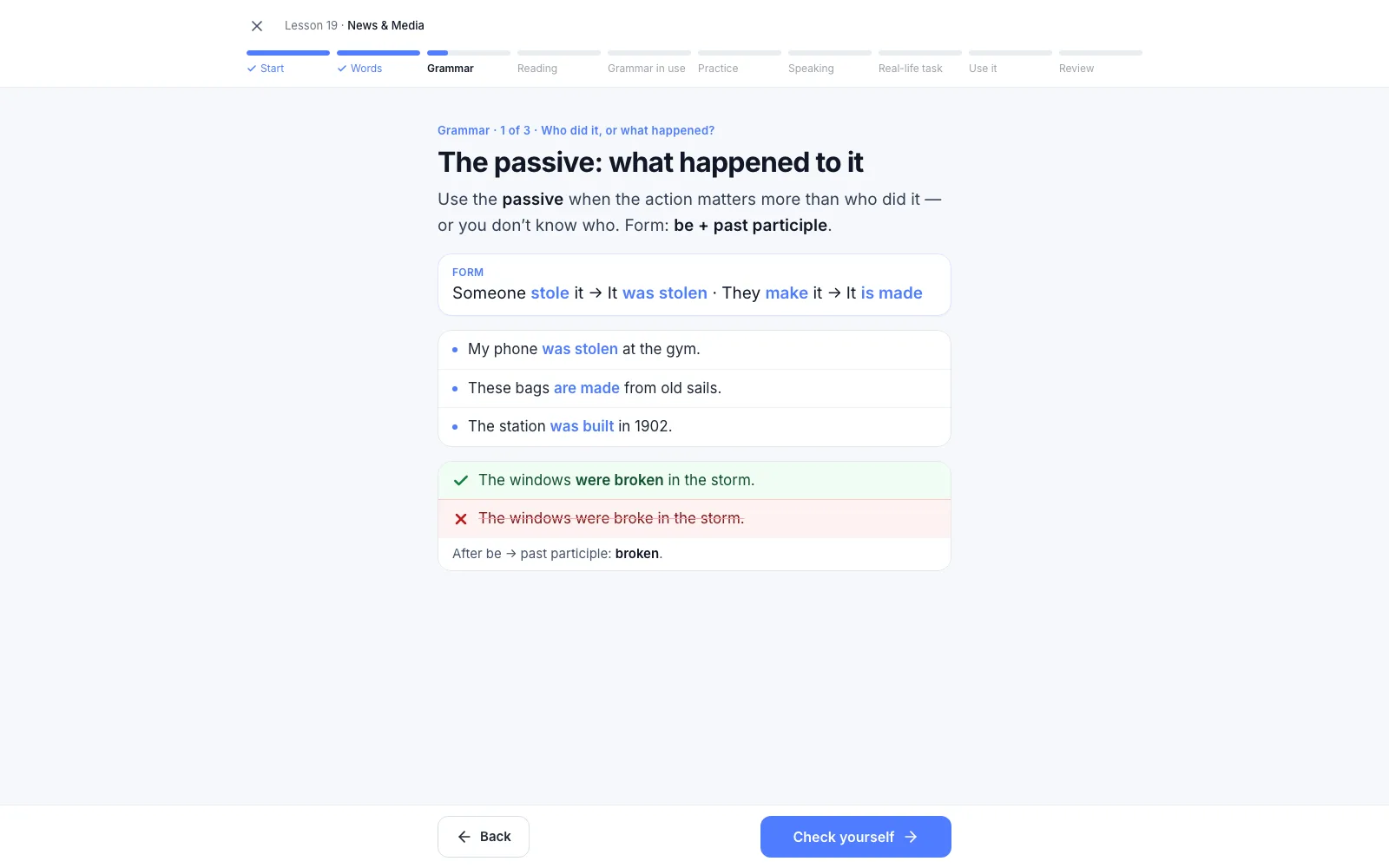
be (in the right tense) + past participle
That's the whole rule. The verb be carries the tense; the main verb is always the past participle (made, written, sent, built, taken).
English is spoken here. · The letter was sent yesterday. · Your order has been shipped.
The passive in every tense
This table is the core of the "rules for active and passive voice". Read across: the active form on the left, the passive on the right, with be changing to match the tense.
| Tense | Active | Passive |
|---|---|---|
| Present simple | They clean the office. | The office is cleaned. |
| Present continuous | They are cleaning the office. | The office is being cleaned. |
| Present perfect | They have cleaned the office. | The office has been cleaned. |
| Past simple | They cleaned the office. | The office was cleaned. |
| Past continuous | They were cleaning the office. | The office was being cleaned. |
| Past perfect | They had cleaned the office. | The office had been cleaned. |
| Future (will) | They will clean the office. | The office will be cleaned. |
| Future perfect | They will have cleaned the office. | The office will have been cleaned. |
| Going to | They are going to clean the office. | The office is going to be cleaned. |
| Modal verbs | They must clean the office. | The office must be cleaned. |
The perfect continuous forms (has been being cleaned) are grammatically possible but so awkward that native speakers almost never use them — rephrase instead. For a refresher on the tenses themselves, see the English tenses chart.
Changing active to passive, step by step
- Find the object of the active sentence. The police arrested two men.
- Make it the subject. Two men …
- Put be in the same tense as the active verb, agreeing with the new subject. Arrested is past simple, the subject is plural → were.
- Add the past participle of the main verb. Two men were arrested …
- Add by + the doer only if it matters. Here we know it's the police — it adds nothing. Two men were arrested.
Pronouns change form when they move: an active object pronoun becomes a subject pronoun (They invited us → We were invited), and a subject pronoun after by becomes an object pronoun (She wrote it → It was written by her).
When to use the passive
1. The doer is unknown
My phone was stolen on the train. (I don't know who took it.)
2. The doer is obvious or unimportant
The road is being repaired. · He was elected in 2020. (By workers, by voters — no need to say.)
3. The action or result matters more than the person
The museum was built in 1890. · All flights have been cancelled.
4. Processes, rules and formal writing
Instructions, scientific reports, news and official notices use the passive a lot, because the focus is on the process, not the people.
The samples are heated to 80°C. · Smoking is not permitted in this building.
5. To keep the same topic across sentences
The Mona Lisa is one of the world's most famous paintings. It was painted by Leonardo da Vinci in the early 1500s and is kept in the Louvre.
The paragraph is about the painting, so the painting stays the subject.
When the active is better
In everyday speech and most writing, the active voice is clearer and shorter. Use it when you know who did something and that person matters:
A mistake was made by me.→ I made a mistake.The meeting was attended by all the managers.→ All the managers attended the meeting.
A useful test: if your sentence ends with by + a person and that person is important, the active is usually better. Passives without a doer can also hide responsibility — "Mistakes were made" is famous for exactly that reason.
Verbs that can't be passive
Only verbs with an object (transitive verbs) have a passive. Verbs like happen, arrive, die, sleep, fall, disappear, stay and come have no object, so they can't be passive:
The accident was happened at night.→ The accident happened at night.He was died in 1990.→ He died in 1990.
Some verbs that describe states also sound wrong in the passive: have (= own), fit, suit, resemble, lack. A car is had by my sister isn't English.
Verbs with two objects
Verbs like give, send, show, offer, teach, tell and lend can have two objects, so they have two possible passives. The person is the more common subject:
Active: They gave me a prize.
Passive: I was given a prize. (most natural) · A prize was given to me.
Questions and negatives in the passive
Move be (or the first auxiliary) to the front for a question; add not after it for a negative.
Was the parcel delivered? · Has the room been booked? · Where was this photo taken?
The email wasn't sent. · The work hasn't been finished yet.
The get-passive
In informal English, get can replace be, usually for something that happens unexpectedly or that the subject didn't want:
He got fired last month. · Our flight got cancelled. · Did you get invited?
It's normal in conversation but too casual for formal writing.
Common mistakes
- Missing be:
The house built in 1950.→ The house was built in 1950. - Past simple instead of the participle:
The letter was wrote.→ The letter was written. - Be in the wrong tense:
The report has finished.(if you mean someone finished it) → The report has been finished. - Passive of a verb with no object:
It was happened.→ It happened. - Unnecessary by:
The thief was arrested by the police.→ The thief was arrested.
Where it fits in your learning
The passive in the present and past simple is usually taught at A2–B1, and the full range (perfect, modal and continuous passives, get-passives) at B1–B2 — see CEFR levels explained. It also appears in reported statements like It is said that…; for reporting what someone said, see direct and indirect speech.
Exercise: active to passive
Change each sentence into the passive. Leave out the doer if it isn't needed. Answers are below.
- Someone cleans the windows every week.
- They are building a new hospital.
- Shakespeare wrote Hamlet.
- Somebody has eaten my sandwich.
- The company will open three new stores.
- They didn't invite us to the wedding.
- You must wear a helmet.
- Did they tell you the news?
- A dog bit the postman.
- They were painting the house when we arrived.
1 The windows are cleaned every week. · 2 A new hospital is being built. · 3 Hamlet was written by Shakespeare. · 4 My sandwich has been eaten. · 5 Three new stores will be opened. · 6 We weren't invited to the wedding. · 7 A helmet must be worn. · 8 Were you told the news? · 9 The postman was bitten by a dog. · 10 The house was being painted when we arrived.
In 3 and 9 the doer stays, because it's the new information.
Questions people ask
How do I know if a sentence is active or passive?
Look for 'be' (in any form) followed by a past participle: is made, was sent, has been done, will be built. If the subject receives the action, it's passive (The window was broken). If the subject does it, it's active (The boy broke the window).
Is 'I love you' active or passive?
Active — the subject 'I' does the loving. The passive would be 'You are loved (by me)', which is grammatical but only used for special emphasis.
What is the formula for the passive voice?
Object of the active sentence + be (in the same tense as the active verb) + past participle (+ by + doer, if it matters). For example: They built the bridge in 1990 → The bridge was built in 1990.
Should I avoid the passive voice?
No — avoid using it without a reason. The passive is the right choice when the doer is unknown or unimportant, when you're describing a process or result, or to keep the same topic. When you know who did it and that matters, the active is clearer.