English Tenses: All 12 Tenses With a Chart and Examples
Twelve tenses sounds like a lot. It's really three times (past, present, future) and four ways of looking at an action — and once you see that pattern, the chart reads itself.
On this page
English has 12 tenses — or, more precisely, 12 combinations of time and aspect. There are three times (past, present and future) and four aspects (simple, continuous, perfect and perfect continuous). Multiply them and you get the familiar chart.
That's good news: you don't have to learn twelve unrelated rules. Learn what each of the four aspects means, and you can read any box in the chart. This guide gives you the full chart first, then explains each tense with examples, the words that signal it, and the mistakes learners make most.
The English tenses chart
Here are all 12 tenses with the verb work. Read across for time, down for aspect.
| Aspect | Past | Present | Future |
|---|---|---|---|
| Simple a fact, habit or complete action | I worked | I work | I will work |
| Continuous in progress at a moment | I was working | I am working | I will be working |
| Perfect done before a point in time | I had worked | I have worked | I will have worked |
| Perfect continuous in progress up to a point | I had been working | I have been working | I will have been working |
Notice the building blocks. Continuous always uses be + -ing. Perfect always uses have + past participle. Perfect continuous combines them: have been + -ing. The time (past, present, future) is carried by the first auxiliary: was / am / will be, had / have / will have.
What the four aspects mean
- Simple — the action as a whole: a fact, a habit, a single finished event. Water boils at 100°C. She called yesterday.
- Continuous — the action in the middle, unfinished, at a particular moment. I'm cooking (now). I was cooking when you called.
- Perfect — the action is complete before a reference point, and we look back at it from there. I've finished (before now). I'd finished before you arrived.
- Perfect continuous — an activity that ran up to a reference point, with the focus on how long. I've been waiting for an hour.
Present tenses
Present simple
Form: base verb (add -s for he / she / it); questions and negatives with do / does.
Use: habits, routines, facts and permanent situations.
She works in a bank. · I don't drink coffee. · Does he live near here?
Signal words: always, usually, often, sometimes, never, every day, on Mondays.
Present continuous
Form: am / is / are + -ing.
Use: actions happening now or around now, temporary situations, and fixed plans for the future.
I'm working from home this week. · Look — it's snowing! · We're meeting Anna on Friday.
Signal words: now, right now, at the moment, today, this week, currently.
Present simple vs continuous is the first tense choice most learners meet: I work in Paris (permanent) vs I'm working in Paris this month (temporary).
Present perfect
Form: have / has + past participle.
Use: life experiences, past actions with a result now, situations that started in the past and continue, recent news.
I've been to Japan twice. · She's lost her keys. · We've lived here since 2020.
Signal words: ever, never, just, already, yet, so far, for, since. It's the tense learners find hardest to choose — see the present perfect explained for the full comparison with the past simple.
Present perfect continuous
Form: have / has been + -ing.
Use: an activity that started in the past and is still going on (or has just stopped), with the focus on duration.
I've been learning English for three years. · You look tired — have you been running?
Signal words: for, since, how long, all day, lately, recently.
Past tenses
Past simple
Form: verb + -ed (regular) or the irregular past form; questions and negatives with did + base verb.
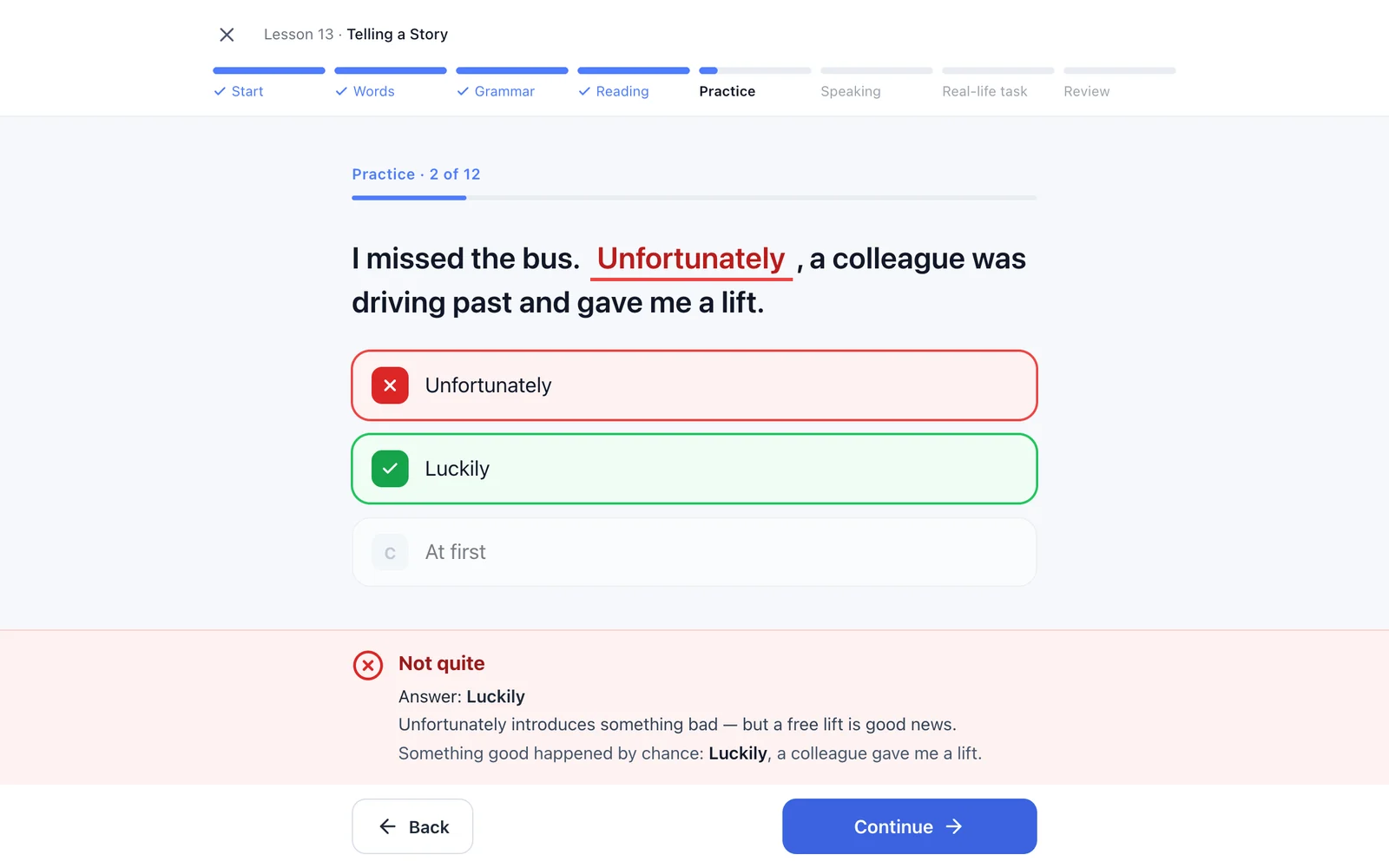
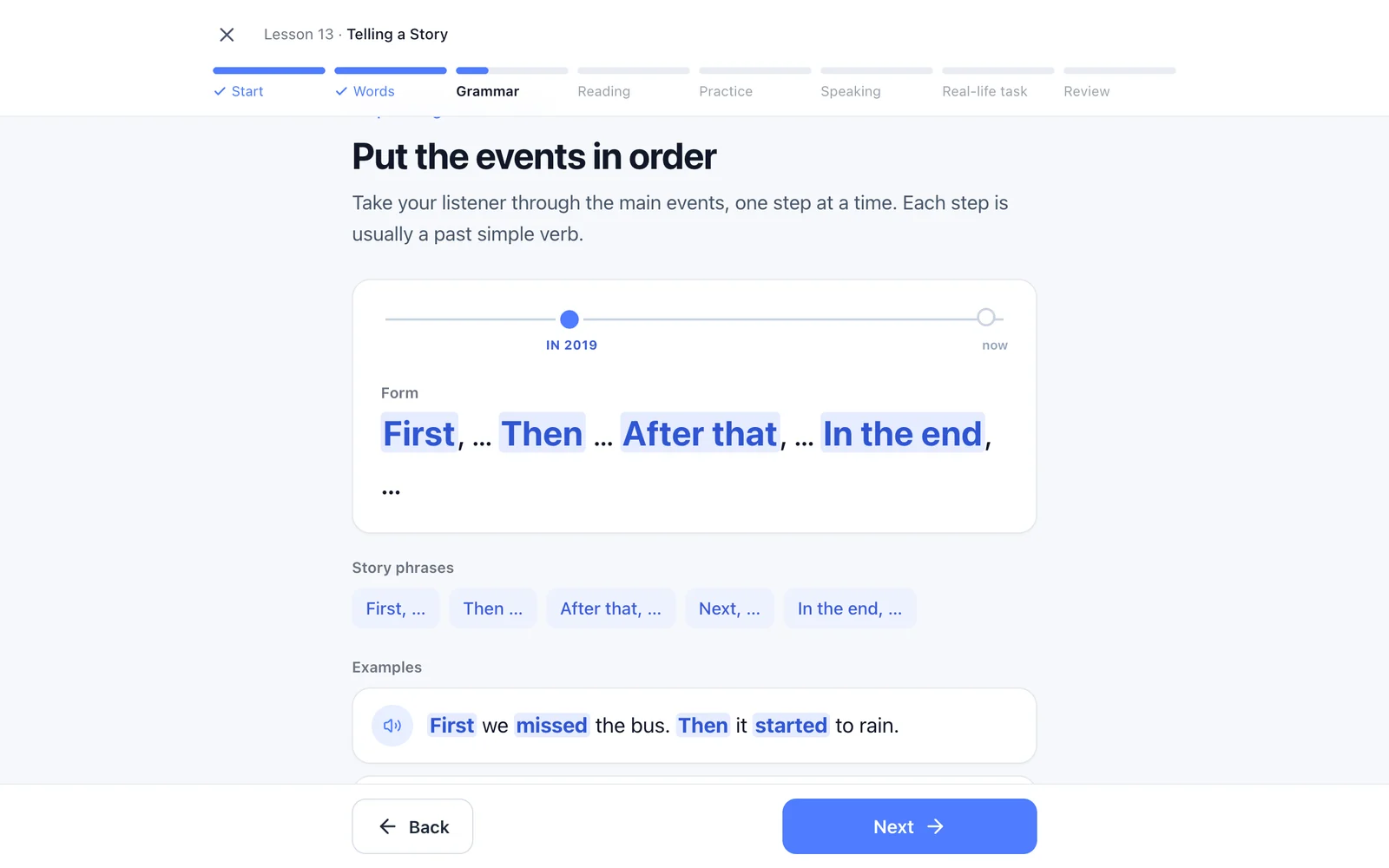
Use: finished actions at a finished time — the main tense for telling stories.
We moved to Berlin in 2018. · I didn't see him yesterday. · Where did you go?
Signal words: yesterday, last week, in 2019, two days ago, when I was a child.
Past continuous
Form: was / were + -ing.
Use: an action in progress at a moment in the past — often the background to a shorter event in the past simple.
At 8 p.m. I was cooking. · I was walking home when it started to rain.
Signal words: while, when, at that time, at 8 o'clock yesterday.
Past perfect
Form: had + past participle.
Use: an action that happened before another past action — "the past before the past".
When we arrived, the film had already started. · She had never flown before that trip.
Signal words: already, before, by the time, after, never … before. More examples in how the past perfect works.
Past perfect continuous
Form: had been + -ing.
Use: an activity that had been going on for some time before a past moment, often to explain a result.
Her eyes were red — she had been crying. · We had been waiting for an hour when the bus finally came.
Future tenses
Future simple (will)
Form: will + base verb.
Use: predictions, decisions made at the moment of speaking, offers and promises.
I think it will rain later. · I'll help you with that. · I won't tell anyone.
Future continuous
Form: will be + -ing.
Use: an action that will be in progress at a moment in the future.
This time tomorrow I'll be flying to Madrid. · Don't call at 9 — we'll be having dinner.
Future perfect
Form: will have + past participle.
Use: an action that will be complete before a point in the future.
By June I'll have finished the course. · They'll have left by the time we get there.
Future perfect continuous
Form: will have been + -ing.
Use: how long an activity will have lasted at a future point. It's the rarest tense in everyday speech.
In May I'll have been working here for ten years.
English also talks about the future with going to (plans and evidence: I'm going to study tonight. Look at those clouds — it's going to rain.), the present continuous (arrangements: I'm seeing the doctor at 4.) and the present simple (timetables: The train leaves at 6.). These aren't separate tenses in the chart, but in conversation they're used at least as much as will.
Which tenses you actually need first
The chart treats all twelve equally, but real English doesn't. A handful do most of the work in conversation, emails and stories:
- Present simple — facts, routines, opinions.
- Past simple — anything that happened.
- Present continuous — now, this week, plans.
- Present perfect — experiences, news, "how long".
- Will and going to — the future.
Learn those well and you can say almost anything. Add the past continuous and past perfect for telling stories; the future continuous, future perfect and the perfect continuous forms are mostly for fine shades of meaning and can wait. Roughly speaking, the first group belongs to A1–A2, the rest to B1–B2 (see CEFR levels explained).
Signal words at a glance
| Words | Usually go with |
|---|---|
| always, usually, every day, on Mondays | Present simple |
| now, at the moment, this week | Present continuous |
| ever, never, just, already, yet, since | Present perfect |
| for / since + how long (activity) | Present perfect continuous |
| yesterday, last…, … ago, in 2019 | Past simple |
| while, at 8 p.m. yesterday | Past continuous |
| by the time, before (in the past) | Past perfect |
| tomorrow, next week, I think… | Will / going to |
| by + future time | Future perfect |
Signal words are a helpful starting point, not a law: I've already eaten and I already ate are both used, the second mostly in American English.
Common mistakes with tenses
- Present tense for "how long":
I live here for five years.→ I've lived here for five years. - Present perfect with a finished time:
I have seen her yesterday.→ I saw her yesterday. - Continuous with state verbs:
I'm knowing the answer.→ I know the answer. (Know, like, want, believe, own and need are usually simple.) - Will after when / if:
When I will arrive, I'll call you.→ When I arrive, I'll call you. - Forgetting -s:
He work in Rome.→ He works in Rome. - Past form after did:
Did you went?→ Did you go?
Quick check
Put the verb in the right tense. Answers are below.
- Listen! Somebody ___ (knock) at the door.
- I ___ (never / be) to Canada.
- She ___ (wash) the car when it started to rain.
- By the time we got to the station, the train ___ (leave).
- Water ___ (freeze) at 0°C.
- This time next week we ___ (lie) on a beach.
- How long ___ you ___ (wait)? — About twenty minutes.
- We ___ (move) here in 2015.
1 is knocking · 2 have never been · 3 was washing · 4 had left · 5 freezes · 6 will be lying · 7 have … been waiting · 8 moved
Questions people ask
How many tenses are there in English?
Most grammar books teach 12: three times (past, present, future) combined with four aspects (simple, continuous, perfect, perfect continuous). Linguists often say English has only two true tenses, present and past, because 'will' is a modal verb — but for learning, the 12-tense chart is the useful map.
Are there 12 or 16 tenses in English?
The standard count is 12. Some books add the four 'future in the past' forms (would do, would be doing, would have done, would have been doing) to make 16. They're real and useful in reported speech, but they're usually treated as uses of 'would' rather than separate tenses.
Which English tenses are used the most?
The present simple and past simple by a wide margin, followed by the present continuous, the present perfect and the future with will or going to. Those five or six cover most everyday conversation.
What is the easiest way to learn the tenses?
Learn the four aspects rather than twelve separate rules: simple (whole action), continuous (in progress), perfect (done before a point), perfect continuous (in progress up to a point). Then practise the most common tenses in real sentences about your own life.