Articles in English: When to Use A, An, The (and No Article)
A, an and the are the most common words in English, and some of the easiest to get wrong. Here are the rules that cover almost every sentence — and the few exceptions worth learning.
On this page
English has three articles: a and an (the indefinite articles) and the (the definite article). They come before a noun and tell the listener one simple thing: do you already know which one I mean?
I saw a dog in the park. (one dog — you don't know which)
The dog was chasing a ball. (the dog I just mentioned)
Dogs are loyal animals. (dogs in general — no article)
That one question — new or known, one of many or a specific one — explains most article choices. This guide covers a vs an, when to use the, when to use no article, place names, and the mistakes learners make most often.
The articles at a glance
| Article | Used with | Meaning | Example |
|---|---|---|---|
| a | singular countable nouns, before a consonant sound | one, not specific | a book, a job |
| an | singular countable nouns, before a vowel sound | one, not specific | an apple, an idea |
| the | any noun: singular, plural or uncountable | specific — we both know which | the book, the books, the water |
| no article | plural and uncountable nouns | things in general | Books are expensive. Water is important. |
A or an? It's about sound, not spelling
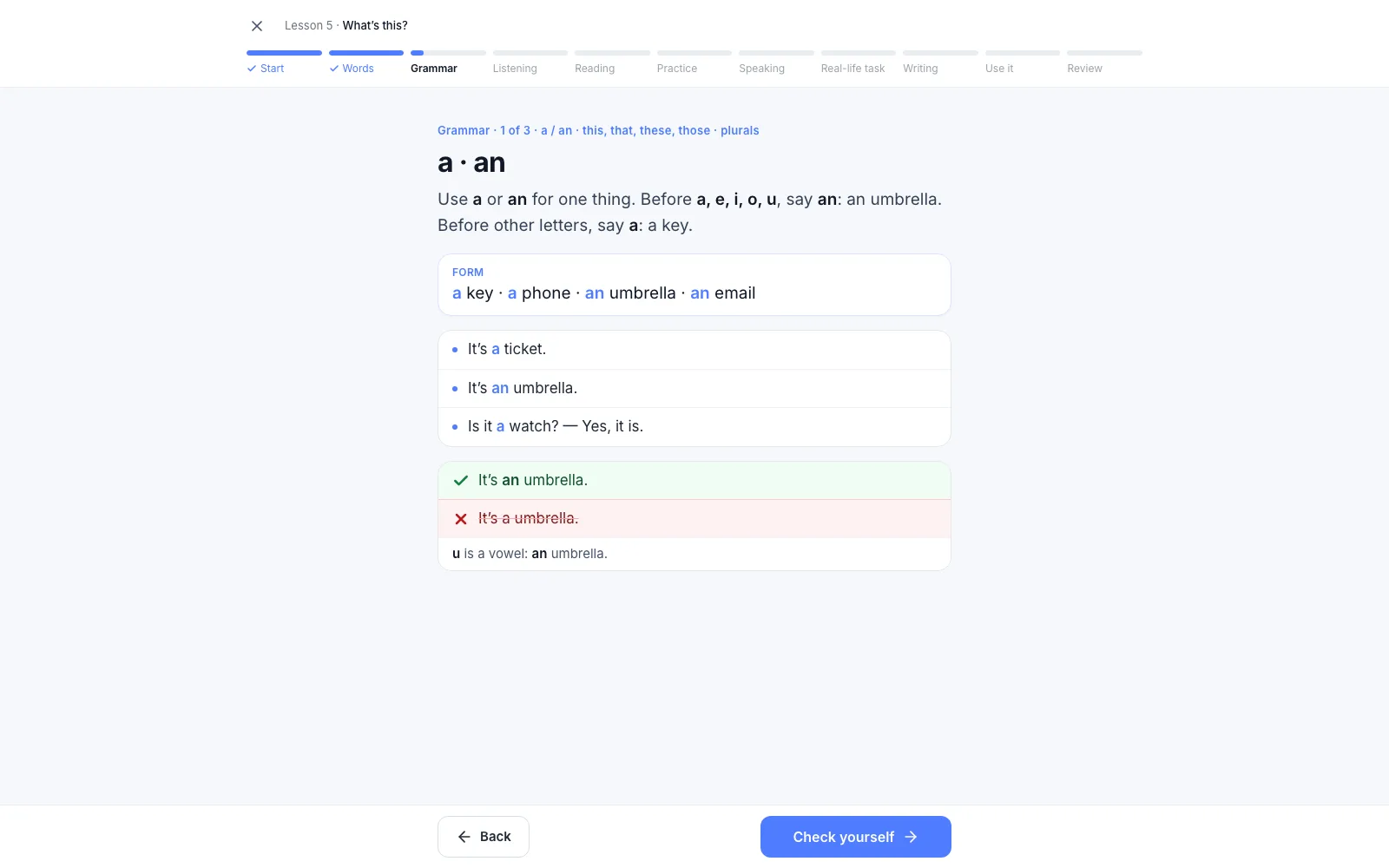
Use an before a vowel sound and a before a consonant sound. Listen to how the next word begins, not how it is written.
| a (consonant sound) | an (vowel sound) |
|---|---|
| a university (sounds like "you") | an umbrella |
| a European country ("you") | an English lesson |
| a one-way ticket ("wun") | an orange |
| a house (h is spoken) | an hour, an honest man (silent h) |
| a USB cable ("you") | an MBA, an FBI agent ("em", "ef") |
The article follows the word directly after it, even if that's an adjective: an apple but a red apple; a job but an interesting job.
When to use a / an
A and an only go with singular countable nouns. Use them:
- To mention something for the first time: I bought a new phone yesterday.
- When it doesn't matter which one: Can I borrow a pen? (any pen)
- For jobs and roles: She's an engineer. He works as a waiter.
- To say what something is or is like: It's a beautiful city. What a great idea!
- Meaning "one" or "per": a hundred people, twice a week, 50 kilometres an hour.
Never use a / an with plural or uncountable nouns: a information → some information / a piece of information.
When to use the
Use the when the listener knows exactly which thing you mean. That happens in a few typical ways:
- You've already mentioned it: I ordered a pizza and a salad. The pizza was cold.
- The situation makes it clear: Close the door, please. Where's the remote? (the one in this room)
- The rest of the sentence identifies it: The man who called you is my uncle. The book on the table is mine.
- There's only one: the sun, the moon, the internet, the world, the government.
- With superlatives and ordinals: the best day, the tallest building, the first time, the last train, the same, the only.
- With musical instruments and some routines: She plays the piano. I listen to the radio. Let's go to the cinema.
- With groups described by an adjective, and nationalities: the rich, the elderly, the French.
When to use no article
Leave the article out (this is sometimes called the zero article):
- Plural and uncountable nouns in general: Cats sleep a lot. Money doesn't buy happiness. I love music.
- Most names of people, cities, countries and continents: Maria lives in Paris. France is in Europe.
- Meals, days, months and years: We have dinner at seven. See you on Monday. I was born in May 2001.
- Languages and school subjects: She speaks Japanese. I'm good at maths.
- Sports and games: They play football / chess.
- Some places used for their main purpose: go to school, go to bed, be at work, go to church, be in hospital (British English). Compare: I went to the school to meet the teacher — the building, not as a student.
- Transport with by: by car, by train, by bus — but in the car, on the train.
General vs specific
The same noun can take the or no article, depending on whether you mean things in general or a particular group:
Coffee keeps me awake. (coffee in general) → The coffee at this café is great. (this café's coffee)
Children learn languages fast. (all children) → The children are in the garden. (our children)
A very common mistake is to use the for things in general: The life is short. → Life is short.
The with place names
Place names are where article rules feel most random. This table covers the most useful patterns:
| Use the | No article |
|---|---|
| Countries with republic, kingdom, states or a plural name: the UK, the USA, the Netherlands, the Philippines | Most countries: France, Japan, Brazil, Armenia |
| Oceans, seas and rivers: the Atlantic, the Mediterranean, the Nile | Single lakes: Lake Geneva, Lake Sevan |
| Mountain ranges and island groups: the Alps, the Canary Islands | Single mountains and islands: Mount Everest, Cyprus |
| Deserts: the Sahara | Continents and cities: Asia, London |
| Many buildings, hotels, museums: the Louvre, the Hilton, the Eiffel Tower | Most streets, parks and squares: Oxford Street, Central Park, Times Square |
Common mistakes with articles
- Missing article with a singular countable noun:
I'm student.→ I'm a student.She has car.→ She has a car. - The for things in general:
The people are friendly here.(if you mean people in general) → People are friendly here. - A / an with uncountable nouns:
a good advice→ some good advice / a piece of advice. Others to watch: information, news, furniture, luggage, homework, equipment. - A or an by spelling:
an university→ a university;a hour→ an hour. - The with most country names:
the Italy→ Italy. - Forgetting the with superlatives:
It's best restaurant in town.→ It's the best restaurant in town. - Mixing up general and specific:
I don't like the coffee.(when you mean all coffee) → I don't like coffee.
A simple way to decide
When you're not sure, ask three questions in order:
- Does the listener know which one I mean? Yes → the.
- If not, is it one singular countable thing? Yes → a / an (choose by the next sound).
- Otherwise — plural or uncountable, talking in general? → no article.
Then check the fixed exceptions: names, meals, go to bed / school / work, and the place-name table above.
Where it fits in your learning
A / an with jobs and simple nouns is taught at A1, and the vs no article for general statements at A2. Using articles accurately in longer speech and writing — especially general vs specific — is something even B2 and C1 learners keep polishing. See CEFR levels explained for what each level expects, and English tenses for the other big grammar system to get right early.
Quick check
Fill in a, an, the or — (no article). Answers are below.
- She's ___ honest person.
- I need ___ information about the course.
- ___ moon looks huge tonight.
- He works at ___ university in Berlin.
- We usually have ___ lunch at one o'clock.
- This is ___ best film I've ever seen.
- I bought a shirt and a jacket. ___ jacket was on sale.
- ___ honey is good for a sore throat.
- They're flying over ___ Atlantic.
- My sister is ___ architect.
1 an (silent h) · 2 — / some (uncountable) · 3 The (only one) · 4 a ("you" sound) · 5 — (meals) · 6 the (superlative) · 7 The (already mentioned) · 8 — (in general) · 9 the (ocean) · 10 an (job, vowel sound)
Questions people ask
When do you use a, an and the?
Use a or an with a singular countable noun when the listener doesn't know which one you mean (a book, an apple). Use the when it's specific — already mentioned, clear from the situation, the only one, or with a superlative (the book I lent you, the sun, the best day). Use no article for plural or uncountable nouns in general (Books are expensive).
How do I know whether to use a or an?
Go by sound, not spelling. Use an before a vowel sound (an apple, an hour, an MBA) and a before a consonant sound (a car, a university, a one-way street). The article follows the word right after it, so it's an egg but a big egg.
What are some examples of articles in sentences?
I need a taxi. She's an artist. The taxi is outside. He bought an umbrella, but the umbrella broke. It's the tallest building in the city. We met at an event in the UK. I love coffee (no article — coffee in general).
When should you not use an article?
Leave it out with plural and uncountable nouns used in general (Dogs are loyal, Water is important), most names of people, cities and countries, meals, days and months, languages, sports, and fixed phrases like go to bed, at work, by car.