Common English Idioms and Phrases: 45 You'll Actually Hear
"It cost an arm and a leg" has nothing to do with arms. Here are 45 idioms native speakers really use, what they mean, when they fit — and how to stop them sounding forced.
On this page
- Idioms vs phrases: what's the difference?
- Everyday idioms
- Idioms about money
- Idioms about people and conversation
- Idioms about work and plans
- Idioms about feelings
- Idioms about time
- Funny idioms worth knowing
- How to use idioms without sounding strange
- Popular American vs British idioms
- Where idioms fit in your learning
- Quick check
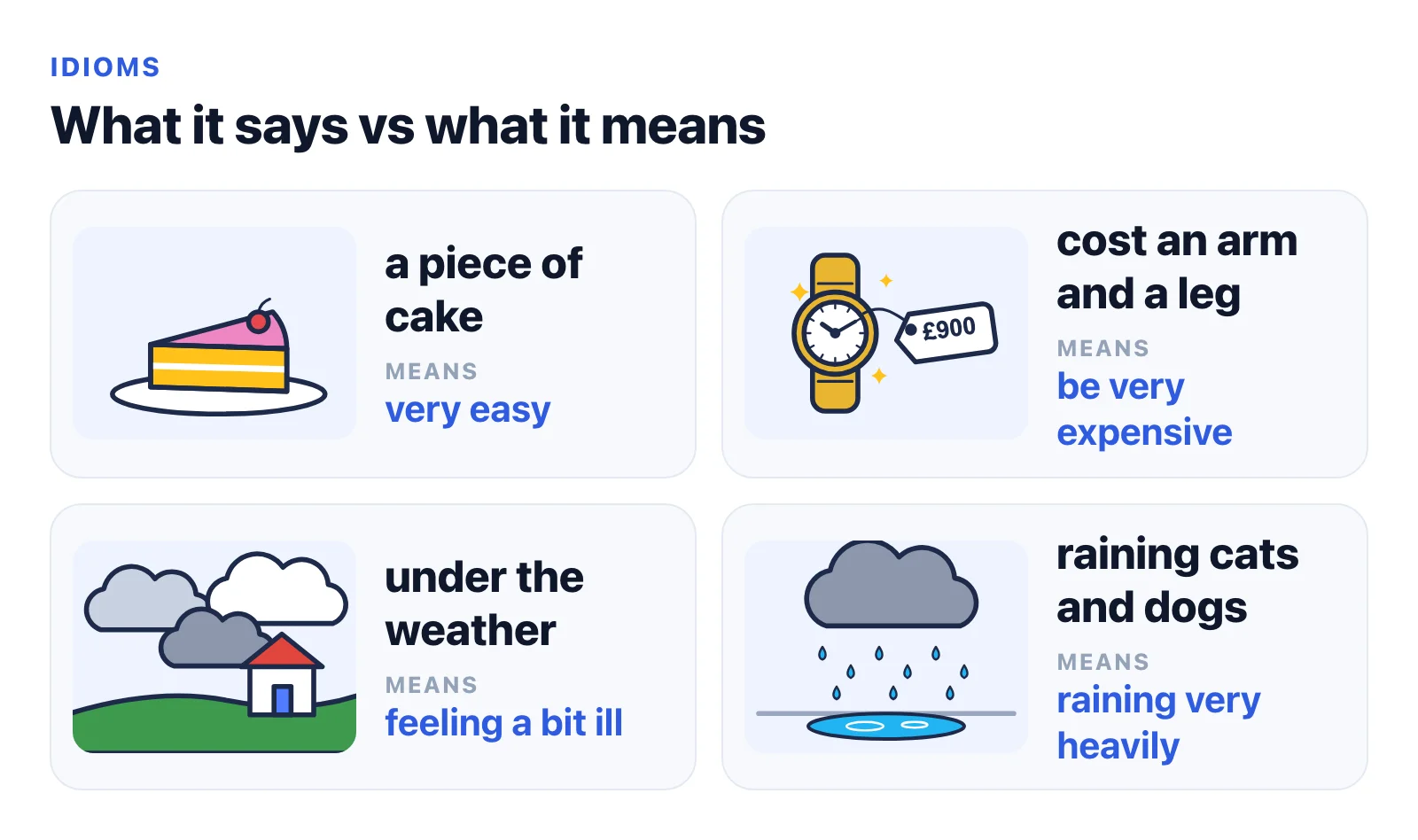
An idiom is a group of words whose meaning is different from the meaning of the individual words. If a friend says your new phone cost an arm and a leg, nobody lost a limb — it was just very expensive.
Don't worry about the test — it'll be a piece of cake. (very easy)
I'm pulling your leg! (joking, teasing you)
Our weekend plans fell through. (failed, didn't happen)
Idioms make English sound natural and warm, and they're everywhere in films, series and everyday conversation. The trick is knowing which ones people still use, what they really mean, and when they fit. Below are 45 common ones, grouped by topic, with an example for each.
Idioms vs phrases: what's the difference?
A phrase is any small group of words that works together: in the morning, a cup of tea, at the end of the day. You can usually understand a phrase from its words.
An idiom is a special kind of fixed phrase whose meaning you can't work out from its words — break the ice, hit the sack, spill the beans. Every idiom is a phrase, but most phrases are not idioms.
| Phrase | Idiom | |
|---|---|---|
| Meaning | comes from the words | different from the words |
| Example | go to bed | hit the sack (go to bed) |
| Can you change it? | often: go to bed early / late | rarely: |
How to spot an idiom: if the sentence makes no sense literally (It's raining cats and dogs), or if a dictionary lists the whole group of words as one entry, you're looking at an idiom.
Everyday idioms
| Idiom | Meaning | Example |
|---|---|---|
| a piece of cake | very easy | The exam was a piece of cake. |
| break the ice | make people feel relaxed when they first meet | He told a joke to break the ice. |
| hit the sack | go to bed | I'm exhausted — I'm going to hit the sack. |
| call it a day | stop working for today | It's seven o'clock. Let's call it a day. |
| under the weather | feeling a bit ill | I'm staying home — I'm a bit under the weather. |
| on the same page | agreeing, understanding the same thing | Let's check we're all on the same page. |
| the best of both worlds | the advantages of two different things | Working from home two days a week is the best of both worlds. |
| once in a blue moon | very rarely | I only eat fast food once in a blue moon. |
Idioms about money
| Idiom | Meaning | Example |
|---|---|---|
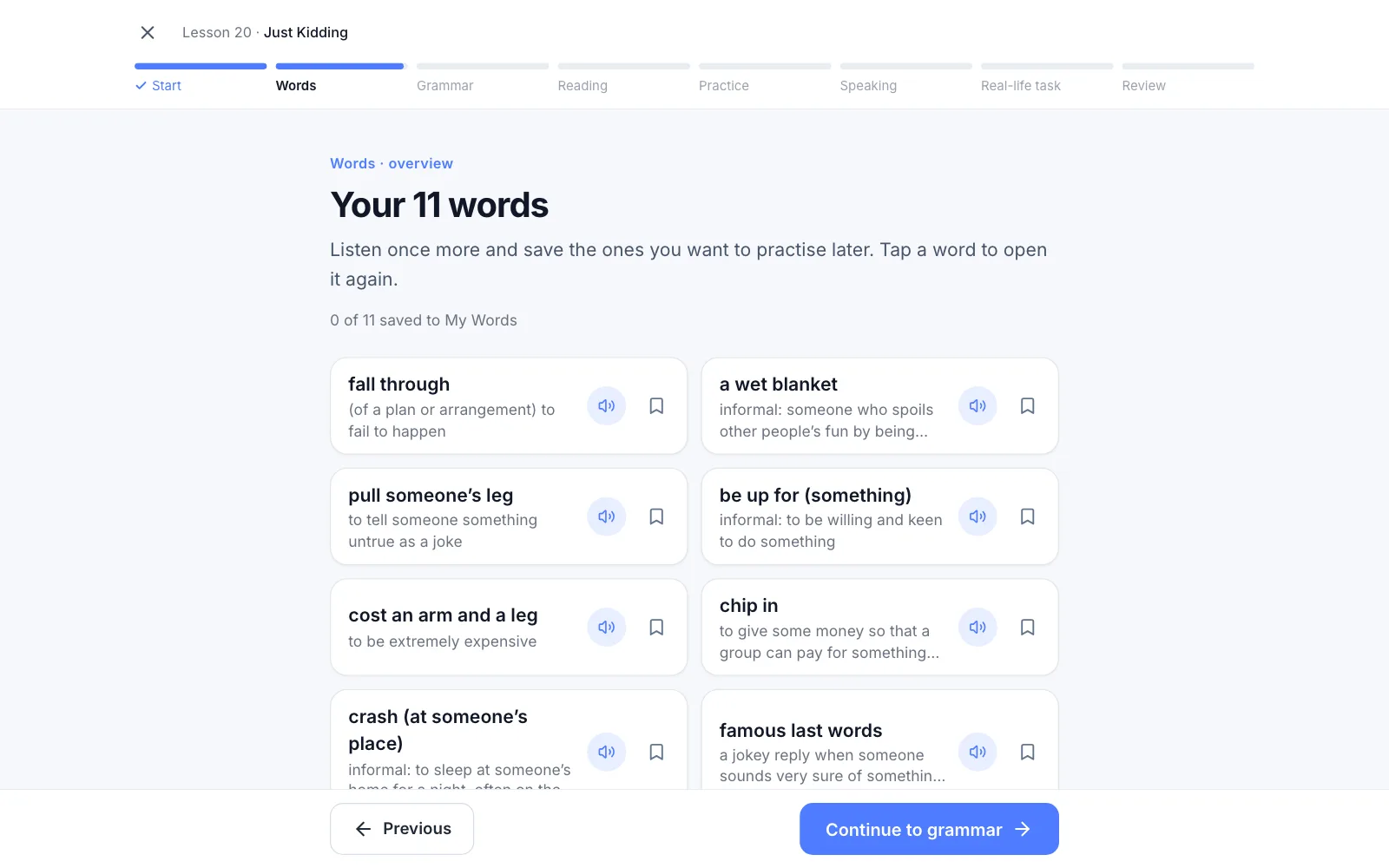
| cost an arm and a leg | be very expensive | Flights in August cost an arm and a leg. |
| chip in | give some money so a group can pay for something | We all chipped in for her present. |
| break the bank | cost more than you can afford (usually negative) | A weekend away won't break the bank. |
| tighten your belt | spend less money | We need to tighten our belts this month. |
| a rip-off | much too expensive; unfair price | Ten euros for a coffee? What a rip-off! |
Idioms about people and conversation
| Idiom | Meaning | Example |
|---|---|---|
| pull someone's leg | tease someone by telling them something untrue | Relax, I'm just pulling your leg. |
| a wet blanket | someone who spoils other people's fun | Don't be a wet blanket — come to the party! |
| spill the beans | tell a secret | Who spilled the beans about the surprise? |
| get something off your chest | tell someone about something that has been worrying you | I need to get this off my chest. |
| see eye to eye | agree with someone | We don't always see eye to eye on politics. |
| give someone the cold shoulder | ignore someone on purpose | She's been giving me the cold shoulder all week. |
| beat around the bush | avoid saying something directly | Stop beating around the bush and tell me. |
| famous last words | a joking reply when someone sounds too sure | "Nothing can go wrong." — "Famous last words." |
Idioms about work and plans
| Idiom | Meaning | Example |
|---|---|---|
| fall through | (of a plan) fail to happen | The deal fell through at the last minute. |
| play it by ear | decide what to do as things happen, not in advance | We don't have a plan — let's play it by ear. |
| be up for something | be willing and keen to do something | Anyone up for a walk? |
| get the ball rolling | start something | Let's get the ball rolling with a quick introduction. |
| back to square one | back to the beginning after a failure | The client said no, so we're back to square one. |
| cut corners | do something cheaply or badly to save time or money | Never cut corners on safety. |
| the ball is in your court | it's your decision or turn to act | I've made my offer — the ball is in your court. |
| hit the nail on the head | describe something exactly right | You hit the nail on the head — that's the problem. |
| bite off more than you can chew | try to do more than you can manage | With three jobs, she's bitten off more than she can chew. |
Idioms about feelings
| Idiom | Meaning | Example |
|---|---|---|
| over the moon | extremely happy | She was over the moon about the new job. |
| on cloud nine | very happy | They've been on cloud nine since the wedding. |
| down in the dumps | sad, depressed | He's been a bit down in the dumps lately. |
| have butterflies in your stomach | feel nervous | I always have butterflies before a presentation. |
| keep your chin up | stay positive in a difficult situation | Keep your chin up — it'll get better. |
| let off steam | do something to get rid of stress or anger | I go running to let off steam. |
Idioms about time
| Idiom | Meaning | Example |
|---|---|---|
| in the nick of time | just before it's too late | We got to the gate in the nick of time. |
| better late than never | it's better to do something late than not at all | You finally replied — better late than never! |
| run out of time | have no time left | I ran out of time and couldn't finish. |
| at the drop of a hat | immediately, without hesitating | He'd travel anywhere at the drop of a hat. |
| around the clock | all day and all night | The hospital staff work around the clock. |
Funny idioms worth knowing
Some idioms are memorable because the picture is so strange:
- It's raining cats and dogs. — It's raining very heavily.
- When pigs fly. — Never. "He'll apologise." — "Yeah, when pigs fly."
- Let the cat out of the bag. — Reveal a secret by accident.
- Bite the bullet. — Do something unpleasant that you've been avoiding.
How to use idioms without sounding strange
- Don't change the words. Idioms are fixed. It's cost an arm and a leg, not
cost a leg and an armorcost two arms; a piece of cake, nota slice of cake. If you change them, people may understand you, but it will sound like a mistake. - Watch the register. Most idioms are informal. The deal fell through is fine in a work email; pull someone's leg or a rip-off belong with friends, not in a complaint to your bank.
- Use one, not five. A single well-placed idiom sounds natural. Several in a row sounds like a textbook — or a joke.
- Prefer common ones. Idioms like it's raining cats and dogs are well known but not used much by native speakers today. It's pouring is more natural in conversation.
- Learn them in a sentence. Save the whole example, not just the idiom — We all chipped in for her present teaches you the grammar (chip in for) as well as the meaning.
Popular American vs British idioms
Most idioms are understood everywhere, but some feel distinctly local:
| More American | More British |
|---|---|
| touch base — make brief contact | a storm in a teacup — a lot of fuss about something small |
| ballpark figure — a rough estimate | Bob's your uncle — and that's it, it's done |
| take a rain check — decline now, maybe another time | throw a spanner in the works — cause a problem (US: a wrench) |
Where idioms fit in your learning
You can understand a few idioms early, but using them comfortably is a B1–B2 skill — around the point where conversation starts to feel relaxed. If you're working on that stage, read how to speak English fluently, and learn the verbs behind many idioms in our guide to phrasal verbs. For simpler everyday lines you can use from day one, see daily English sentences.
Quick check
Choose the idiom that fits. Answers are below.
- Our holiday plans ___ when the airline cancelled the flight. (fell through / hit the sack)
- Don't worry about the interview — you'll be fine. ___! (Keep your chin up / Spill the beans)
- That hotel was beautiful, but it ___. (cost an arm and a leg / broke the ice)
- "I'm moving to the moon." — "Stop ___!" (pulling my leg / cutting corners)
- We haven't booked anything — we'll just ___. (play it by ear / call it a day)
- She's ___ — she just got engaged. (over the moon / under the weather)
- Everyone ___ £10 for the teacher's gift. (chipped in / let off steam)
1 fell through · 2 Keep your chin up · 3 cost an arm and a leg · 4 pulling my leg · 5 play it by ear · 6 over the moon · 7 chipped in
Questions people ask
What is the difference between idioms and phrases?
A phrase is any group of words that works together, and you can usually understand it from its words (a cup of tea). An idiom is a fixed phrase whose meaning is different from its words (a piece of cake = very easy). All idioms are phrases, but most phrases are not idioms.
How do you identify idioms and phrases?
If the words make no literal sense in context (it's raining cats and dogs), or a dictionary lists the whole expression as one entry, it's an idiom. If you can understand it word by word, it's an ordinary phrase.
What are some funny idioms?
It's raining cats and dogs (very heavy rain), when pigs fly (never), let the cat out of the bag (reveal a secret by accident), and bite the bullet (do something unpleasant you've been avoiding).
What are 20 examples of idiomatic expressions?
A piece of cake, break the ice, hit the sack, call it a day, under the weather, cost an arm and a leg, chip in, pull someone's leg, a wet blanket, spill the beans, see eye to eye, fall through, play it by ear, get the ball rolling, back to square one, hit the nail on the head, over the moon, keep your chin up, in the nick of time and once in a blue moon.
What are popular American phrases?
Touch base (make brief contact), ballpark figure (rough estimate), take a rain check (decline for now), hit it out of the park (do something extremely well) and bring home the bacon (earn money for the family) are typically American.
Should English learners use idioms?
Yes, but sparingly and correctly. Use common ones in informal situations, never change their words, and learn each one in a full example sentence so you also learn the grammar around it.