100 Daily Use English Sentences for Real-Life Situations
You don't need thousands of words to get through a day in English. These 100 sentences, grouped by situation, cover greetings, cafés, shops, directions, work and small talk.
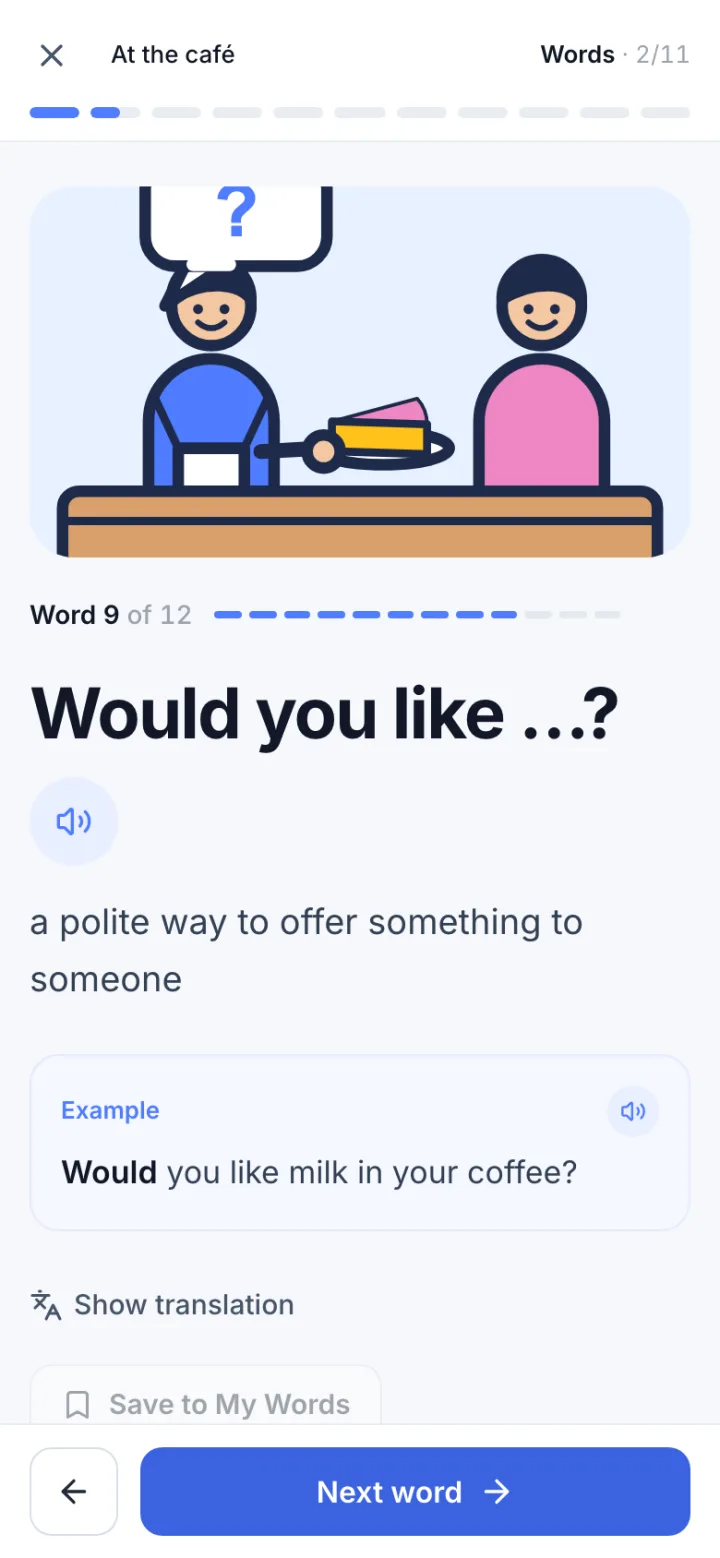
Would you like milk in your coffee? One sentence, used every day.
On this page
Most of a normal day in English runs on a surprisingly small set of sentences. You greet people, order something, ask where something is, apologise, make a plan and say goodbye. Learn the sentences for those moments well and you can handle far more than your vocabulary size suggests.
Below are 100 daily use English sentences, grouped by the situation you'll need them in. They're natural, polite and neutral — fine with strangers, colleagues and friends. Read them aloud: a sentence you've said ten times comes out much faster than one you've only read.
Greetings and goodbyes
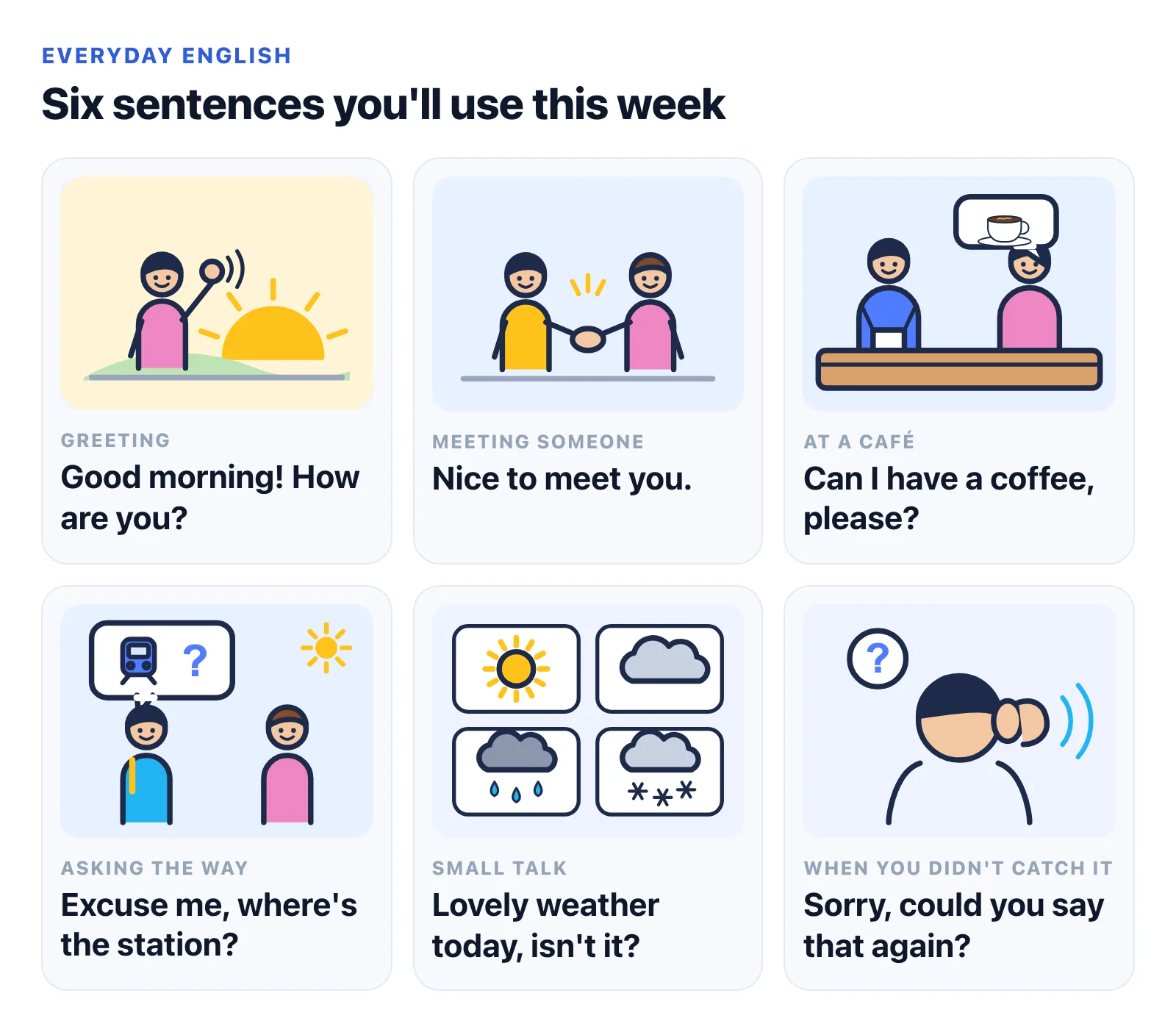
- Good morning! How are you?
- Hi, how's it going?
- I'm fine, thanks. And you?
- Not bad, thanks.
- Long time no see!
- Have a nice day.
- See you later.
- See you tomorrow.
- It was nice talking to you.
- Take care!
Tip: How are you? in a shop or at work is a greeting, not a real question. A short Fine, thanks — you? is the expected answer.
Introducing yourself
- Hi, I'm Anna. Nice to meet you.
- Nice to meet you too.
- I'm from Armenia. Where are you from?
- I work as a designer.
- I live in Yerevan, near the centre.
- I'm learning English.
- What do you do?
- How do you know Sam?
At a café or restaurant
- Can I have a coffee, please?
- I'd like a cheese sandwich, please.
- Could I see the menu, please?
- A table for two, please.
- For here, please. / To take away, please. (US: to go)
- Could we have the bill, please? (US: the check)
- Can I pay by card?
- Is this seat free?
- No milk, thanks.
- That was delicious, thank you.
When the waiter asks Would you like anything else?, the natural answers are Yes, please — … or No, thank you, that's all.
Shopping
- How much is this?
- Do you have this in a smaller size?
- Can I try it on?
- Where are the fitting rooms?
- I'm just looking, thanks.
- I'll take it.
- Can I have a bag, please?
- Could I return this, please? It doesn't fit.
Asking for directions
- Excuse me, where's the station?
- How do I get to the city centre?
- Is it far from here?
- Is there a pharmacy near here?
- Go straight on and turn left at the lights.
- It's on the right, opposite the bank.
- It's about ten minutes on foot.
- Sorry, I'm not from here.
The small words matter in directions — on the right, opposite, next to, between. Our guide to prepositions has pictures for each.
At work
- Do you have a minute?
- Could you send me the file, please?
- I'll get back to you this afternoon.
- Sorry, I'm running late. I'll be there in ten minutes.
- Can we move the meeting to Thursday?
- I'm working on it now.
- Let me check and let you know.
- That sounds good to me.
- Could you explain that again?
- Thanks for your help.
On the phone and in messages
- Hello, this is Anna speaking.
- Could I speak to Mr Harris, please?
- Sorry, you're breaking up.
- Can I call you back in five minutes?
- Could you speak a bit more slowly, please?
- I'll text you the address.
- Sorry I missed your call.
- Just checking in — is everything OK?
Making plans
- Are you free this weekend?
- Do you want to grab a coffee?
- How about Saturday afternoon?
- What time works for you?
- Let's meet at the station at six.
- Sorry, I can't make it.
- Maybe another time?
- Sounds great — see you then!
Small talk
- Lovely weather today, isn't it?
- It's freezing today!
- How was your weekend?
- Did you do anything nice?
- Have you been here before?
- What do you like doing in your free time?
- Have you seen any good films lately?
- How's work going?
Small talk is less about information than about being friendly. Ask a question, add one detail about yourself, and ask another.
Polite words and phrases
- Please. / Thank you. / Thanks a lot.
- You're welcome.
- Excuse me. (to get attention or get past)
- Sorry! (for a small mistake)
- No problem.
- Could you help me, please?
- Would you mind opening the window?
- After you.
Could you…? and Would you mind…? are softer than Can you…? — useful with strangers and at work. More on these in our guide to modal verbs.
When you don't understand
- Sorry, could you say that again?
- Sorry, I didn't catch that.
- What does "deadline" mean?
- How do you spell that?
- How do you say this in English?
- Do you mean tomorrow or Friday?
- Could you write it down, please?
- I'm not sure I understand.
These may be the most important sentences on the page. Asking someone to repeat is normal for native speakers too — it's much better than nodding and guessing.
Feelings and opinions
- I'm really tired today.
- I'm so happy for you!
- I think that's a great idea.
- I'm not sure about that.
- I agree with you.
- That's a shame.
How many words do you really need?
Everyday conversation leans heavily on a small core of very common words. A few thousand words cover most of what people say day to day, and the most frequent thousand or so — be, have, do, go, get, want, need, like, think, good, time, day, people — appear over and over again. That's why fixed sentences pay off so well: each one packs several of those high-frequency words into a ready-made pattern.
Notice how much these 100 sentences reuse: Can I…? Could you…? I'd like… How about…? Sorry, … Once you own the frame, you can swap the noun: Can I have a tea / the bill / a bag, please?
How to make these sentences stick
- Pick ten, not a hundred. Choose the ten you'll actually need this week — at work, at the café, on the bus.
- Say them out loud. Reading a sentence and producing it are different skills. Say each one until it comes out without thinking.
- Change one word. Turn Can I have a coffee? into Can I have a glass of water? Can I have the menu? That's how a sentence becomes a pattern.
- Practise the conversation, not the line. Prepare what the other person might say back — Would you like anything else? — and your answer.
- Use them the same day. One real use beats ten reviews. If you have no one to talk to, our guide to English speaking practice alone has routines that work.
When these feel comfortable, the next step is speaking in longer turns without pausing — see how to speak English fluently.
Quick check
What would you say? Suggested answers are below.
- You want to pay at the end of a meal.
- You didn't hear what someone said.
- You want to know if a café is far away.
- A colleague asks for something and you need time to find out.
- A friend invites you out, but you're busy.
- You want to try on a jacket in a shop.
1 Could we have the bill, please? · 2 Sorry, could you say that again? / Sorry, I didn't catch that. · 3 Is it far from here? · 4 Let me check and let you know. · 5 Sorry, I can't make it. Maybe another time? · 6 Can I try it on?
Questions people ask
What are 100 common English sentences used daily?
The most useful ones fall into a few situations: greetings (Good morning! How are you?), introductions (Nice to meet you), cafés (Can I have a coffee, please?), shopping (How much is this?), directions (Excuse me, where's the station?), work (I'll get back to you), plans (Are you free this weekend?) and asking for help (Sorry, could you say that again?). This page lists 100 of them by situation.
How many English words are used in everyday English?
Everyday conversation relies on a fairly small core. A few thousand words cover most of what people say day to day, and the most frequent thousand or so do a large share of the work — which is why learning common sentences and patterns pays off quickly.
How can I improve my English in daily life?
Choose a handful of sentences you need this week, say them aloud until they're automatic, change one word to make new sentences, and use them in real situations the same day. Short daily practice beats long occasional sessions.
What are the 20 polite words in English?
Common polite words and phrases include please, thank you, thanks, you're welcome, excuse me, sorry, pardon, no problem, of course, after you, could you, would you mind, may I, I'd like, I appreciate it, have a nice day, take care, bless you, I'm afraid and if you don't mind.
When do you use daily in a sentence?
Daily can be an adverb meaning every day (The shop is open daily) or an adjective meaning happening every day (my daily routine, a daily newspaper). Use every day, written as two words, as the time expression: I walk every day.
What are some useful phrases to use in English?
Could you…? (polite requests), I'd like… (asking for things), How about…? (suggestions), I'm not sure (uncertainty), Let me check (buying time), Sorry, I didn't catch that (asking someone to repeat) and That sounds good (agreeing).