Modal Verbs in English: Meanings, Rules and Examples
Modal verbs are small words that change the whole meaning of a sentence: you can go, you must go, you should go, you might go. Here's what each one does, and how to choose.
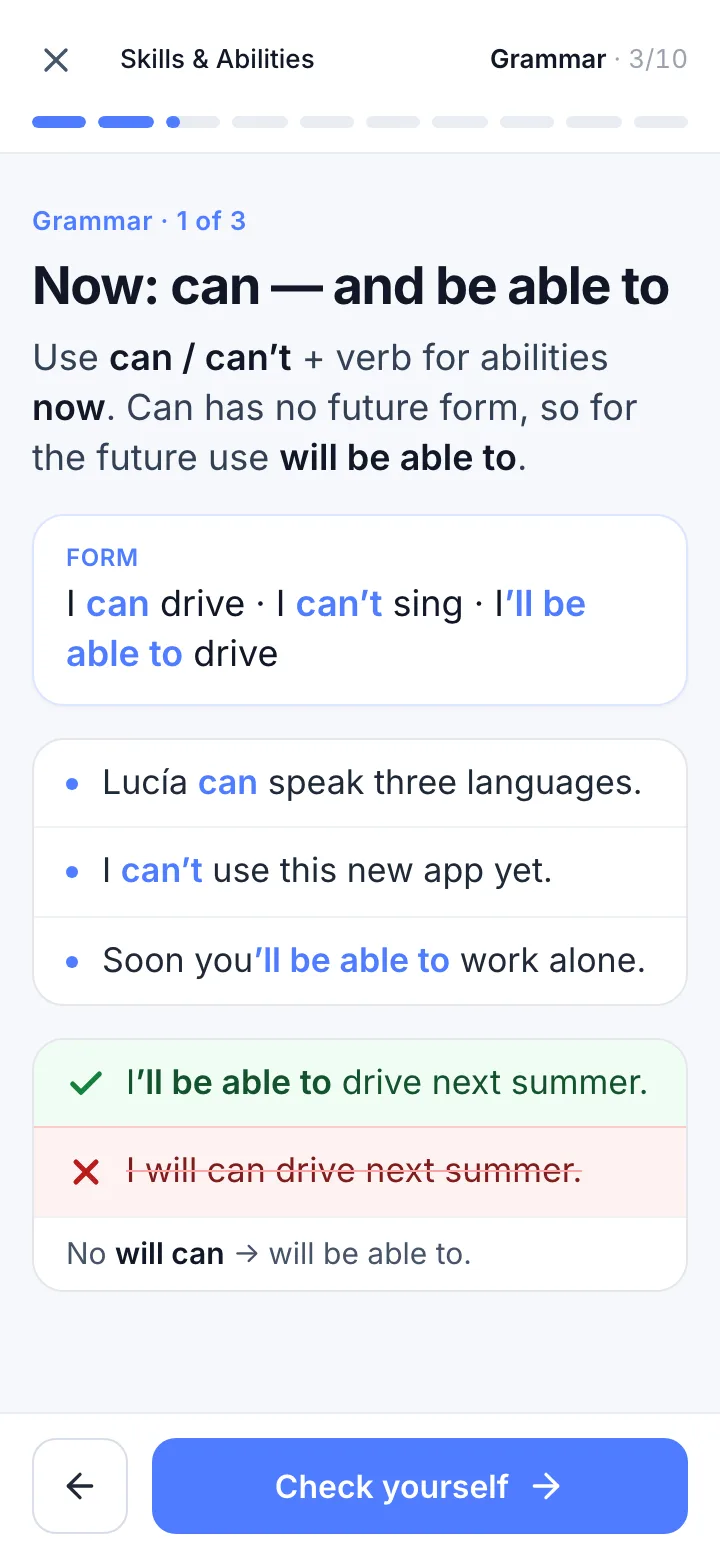
No will can: a modal never follows another modal, so the future is will be able to.
On this page
- The modal verbs at a glance
- The grammar rules all modal verbs share
- Modal verbs vs auxiliary verbs
- Ability: can, could, be able to
- Permission and requests: can, could, may
- Possibility and certainty: must, may, might, could, can't
- Obligation: must, have to, mustn't, don't have to
- Advice: should, ought to, had better
- Offers and suggestions: shall, will, could
- Will or would?
- Modals about the past: should have, must have, could have
- Common mistakes
- Where it fits in your learning
- Quick check
Modal verbs are the small helping verbs that add meaning to a main verb: can, could, may, might, must, shall, should, will and would (plus ought to). They tell us how the speaker sees an action — is it possible, necessary, allowed, likely, a good idea?
You can park here. (it's allowed) · You must park here. (it's required) · You should park here. (it's a good idea) · You might park here. (it's possible)
Same sentence, four different meanings. This guide covers the grammar rules all modal verbs share, then goes through them by meaning — ability, permission, possibility, obligation, advice — so you can choose the right one.
The modal verbs at a glance
| Modal | Main meanings | Example |
|---|---|---|
| can | ability, permission, possibility, requests | I can swim. · Can I sit here? |
| could | past ability, polite requests, possibility | I could read at four. · Could you help me? |
| may | formal permission, possibility | May I come in? · It may rain. |
| might | weaker possibility | She might be late. |
| must | strong obligation, logical certainty | You must wear a seatbelt. · He must be tired. |
| shall | offers and suggestions (mainly British) | Shall I open the window? |
| should | advice, expectation | You should rest. · It should arrive today. |
| ought to | advice (like should, a little more formal) | We ought to leave soon. |
| will | future, decisions, promises, offers | I'll call you tonight. |
| would | polite requests, imagined situations, past habits | Would you like tea? · I would go if I could. |
The grammar rules all modal verbs share
- The next verb is the base form, without to: I can swim — not
I can to swimorI can swimming. (Ought to is the exception.) - No -s for he / she / it: She can drive — not
she cans. - No do in questions and negatives: Can you drive? I can't drive — not
Do you can drive? - Negatives add not: cannot / can't, could not / couldn't, should not / shouldn't, must not / mustn't, will not / won't, would not / wouldn't, might not / mightn't (rare).
- No infinitive or -ing form, and only one modal at a time:
I will can help→ I will be able to help.
Modal verbs vs auxiliary verbs
All modal verbs are auxiliary (helping) verbs, but not all auxiliary verbs are modal. English has two groups:
- Primary auxiliaries — be, have, do — build tenses, questions and the passive, and add no meaning of their own: She is working. Have you eaten? I don't know. They change form (is, was, has, did) and can also be main verbs (I have a car).
- Modal auxiliaries — can, must, should and the rest — add meaning (ability, obligation, advice…), never change form and are never main verbs.
Semi-modals sit in between: have to, need to, be able to, used to and had better. They do a modal's job but behave like ordinary verbs, so they can change tense: I had to leave. Will you be able to come?
Ability: can, could, be able to
She can speak three languages. (present)
When I was a child, I could run for hours. (general past ability)
I'll be able to help you tomorrow. (future)
For one specific success in the past, use was / were able to or managed to, not could: The fire was huge, but everyone was able to escape. In the negative, couldn't is fine for both: I couldn't open the door.
Permission and requests: can, could, may
Can I borrow your pen? (informal)
Could I borrow your pen? (more polite)
May I borrow your pen? (formal)
Could you / Would you close the door, please? (asking someone to do something)
To give permission, use can or may, not could: "Could I sit here?" — "Yes, of course you can."
Possibility and certainty: must, may, might, could, can't
These modals show how sure you are. Think of a scale:
| How sure? | Modal | Example |
|---|---|---|
| Almost certain it's true | must | She's not answering. She must be asleep. |
| Possible | may / might / could | She may / might / could be at work. |
| Almost certain it's not true | can't / couldn't | She can't be at work — it's Sunday. |
Note that the opposite of must be (certain) is can't be, not mustn't be.
May or might?
For possibility, they're almost the same. Might sounds slightly less certain and is more common in conversation; may is a little more formal. It may rain and It might rain are both correct. Only may is used for formal permission (You may now begin).
Obligation: must, have to, mustn't, don't have to
Must and have to both mean something is necessary. The difference is mainly where the rule comes from:
- must — the speaker's own feeling, or written rules: I must call my mum. Passengers must wear seatbelts.
- have to — an outside rule or situation: I have to wear a uniform at work.
The big difference is in the negative:
| Modal | Meaning | Example |
|---|---|---|
| mustn't | it's not allowed | You mustn't smoke here. |
| don't have to | it's not necessary (but you can) | You don't have to come — it's optional. |
For the past and future of must, use have to: I had to work late. We'll have to wait.
Advice: should, ought to, had better
You should see a doctor. · You ought to apologise.
You'd better leave now, or you'll miss the train. (stronger: there will be a problem if you don't)
To ask for advice: What should I do? Should I tell him?
Offers and suggestions: shall, will, could
Shall I carry that for you? · I'll carry that for you. (offers)
Shall we go out tonight? · We could try the new café. (suggestions)
Will or would?
Will is for real future situations and decisions; would is for imagined situations, polite requests and offers, and reporting will in the past.
If it rains, I'll stay at home. (real possibility)
If I won the lottery, I'd travel the world. (imagined)
Would you like some coffee? · She said she would call. (reported will)
More on the first and second conditionals in conditional sentences explained, and on will → would in direct and indirect speech.
Modals about the past: should have, must have, could have
modal + have + past participle looks back at the past:
| Form | Meaning | Example |
|---|---|---|
| should have done | it was a good idea, but you didn't | You should have told me. |
| must have done | I'm almost sure it happened | The ground is wet — it must have rained. |
| might / could have done | it possibly happened | She might have missed the bus. |
| can't / couldn't have done | I'm almost sure it didn't happen | He can't have finished already. |
| could have done | it was possible, but it didn't happen | You could have hurt yourself! |
Common mistakes
- To after a modal:
I must to go.→ I must go. - -s on the modal or the verb:
He cans swim./He can swims.→ He can swim. - Do in questions:
Do you can come?→ Can you come? - Two modals together:
I will can do it.→ I will be able to do it. - Mustn't for "not necessary":
You mustn't bring food — we have plenty.→ You don't have to bring food. - Must be / can't be mix-up:
He mustn't be at home — the lights are off.→ He can't be at home.
Where it fits in your learning
Can, can't, will and would like appear at A1; should, must, have to and could at A2; possibility and certainty (might, must be, can't be) at B1; and the past modals (should have, must have) at B1–B2. See CEFR levels explained for what each level expects.
Quick check
Choose the best modal. Answers are below.
- You ___ (mustn't / don't have to) pay — the museum is free on Sundays.
- She ___ (can / could) play the piano when she was five.
- Take an umbrella. It ___ (might / must) rain later.
- That ___ (can't / mustn't) be Tom — he's in Spain this week.
- ___ (Shall / Will) I make you a sandwich?
- You look ill. You ___ (should / would) go home.
- I missed the bus, so I ___ (must / had to) walk.
- You ___ (should have / must have) told me you were vegetarian!
1 don't have to (not necessary) · 2 could (past ability) · 3 might (possibility) · 4 can't (almost certain it isn't) · 5 Shall (offer) · 6 should (advice) · 7 had to (past obligation) · 8 should have (a good idea that didn't happen)
Questions people ask
What are the modal verbs in English?
The core modal verbs are can, could, may, might, must, shall, should, will and would, plus ought to. Have to, need to, be able to and had better are often called semi-modals: they do a similar job but behave like ordinary verbs.
What is the difference between modal verbs and auxiliary verbs?
Every modal is an auxiliary (helping) verb, but the primary auxiliaries be, have and do are not modals. Be, have and do build tenses, questions and the passive without adding meaning; modals add meaning such as ability, obligation or possibility and never change form.
What is the difference between may and might?
For possibility they're almost interchangeable: It may rain / It might rain. Might sounds slightly less certain and is more common in speech. Only may is used for formal permission: You may leave now.
Should I say 'I would' or 'I will'?
Use will for real future plans, decisions and predictions (I'll call you tomorrow). Use would for imagined situations (I would buy a house if I had the money), polite requests (Would you help me?) and to report will in the past (She said she would come).