Prepositions in English: Place, Time and the Ones People Get Wrong
In, on, at, under, between: short words that cause long arguments. Here are the rules for place, time and movement, the most common prepositions, and the fixed combinations you simply have to learn.
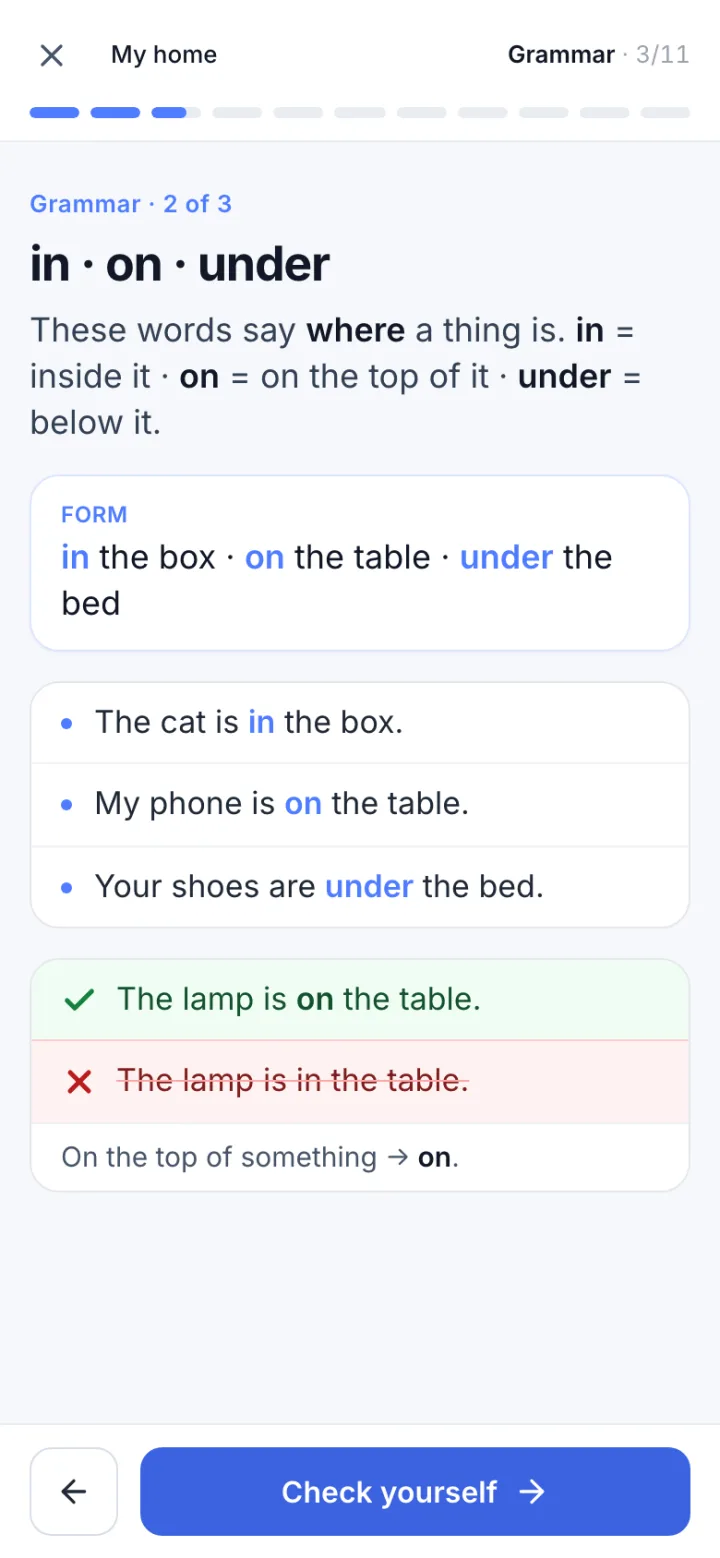
In the box, on the table, under the bed: place first, then time.
On this page
A preposition is a small word that connects a noun or pronoun to the rest of the sentence. Most of the time it tells you where something is, when something happens, or how things are related.
The keys are on the table. (place)
The meeting is at ten on Friday. (time)
She walked into the room with her dog. (movement, relationship)
English has well over a hundred prepositions, but a couple of dozen do almost all the work. This guide covers place, time and movement, the most common prepositions, the fixed combinations learners trip over, and a quick check at the end.
Prepositions of place
These answer the question Where is it? The easiest way to learn them is with a picture, not a definition.
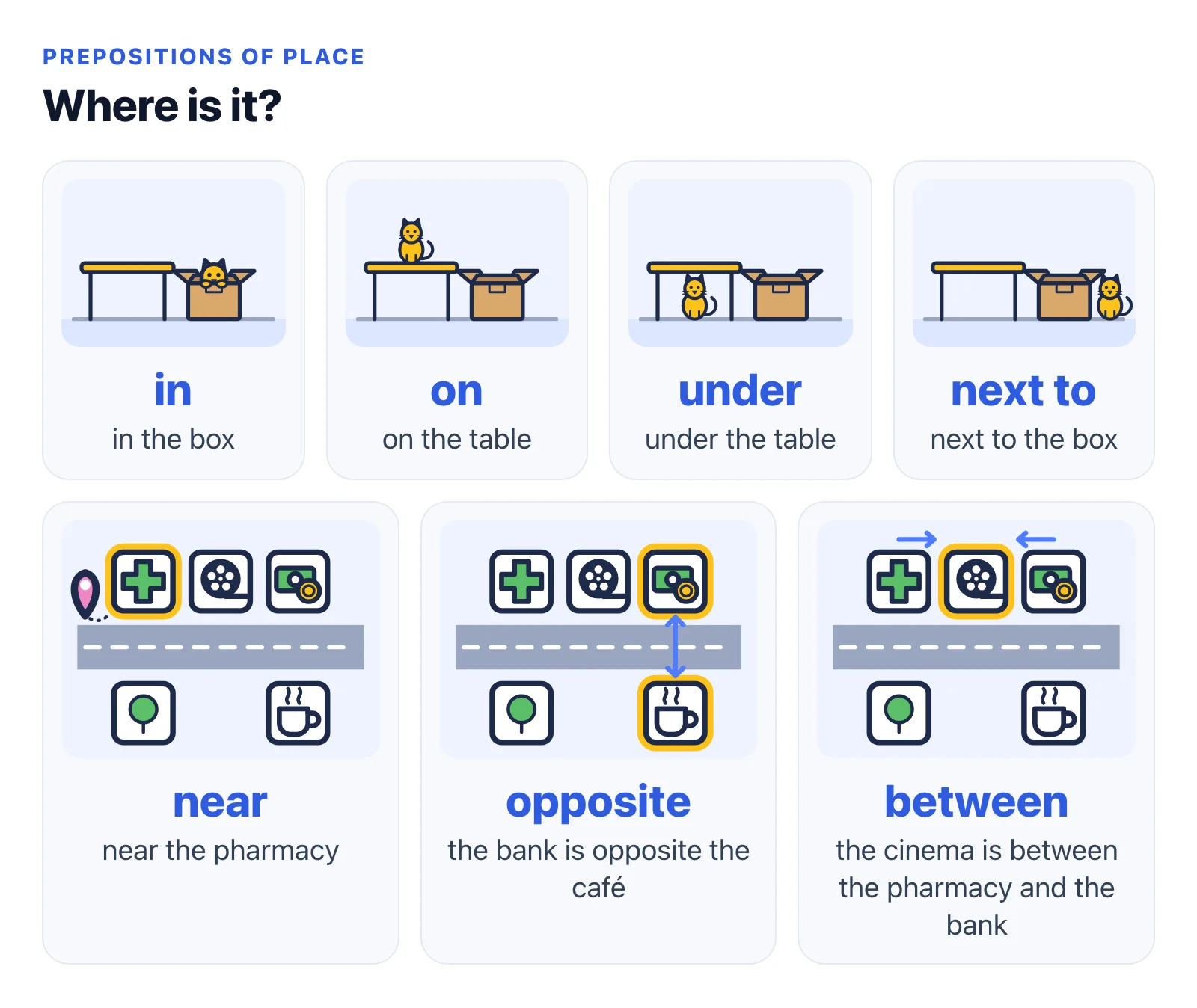
| Preposition | Meaning | Example |
|---|---|---|
| in | inside a space | The cat is in the box. She lives in Madrid. |
| on | touching a surface | Your phone is on the desk. There's a picture on the wall. |
| at | a point or a place for an activity | I'm at the bus stop. She's at work. |
| under / below | lower than | The shoes are under the bed. |
| above / over | higher than | There's a light above the table. |
| next to / beside | at the side of | Sit next to me. |
| near | a short distance from | We live near the station. |
| opposite | facing, on the other side | The bank is opposite the café. |
| between | with one thing on each side | The cinema is between the pharmacy and the bank. |
| in front of / behind | before / at the back of | Park in front of the house. The garden is behind it. |
In, on or at for places?
Think of three sizes of "where":
- in = inside an area or enclosed space: in the kitchen, in a car, in London, in France.
- on = on a surface or a line: on the floor, on the second floor, on a bus / train / plane, on Oxford Street.
- at = a specific point, an address, or a place where an activity happens: at the door, at 25 Park Road, at school, at the airport, at a party.
Note the transport pair: in a car / taxi (small, you sit inside) but on a bus / train / plane / bike.
Prepositions of time: at, on, in
For time, the three core prepositions go from small to large: at for exact times, on for days and dates, in for longer periods.
| at | on | in |
|---|---|---|
| clock times: at 7:30, at noon, at midnight | days: on Monday, on weekdays | months: in May |
| at night, at the weekend (UK) | dates: on 4 July, on my birthday | years and decades: in 2026, in the 1990s |
| holidays as a period: at Christmas, at Easter | a day + part of it: on Friday evening | parts of the day: in the morning / afternoon / evening |
| at the moment, at the same time | on the weekend (US) | seasons and centuries: in winter, in the 21st century |
No preposition before this, next, last, every, today, tomorrow, yesterday: on next Monday → next Monday; in this morning → this morning.
Other time prepositions
- for + a length of time: I've lived here for six years.
- since + a starting point: I've lived here since 2020. (Both usually go with the present perfect — see present perfect tense.)
- during + a noun: She fell asleep during the film.
- by = not later than: Send it by Friday. until / till = up to that time: The shop is open until 9.
- before / after: before lunch, after work.
- from … to / until: I work from 9 to 5.
Prepositions of movement
These describe direction — where something is going rather than where it is.
| Preposition | Example |
|---|---|
| to (destination) | We're going to the beach. |
| into / out of | He jumped into the pool. She ran out of the house. |
| onto / off | The cat jumped onto the table. Get off the bus here. |
| through | The train goes through a tunnel. |
| across | Walk across the bridge. |
| along | Go along this street for 200 metres. |
| past | Walk past the church and turn left. |
| up / down | She ran up the stairs. |
| towards | He walked towards me. |
Notice arrive: you arrive in a city or country and at a building or point — never arrive to. And home takes no preposition after verbs of movement: go to home → go home.
The 25 most common prepositions
If you know these well, you can understand most everyday English. Roughly in order of how often they appear:
| Most common English prepositions | ||||
|---|---|---|---|---|
| of | in | to | for | with |
| on | at | from | by | about |
| as | into | like | through | after |
| over | between | out of | against | during |
| without | before | under | around | among |
A few of these (after, before, as, like) can also work as conjunctions, joining whole clauses: Call me after you finish. That's normal — see parts of speech for how one word can do several jobs.
The golden rule: what comes after a preposition
A preposition is followed by a noun, a pronoun or a verb in the -ing form — never by an infinitive with to or a subject pronoun.
She's good at languages. (noun)
This is for you. Come with us. (object pronoun — not for I, with we)
Thanks for helping. I'm thinking about moving. (-ing — not Thanks for help me or thinking about to move)
And yes, you can end a sentence with a preposition. It's completely natural in English: Who are you talking to? What are you looking for? This is the flat I told you about.
Fixed combinations you just have to learn
Many prepositions aren't chosen by logic at all — they belong to the word before them. Learn these as one unit.
Adjective + preposition
| Phrase | Example |
|---|---|
| good / bad at | I'm terrible at maths. |
| interested in | Are you interested in art? |
| afraid / scared of | She's afraid of dogs. |
| proud of | We're proud of you. |
| married to | He's married to a doctor. |
| different from | This one is different from the others. |
| worried about | Don't be worried about the test. |
| responsible for | Who's responsible for this? |
Verb + preposition
listen to · wait for · depend on · belong to · agree with someone · look at · pay for · apply for a job · believe in · think about / of
When the small word changes the meaning of the verb (give up, look after, run out of), it's usually treated as a phrasal verb rather than a verb + preposition.
Common preposition mistakes
married with→ married todiscuss about the plan→ discuss the plan (no preposition) — but talk about the planarrive to London→ arrive in London; arrive at the stationin Monday→ on Monday;on the morning→ in the morningdepend of→ depend onI'm agree with you→ I agree with you (agree is a verb, no am)since three years→ for three yearsenter into the room→ enter the room
Quick check
Fill in the gap with the best preposition. Answers are below.
- The keys are ___ the table.
- My birthday is ___ 12 March.
- I'll see you ___ six o'clock.
- She was born ___ 1998.
- The pharmacy is ___ the bank and the café.
- We arrived ___ the airport two hours early.
- He's very good ___ football.
- I've worked here ___ 2021.
- The cat jumped ___ the sofa.
- What are you afraid ___?
1 on · 2 on (a date) · 3 at (clock time) · 4 in (a year) · 5 between · 6 at (a point / building) · 7 at · 8 since (starting point) · 9 onto (movement) — on is also heard · 10 of
Questions people ask
What are the 10 most common prepositions?
Of, in, to, for, with, on, at, from, by and about. Together they make up a large share of all the prepositions you'll read and hear, so learn their main uses first.
What are the 25 most common prepositions?
Of, in, to, for, with, on, at, from, by, about, as, into, like, through, after, over, between, out of, against, during, without, before, under, around and among.
What is the golden rule of prepositions?
A preposition is followed by a noun, a pronoun in the object form, or a verb ending in -ing: at school, for me, before leaving. Never use a subject pronoun (for I) or to + verb (thinking about to move) straight after a preposition.
When do you use in, on and at?
For time: at for exact times (at 6:00), on for days and dates (on Monday, on 3 May), in for longer periods (in July, in 2026, in the morning). For place: in for inside an area (in the room, in Paris), on for surfaces and lines (on the table, on the bus), at for a point or activity place (at the door, at work).
What are 100 examples of prepositions?
You don't need 100 to communicate well. Start with the core place words (in, on, at, under, next to, near, opposite, between, behind, in front of), the time trio (at, on, in plus for, since, until, by), and movement words (to, into, out of, through, across, along, past). Then learn fixed pairs like good at and interested in as you meet them.
Can you end a sentence with a preposition?
Yes. It's natural, correct English: Who are you waiting for? That's the song I was talking about. Rewriting these to avoid the final preposition usually sounds stiff.