Homophones in English: Meaning, 40+ Common Pairs and Mix-Ups
Sea and see. Right and write. Their, there and they're. Homophones sound the same but mean different things — here's how to tell them apart when you listen and when you write.
Homophones start with the ear: hear the word, then say it.
On this page
Homophones are words that sound the same but have different meanings, and often different spellings. The word comes from Greek: homo (same) + phone (sound).
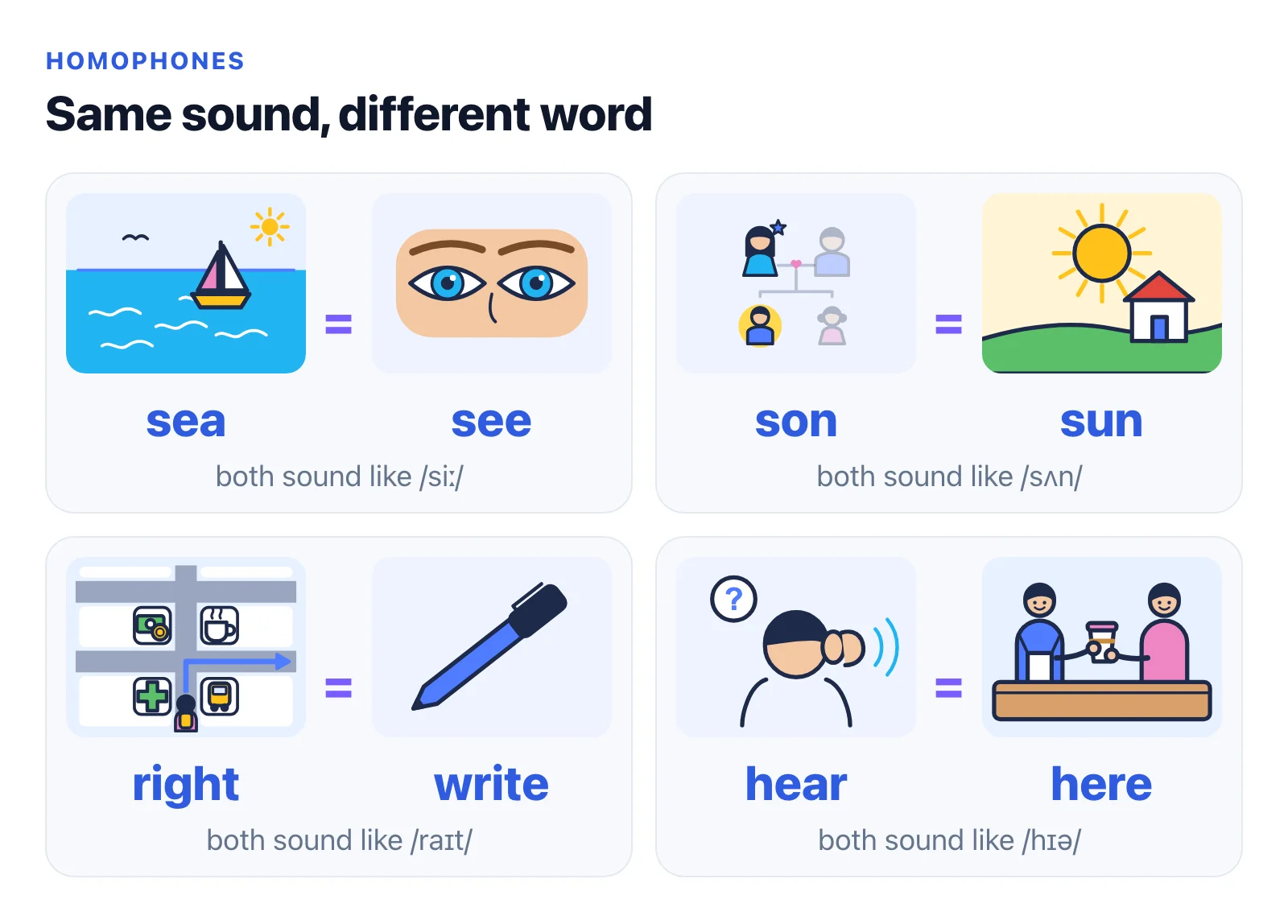
I'd love to live by the sea. / Can you see the boat?
Turn right at the corner. / Please write your name here.
Their car is over there — they're waiting for us.
When you're listening, homophones are rarely a problem — context tells you which word it is. The trouble comes when you write, because your ear can't help you choose the spelling. That's why their / there / they're and your / you're are among the most common writing mistakes in English, made by native speakers as often as by learners.
Homophones, homonyms and homographs
These three terms get mixed up constantly. The difference is whether the words share their sound, their spelling, or both:
| Term | Same sound? | Same spelling? | Example |
|---|---|---|---|
| Homophone | yes | not necessarily | flower / flour, knight / night |
| Homograph | not necessarily | yes | lead (to guide) / lead (the metal); tear (from your eye) / tear (to rip) |
| Homonym | yes | yes | bat (the animal) / bat (for cricket); bank (money) / bank (of a river) |
In everyday use, homonym is sometimes used loosely for any of these. For learning English, the useful distinction is simple: homophones are a spelling problem, homographs are a pronunciation problem.
The ones people get wrong most
These are the homophones that cause the most real mistakes in emails, messages and essays. Learn them first.
| Words | Meaning | Example |
|---|---|---|
| there their they're | a place / existence belonging to them they are | There's a café over there. Their flat is huge. They're late again. |
| your you're | belonging to you you are | Is this your bag? You're right. |
| its it's | belonging to it it is / it has | The dog hurt its paw. It's raining. It's been ages. |
| to too two | direction / infinitive also; more than enough the number 2 | I'm going to work. It's too big. Me too. Two coffees, please. |
| who's whose | who is / who has belonging to whom | Who's coming tonight? Whose phone is this? |
The apostrophe test: if you can replace the word with the full form — they are, you are, it is, who is — use the apostrophe version. If it doesn't make sense, use the other one. Its paw → it is paw, so no apostrophe.
Common homophones with meanings
Together with the five groups above, these make more than 40 sets of common homophones — around 90 words — with what each one means.
| Homophones | Meanings |
|---|---|
| ate / eight | past of eat / the number 8 |
| bare / bear | uncovered / a large animal; to carry or tolerate |
| be / bee | the verb / the insect that makes honey |
| blew / blue | past of blow / the colour |
| brake / break | to slow a vehicle / to damage; a short rest |
| buy / by / bye | to pay for / next to, or through / goodbye |
| cell / sell | a small room or unit of life / to exchange for money |
| dear / deer | loved; expensive (UK) / a forest animal |
| fair / fare | just, equal; light-coloured / the price of a journey |
| flour / flower | powder for baking / part of a plant |
| for / four | preposition / the number 4 |
| hear / here | to receive sound / in this place |
| hole / whole | an opening / complete, all of it |
| hour / our | 60 minutes / belonging to us (in most accents) |
| knew / new | past of know / not old |
| knight / night | a medieval soldier / the dark part of the day |
| know / no | to have information / the opposite of yes |
| mail / male | letters and post / a man or boy |
| meat / meet | animal flesh as food / to see someone by arrangement |
| pair / pear | two of something / a fruit |
| peace / piece | no war; calm / a part of something |
| plain / plane | simple; flat land / an aircraft |
| rain / reign / rein | water from clouds / to rule as a king or queen / a strap for controlling a horse |
| read / red | past of read (said "red") / the colour |
| right / write | correct; the opposite of left / to put words on paper |
| road / rode | a street / past of ride |
| sail / sale | to travel by boat; the cloth on a boat / selling, often at a discount |
| sea / see | a large area of salt water / to use your eyes |
| son / sun | a male child / the star that gives us light |
| steal / steel | to take without permission / a strong metal |
| tail / tale | the end part of an animal / a story |
| threw / through | past of throw / from one side to the other |
| wait / weight | to stay until something happens / how heavy something is |
| weak / week | not strong / seven days |
| wear / where | to have clothes on / in what place (in most accents) |
| weather / whether | rain, sun, etc. / if |
| which / witch | question word / a woman with magic powers in stories |
| wood / would | material from trees / modal verb |
Homophones that only work in some accents
Whether two words are homophones can depend on the accent. Some useful examples:
- caught / court, sauce / source, father / farther — homophones in most British accents, where the r after a vowel isn't pronounced. In most American accents the r is heard, so they sound different.
- cot / caught, Don / dawn — homophones for many American and Canadian speakers, different in British English.
- which / witch, where / wear — the same for most speakers today, but some Scottish, Irish and older American speakers still pronounce wh- differently.
- here / hear are homophones everywhere, but the vowel differs by accent: roughly /hɪə/ in British English and /hɪr/ in American English.
Don't worry about choosing an accent for this. Just be ready to hear both — and rely on context, as native speakers do.
How to tell homophones apart
When you're listening
Listen to the whole sentence, not the single word. I need to buy some __our for the cake can only be flour. If a sentence seems strange, try the other meaning: The knight was cold is about a soldier; the night was cold is about the weather.
When you're writing
- Test the apostrophe (it's = it is, you're = you are).
- Use spelling clues: here and there both contain here — they're places. Hear contains ear. Piece has pie in it — a piece of pie.
- Check the part of speech: whether joins clauses (a conjunction), weather is a noun. Brake and break are both verbs and nouns, so learn them with their typical partners: hit the brakes, take a break. More on word types in parts of speech.
- Don't trust spell check. Their going too the see passes a spell checker — every word is a real word. Read your sentence once more for meaning.
Homophones and pronunciation
Homophones are a useful reminder that English spelling and sound don't match neatly. Knight and night sound identical because the k and gh are silent; hour starts with a vowel sound because the h is silent — which is also why it's an hour, not a hour (see articles in English). The fastest way to learn how a word sounds is to hear it, not to guess from its letters.
Homophones are also behind a lot of English humour: Why did the bicycle fall over? Because it was two-tired. It has two tyres — and it's too tired. If you get the joke, you've understood two / too.
Quick check
Choose the correct word. Answers are below.
- I can't (hear / here) you — the music is too loud.
- (Their / There / They're) going to be late.
- Is this (your / you're) coat?
- The company changed (its / it's) logo.
- We walked (threw / through) the park.
- I'm not sure (weather / whether) I can come.
- Could I have a (peace / piece) of cake?
- She (new / knew) the answer.
- The train (fair / fare) went up again.
- (Whose / Who's) turn is it?
1 hear · 2 They're (they are) · 3 your · 4 its (no "it is") · 5 through · 6 whether · 7 piece · 8 knew · 9 fare · 10 Whose
Questions people ask
What are homophones?
Homophones are words that sound the same but have different meanings, and often different spellings — for example sea and see, right and write, or there, their and they're.
What are 20 examples of homophones?
There / their / they're, your / you're, its / it's, to / too / two, who's / whose, sea / see, son / sun, right / write, hear / here, buy / by / bye, flour / flower, knight / night, know / no, meat / meet, pair / pear, peace / piece, weak / week, wait / weight, weather / whether and wood / would.
What is the difference between a homonym and a homophone?
Homophones only need to sound the same (flower / flour). Homonyms sound the same and are spelled the same but mean different things (bat the animal / bat for sport). Homographs are spelled the same but may sound different (lead the verb / lead the metal).
What is the hardest homophone?
For writing, the trickiest are the contraction pairs: its / it's, your / you're, there / their / they're and who's / whose, because spell checkers accept every option. Test them by expanding the contraction: if it is or you are doesn't fit, drop the apostrophe.
What word in English has the most homophones?
Few English words have more than four homophones. Sets like right / write / rite / wright and air / heir / ere / e'er are among the largest, though some of those words are rare or old-fashioned.
What is an incorrect homophone?
It's when the wrong word of a homophone pair is written, such as "your welcome" instead of you're welcome, or "there car" instead of their car. The sentence sounds right aloud but is spelled wrongly.