Parts of Speech in English: The 8 Types, With Examples
Every word in a sentence has a job. Learn the eight parts of speech, how to spot each one, and why the same word can be a noun in one sentence and a verb in the next.
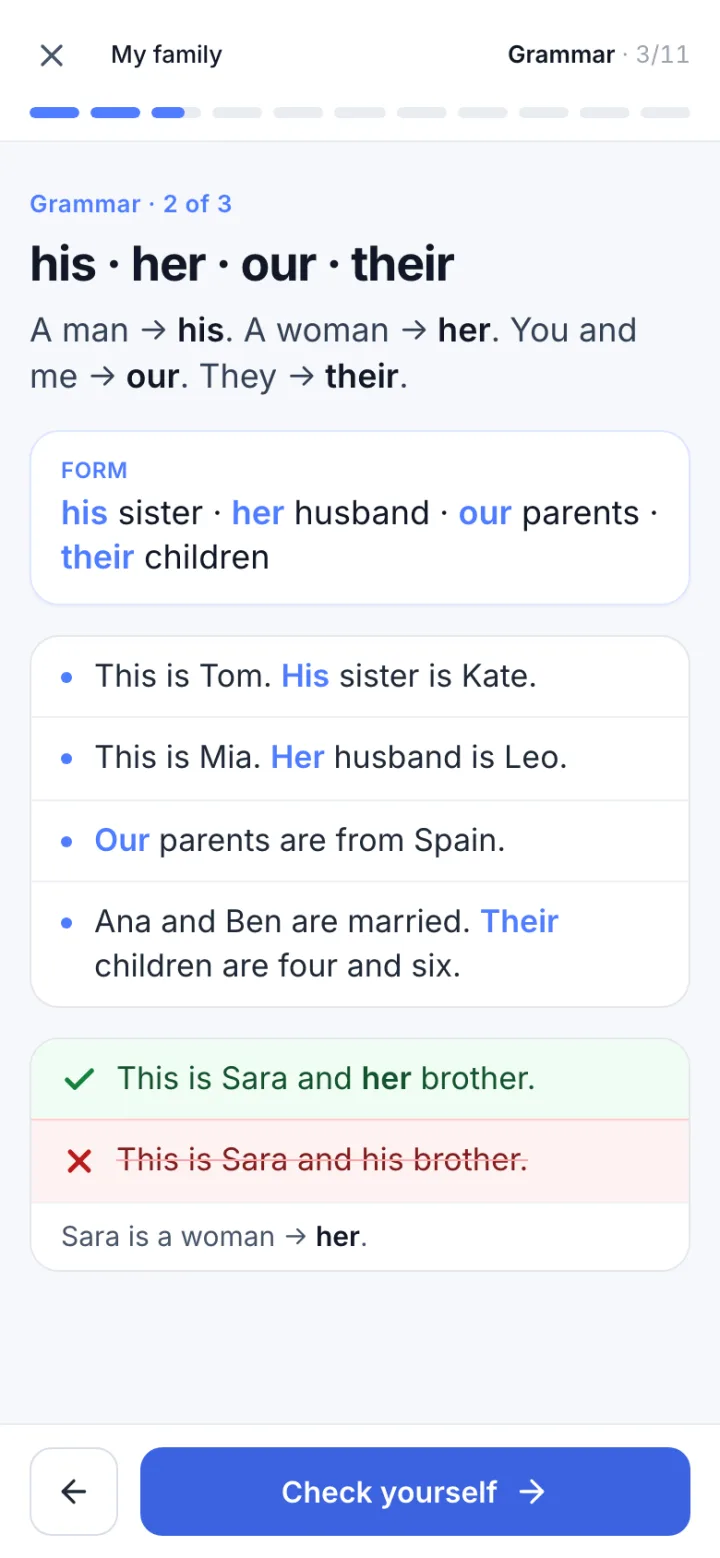
His, her, our, their: small words that point back to a noun.
On this page
The parts of speech are the categories English uses to describe what a word does in a sentence. A word can name something (a noun), show an action (a verb), describe something (an adjective) and so on. Traditional grammar counts eight of them.
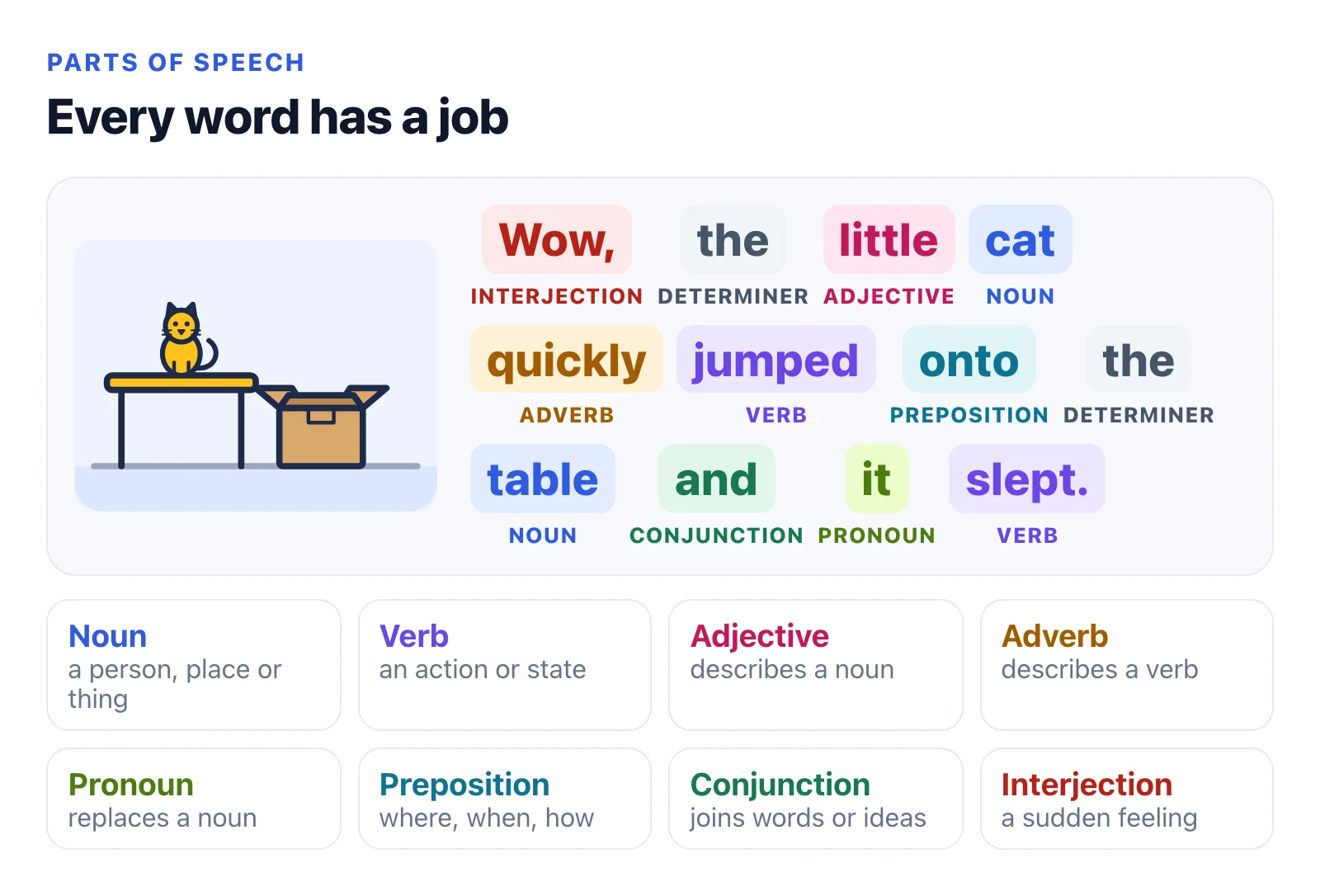
Wow, the little cat quickly jumped onto the table and it slept.
interjection · determiner · adjective · noun · adverb · verb · preposition · determiner · noun · conjunction · pronoun · verb
You don't need to label every word when you speak. But knowing the parts of speech makes grammar explanations, dictionaries and your own mistakes much easier to understand — "you need an adverb here, not an adjective" only helps if you know what each one is.
The 8 parts of speech at a glance
| Part of speech | What it does | Examples | In a sentence |
|---|---|---|---|
| Noun | names a person, place, thing or idea | teacher, Paris, phone, love | My sister lives in London. |
| Pronoun | replaces a noun | I, you, she, it, they, mine, who | She called me. |
| Verb | shows an action or a state | run, eat, be, have, seem | We are tired, so we stayed home. |
| Adjective | describes a noun or pronoun | big, red, happy, expensive | It's a small but bright flat. |
| Adverb | describes a verb, adjective or another adverb | quickly, very, often, here | He speaks very slowly. |
| Preposition | shows place, time or relationship | in, on, at, under, before, with | The keys are on the table. |
| Conjunction | joins words, phrases or clauses | and, but, or, because, although | I called but she was busy. |
| Interjection | expresses a sudden feeling | wow, oh, oops, hey, ouch | Oops, I dropped it. |
Nouns
A noun is the name of something: a person (doctor, Anna), a place (kitchen, Japan), a thing (chair, coffee) or an idea you can't touch (freedom, advice, happiness).
- Common vs proper: city is a common noun; Rome is a proper noun and takes a capital letter.
- Countable vs uncountable: you can count one apple, two apples, but not
two advices— advice is uncountable. This decides whether you can use a / an (see articles in English). - Singular vs plural: most plurals add -s (books), some are irregular (children, people, feet).
Quick test: if you can put the or a in front of it, it's probably a noun — the chair, a decision.
Pronouns
A pronoun stands in for a noun so you don't have to repeat it: Maria is late. She missed the bus.
| Type | Examples | Example sentence |
|---|---|---|
| Subject | I, you, he, she, it, we, they | They live nearby. |
| Object | me, you, him, her, it, us, them | Can you help us? |
| Possessive | mine, yours, his, hers, ours, theirs | That bag is mine. |
| Reflexive | myself, yourself, themselves… | She taught herself to code. |
| Relative / question | who, which, that, what, whose | The man who called is my uncle. |
| Demonstrative | this, that, these, those | This is delicious. |
Words like my, your, his, her, our, their come before a noun (her brother). Many grammars call them possessive determiners rather than pronouns, but they follow the same logic: his for a man, her for a woman, their for more than one person.
Verbs
A verb shows what someone does (write, cook, travel) or what someone or something is (be, seem, belong, know). Every complete English sentence needs one.
- Main verbs carry the meaning: She works in a bank.
- Auxiliary (helping) verbs — be, do, have — build tenses, questions and negatives: She is working. Do you like it? I have finished.
- Modal verbs — can, could, should, must, might, will, would — add ability, advice, possibility or obligation. See modal verbs.
- Phrasal verbs combine a verb with a small word: give up, look after, run out of. See phrasal verbs.
Verbs change form to show time — I work, I worked, I've worked, I'll work. That system is covered in English tenses.
Adjectives
An adjective describes a noun: its size, colour, age, quality, nationality and so on. In English it usually goes before the noun or after a verb like be, look, seem, feel.
a comfortable chair · an old Italian car · The soup smells good. · You look tired.
Adjectives never take a plural -s: two bigs houses → two big houses. They also have comparative and superlative forms: cheap → cheaper → the cheapest, expensive → more expensive → the most expensive.
Adverbs
An adverb describes a verb, an adjective, another adverb or the whole sentence. It answers questions like how? when? where? how often? how much?
| Answers… | Examples | Sentence |
|---|---|---|
| How? | carefully, fast, well | Drive carefully. |
| When? | now, yesterday, soon | I'll call you later. |
| Where? | here, outside, upstairs | The kids are outside. |
| How often? | always, usually, never | She never eats meat. |
| How much? | very, quite, too, extremely | It's too hot. |
Many adverbs are an adjective + -ly (quick → quickly), but not all: good → well, fast → fast, hard → hard. And some -ly words are adjectives: a friendly dog, a lovely day.
Prepositions
A preposition links a noun or pronoun to the rest of the sentence, usually to show place (in, on, under, next to), time (at, on, in, before, until) or another relationship (with, for, about, by).
The cat is under the table. · See you on Monday at six. · I went with my brother.
Prepositions are short but famously hard to choose, because many uses are fixed (good at, interested in, married to). Our full guide to prepositions has the rules and the lists.
Conjunctions
A conjunction joins words or ideas.
- Coordinating conjunctions join equal parts. There are seven, often remembered as FANBOYS: for, and, nor, but, or, yet, so. I was hungry, so I made a sandwich.
- Subordinating conjunctions start a clause that depends on the main one: because, although, when, if, while, until, since. We stayed in because it was raining.
- Correlative pairs work together: both… and, either… or, neither… nor, not only… but also.
Interjections
An interjection is a word or sound that shows a sudden feeling or reaction. It usually stands alone or at the start of a sentence, followed by a comma or an exclamation mark: Wow! · Oh no, I forgot. · Ouch, that hurt. · Hey, wait for me. · Oops. Interjections are common in speech and informal writing and rare in formal writing.
Is there a 9th part of speech?
Many modern grammars add a ninth class: determiners. These are the words that come before a noun to say which one or how many:
- Articles: a, an, the
- Demonstratives: this, that, these, those (+ noun)
- Possessives: my, your, his, her, its, our, their
- Quantifiers: some, any, many, much, few, every, each, no
- Numbers: one, two, first, second
Older textbooks file these under adjectives or pronouns. Either way, they matter: a vs the and much vs many are some of the most common learner mistakes.
One word, different parts of speech
English words don't come with a fixed label. The same word can be a different part of speech depending on how it's used — which is why you identify a part of speech by its job in the sentence, not by the word alone.
| Word | As a noun | As a verb | As another part |
|---|---|---|---|
| run | I went for a run. | I run every morning. | — |
| light | Turn on the light. | They light candles. | a light bag (adjective) |
| back | My back hurts. | I back your idea. | Come back soon. (adverb) |
| well | a deep well | Tears welled up. | She sings well. (adverb) · Well, maybe. (interjection) |
| before | — | — | before lunch (preposition) · before you go (conjunction) |
How to identify a part of speech
When you're not sure, try these quick tests on the word in its sentence:
- Can you put the or a before it? → noun (the meeting).
- Can you change its tense? (-ed, -ing, will) → verb (meet, met, meeting).
- Does it fit "a very ___ thing" or "It's ___"? → adjective (a very useful thing).
- Does it answer how, when, where or how often about an action? → adverb (She left early).
- Can you replace a noun phrase with it? → pronoun (The tall man → he).
- Is it followed by a noun and does it show place, time or a link? → preposition (after work).
- Does it join two words or clauses? → conjunction (tea or coffee).
Common mistakes with parts of speech
- Adjective instead of adverb:
She speaks English very good.→ She speaks English very well.Drive careful.→ Drive carefully. - Noun instead of verb: advice is the noun and advise the verb —
Can you advice me?→ Can you advise me? The same pair exists in belief / believe and success / succeed:I want to success.→ I want to succeed. - Wrong pronoun case:
Me and him went.→ He and I went.between you and I→ between you and me (after a preposition, use the object form). - Plural adjectives:
differents ideas→ different ideas. - Mixing up his and her: the word matches the owner, not the thing owned — Sara and her brother, not
Sara and his brother.
Parts of speech vs figures of speech
These two get searched together, but they're different things. Parts of speech are grammar categories for single words. Figures of speech are ways of using language for effect — metaphor (time is money), simile (as busy as a bee), hyperbole (I've told you a million times), personification, irony and so on. Idioms are a close cousin; see our list of common English idioms.
Quick check
What part of speech is the bold word? Answers are below.
- We had a great time.
- She usually walks to work.
- The keys are behind the sofa.
- They moved to Canada last year.
- I'd like tea, but there's only coffee.
- Ouch! That's hot.
- Can you email me the file?
- Her advice was really useful.
- He works hard.
- I bought a new laptop.
1 adjective · 2 adverb (how often) · 3 preposition · 4 pronoun · 5 conjunction · 6 interjection · 7 verb (here email is an action) · 8 noun · 9 adverb (hard has no -ly form here) · 10 determiner / article
Questions people ask
What are the 8 parts of speech?
Noun (teacher, city), pronoun (she, it, them), verb (run, be, have), adjective (big, happy), adverb (quickly, often, very), preposition (in, on, at, with), conjunction (and, but, because) and interjection (wow, oops, ouch).
What is the 9th part of speech?
Many modern grammars add determiners as a ninth part of speech: the words before a noun that say which one or how many — articles (a, an, the), this/that/these/those, my/your/their, and quantifiers like some, many and every. Older grammars treat them as adjectives.
What are 5 examples of parts of speech?
In "My brother quickly finished his homework": brother is a noun, quickly is an adverb, finished is a verb, his is a possessive word (determiner) and homework is a noun. In "She is happy": she is a pronoun and happy is an adjective.
What is the hardest part of speech?
For most learners it's prepositions, because so many uses are fixed rather than logical — interested in, good at, depend on, married to. Adverbs vs adjectives (good vs well) and determiners (a vs the, much vs many) are close behind.
Can a word be more than one part of speech?
Yes, very often. Run, light, back and well can each be several parts of speech. You decide by the word's job in that sentence: I went for a run (noun) vs I run every day (verb).
What are the 12 main figures of speech?
Figures of speech are different from parts of speech: they are stylistic devices, not word classes. Lists commonly include metaphor, simile, personification, hyperbole, understatement, irony, oxymoron, alliteration, onomatopoeia, metonymy, synecdoche and euphemism.