Elementary English (A2)
Build on the basics: talk about the past and your plans, compare and choose, and handle everyday problems.

- A2CEFR level · Elementary
- 24lessons in 6 modules
- about 19 hof lessons
- Every lessonhas homework
What you'll be able to do
- Talk about your week, your weekend and a trip
- Make plans, invite people and arrange a time
- Compare, recommend and solve everyday problems
What every lesson includes
- Warm-up — A few questions to get you thinking about the topic.
- Words and phrases — Clear meanings, real examples and audio. Save anything to My Words.
- Grammar — Small steps with examples and a quick check.
- Listening and reading — A conversation to listen to and a text to read that use the new language.
- Practice — Mixed questions with feedback on the exact answer you chose.
- Speaking — Record your answer, play it back and compare it with an example.
- Real-life task — Put it together in a situation you'll actually meet.
- Writing — A short piece of writing using what you've just learned.
- Review — A quick recap before you move on to the next lesson.
After every lesson there's homework with vocabulary, grammar, writing and speaking tasks.
Skills you practise
- Vocabulary
- Grammar
- Reading
- Listening
- Speaking
- Writing
Modules and lessons
All 24 lessons, grouped into 6 modules. Each lesson has one clear goal.
Module 1Everyday life and the past
Talk about your week, your weekend and a trip.
- Lesson 1 Free previewNow and every day
Say what you usually do and what is different now.
Present simple for routines: I usually take the bus · Present continuous for now and this week: I’m working from home this week · Which one? usually / every day or at the moment / this week
- Lesson 2 Free previewLast weekend
Talk about what you did.
Past simple regular: -ed (cleaned, played) · Spelling: study → studied, stop → stopped · yesterday · last … · … ago — and the three -ed sounds
- Lesson 3A trip to remember
Ask and answer about a trip.
Irregular past: went, saw, took, ate, bought · didn’t + verb · Did you …? · Where did you go?
- Lesson 4Asking questions
Ask the right question in the right order.
Question words: where · when · why · how · Word order: do / does + subject + verb · How often · How long · How far
Module 2Plans and arrangements
Make plans, invite people and arrange a time.
- Lesson 5Weekend plans
Tell a friend your plans and ask about theirs.
going to: plans · not and questions · Plans or routines?
- Lesson 6Would you like to come?
Invite a friend, accept and say no politely.
Would you like to + verb? · Do you want to …? · Let’s … · Why don’t we …? · Yes and no politely: I’d love to · I’m afraid I can’t
- Lesson 7Are you free on Friday?
Arrange a day and time that works for both.
Present continuous for arrangements: I’m meeting Sam on Friday · at · on · in (time) · Are you doing anything on …?
- Lesson 8I’ll call you back
Handle a short phone call and take a message.
will for offers: I’ll call you back · Shall I …? · Quick decisions: OK, I’ll take it
Module 3Comparing and choosing
Compare, recommend, shop for food and eat out.
- Lesson 9Bigger and better
Compare two places or things.
-er + than: cheaper, quieter · more + long adjectives: more comfortable · better · worse
- Lesson 10The best place in town
Recommend the best option.
the -est: the cheapest · the most + long adjective · in + place · of + group
- Lesson 11How much? How many?
Talk about quantities and make a shopping list.
countable or uncountable? · some · any · much · many · a lot of
- Lesson 12Eating out
Book, order and solve a small problem in a restaurant.
Could I have …? · I’ll have … · Are you ready to order? · Can we have the bill, please? · There’s a problem with … · It’s cold
Module 4Experiences and life stories
Share experiences and tell short stories about your life.
- Lesson 13Have you ever…?
Share experiences.
Have you ever + past participle? · been to · never · not … yet · once · twice
- Lesson 14Life events
Tell a short life story.
was born · were born · Past simple for a life story: grew up, moved, got married · in + year · when + past
- Lesson 15When I was young
Compare your childhood with now.
could · couldn’t (past ability) · Past simple for childhood habits · When I was young / a child …
- Lesson 16What happened?
Tell a short story in order.
Past continuous: I was walking · I was walking when … (past simple interrupts) · first · then · after that · finally
Module 5Work, study and health
Talk about your job, learning and your health.
- Lesson 17My job
Describe your work and duties.
have to + verb · don’t have to (not necessary) · Do you have to …?
- Lesson 18Learning something new
Talk about what you want to learn and sign up for a course.
want to · would like to + verb · need to + verb · well · badly · fast · slowly
- Lesson 19I don’t feel well
Say what’s wrong and give simple advice.
What’s the matter? — I’ve got a headache · should · shouldn’t · If it hurts, stop. (if + present, imperative)
- Lesson 20Making an appointment
Book and change an appointment.
Can I make an appointment for …? · Is … OK? · I can’t come on … · must · mustn’t (rules and signs)
Module 6Problems and opinions
Solve everyday problems and say what you think.
- Lesson 21There’s a problem
Report a travel problem.
Describing things: a big black suitcase with wheels · Past simple to report: I left it on the plane · If it doesn’t arrive, we’ll call you
- Lesson 22Could you help me?
Ask for a service and check the details.
Could you + verb? · Can I + verb? · Answers: Of course. · I’m sorry, but …
- Lesson 23I think…
Give and explain a simple opinion.
I think · I don’t think + sentence · because · so · but · I agree · I’m not sure · I don’t agree
- Lesson 24Final A2 challenge
Use everything in one real situation.
Review: present tenses and past simple · Review: going to · will · present perfect · Review: comparing, requests and opinions
How access works
Lessons 1 and 2 of every course are a free preview for anyone signed in to Fluentra — creating an account is free. From Lesson 3, a course needs full access: choose Request full access in the app, and once your access is active you can continue through the rest of the course.
Vocabulary in your language
The vocabulary in every lesson can be translated into your own language — Fluentra supports 20 languages, including Armenian. The courses themselves are taught in English; words without a written translation are translated automatically.
Related guides
CEFR Levels Explained: A1 to C2 in Plain English
A1 to C2 describe what you can do in English, not how many words you know. Here's each level in practical terms, how long they typically take, and how to find yours.
How to Learn English Fast: A Realistic Plan for Faster Progress
Nobody learns English in a week. But you can learn it much faster than most people do — by studying in a way that wastes less time. Here's how.
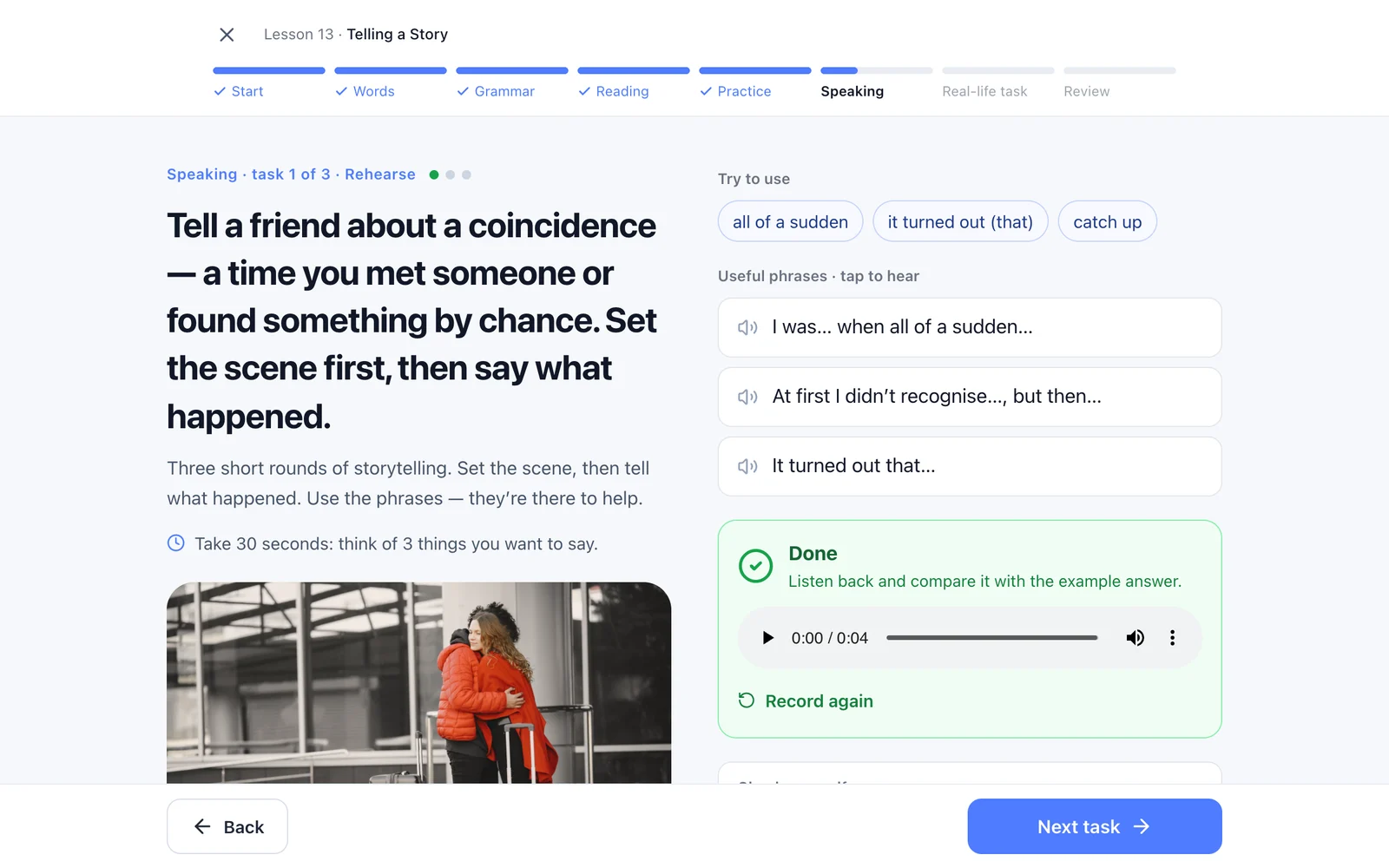
How to Speak English Fluently: A 30-Day Practice Plan
You understand English but freeze when you speak. That gap is normal, and it closes with the right kind of practice. Here's what builds fluency, and a plan for the next 30 days.