Advanced English (C1)
Say exactly what you mean, read between the lines and handle complex professional and social situations with nuance and control.

- C1CEFR level · Advanced
- 24lessons in 6 modules
- about 18 hof lessons
- Every lessonhas homework
What you'll be able to do
- Choose words for their precise meaning, tone and register
- Read and hear what is implied, not just what is said
- Argue, persuade and mediate with nuance and diplomacy
What every lesson includes
- Warm-up — A few questions to get you thinking about the topic.
- Words and phrases — Clear meanings, real examples and audio. Save anything to My Words.
- Grammar — Small steps with examples and a quick check.
- Reading and listening — A text that uses the new language — read it or listen to it.
- Practice — Mixed questions with feedback on the exact answer you chose.
- Speaking — Record your answer, play it back and compare it with an example.
- Real-life task — Put it together in a situation you'll actually meet.
- Review — A quick recap before you move on to the next lesson.
After every lesson there's homework with vocabulary, grammar, writing and speaking tasks.
Skills you practise
- Vocabulary
- Grammar
- Reading
- Listening
- Speaking
- Writing
Modules and lessons
All 24 lessons, grouped into 6 modules. Each lesson has one clear goal.
Module 1Precision & Nuance
Choose words for their exact meaning and connotation, control your stance and register, and hear what people imply.
- Lesson 1 Free previewThe Right Word
By the end of this lesson, you can choose between near-synonyms for their connotation and strength, so that you say exactly what you mean.
Connotation: positive, neutral and negative near-synonyms · Intensifying collocations (deeply, utterly, highly, bitterly) · Strength and tone of adjectives · Correcting words that are nearly right
- Lesson 2 Free previewTaking a Stance
By the end of this lesson, you can signal how certain and committed you are, and hedge claims without sounding vague.
Hedging: would appear, arguably, to some extent, tends to · Stance adverbs: admittedly, undeniably, presumably · Distinguishing claims from facts · Being cautious without being evasive
- Lesson 3Shifting Register
By the end of this lesson, you can move the same message up or down in formality and choose the register a situation calls for.
Nominalisation vs verb-based style · Phrasal verbs vs formal equivalents · Reformulating for different readers · Spotting register that is out of place
- Lesson 4What Isn’t Said
By the end of this lesson, you can understand implication, understatement and polite indirectness — and respond to what people actually mean.
Implicature and understatement (not ideal, a brave choice) · British-style indirectness · Reading tone in workplace messages · Responding to the real message
Module 2Professional Influence
Lead a discussion, frame an argument persuasively, deliver unwelcome news and negotiate beyond yes and no.
- Lesson 5Steering the Conversation
By the end of this lesson, you can manage a discussion: bring people in, keep it on track and close it with clear next steps.
Discourse management (If I could just come in here…, To bring us back to…) · Interrupting and handing over · Summarising and closing · Chairing without dominating
- Lesson 6Framing the Argument
By the end of this lesson, you can frame a message persuasively, using structure and emphasis rather than pressure.
Rhetorical patterns: contrast, rule of three, rhetorical questions · Fronting and emphasis for effect · Framing benefits vs losses · Persuading without overselling
- Lesson 7Unwelcome News
By the end of this lesson, you can deliver bad news clearly and humanely, and handle the reaction.
Impersonal and passive structures for tact · Regret and responsibility language · Being clear without being blunt · Responding to disappointment and anger
- Lesson 8Beyond Yes and No
By the end of this lesson, you can negotiate with nuance: make tentative offers, trade concessions and keep the relationship intact.
Formal conditionals: should you…, were we to…, provided that · Tentative offers and concessions · Holding your position politely · Creating options for both sides
Module 3Argument & Evidence
Weigh claims and evidence, build an argument that survives counter-argument, describe data precisely and synthesise sources.
- Lesson 9Weighing the Evidence
By the end of this lesson, you can judge how strong a claim is and report research with appropriate caution.
Reporting verbs by strength: suggest, indicate, show, prove · Correlation vs causation · Evaluating studies and headlines · Expressing justified scepticism
- Lesson 10Making the Case
By the end of this lesson, you can build an argument that acknowledges the other side and still lands your point.
Concession and counter-argument: admittedly, granted, that said, nonetheless · Structuring an argument · Anticipating objections · Conceding without giving in
- Lesson 11Telling It With Numbers
By the end of this lesson, you can describe data and trends precisely, and interpret what the numbers do and don’t show.
Complex noun phrases · Precise language of change and proportion · Interpreting rather than repeating data · Qualifying conclusions
- Lesson 12Bringing Sources Together
By the end of this lesson, you can synthesise several viewpoints into one balanced summary and position yourself within the debate.
Reporting and distancing: X contends, according to Y, it has been argued · Comparing and reconciling sources · Summarising without distorting · Signalling your own position
Module 4Language & Society
Use emphasis and information structure for effect, speculate carefully about the past and future, and read tone and irony.
- Lesson 13Who We Are
By the end of this lesson, you can talk about identity and belonging, using inversion and emphasis for effect.
Inversion for emphasis (Not only…, Rarely…, Little did I…) · Language, accent and identity · Personal reflection with a formal edge · When inversion sounds natural — and when it doesn’t
- Lesson 14Tech & Consequences
By the end of this lesson, you can speculate carefully about the causes and effects of technology, past and future.
Advanced modality: may well have, is likely to have been, could conceivably · Speculating vs asserting · Technology and ethics vocabulary · Weighing unintended consequences
- Lesson 15Rethinking Work
By the end of this lesson, you can highlight what matters most in an argument using information structure.
Cleft and pseudo-cleft sentences (It’s not… that…, What worries me is…) · Given vs new information · Changing work culture · Putting the focus where you want it
- Lesson 16Tone & Irony
By the end of this lesson, you can recognise irony, sarcasm and understatement in reviews and conversation — and control your own tone.
Irony, sarcasm and understatement · Tone markers in writing · When humour helps and when it backfires · Rewriting to change tone
Module 5Complex Interpersonal Communication
Disagree upwards diplomatically, handle criticism, build professional relationships and mediate between others.
- Lesson 17Disagreeing Upwards
By the end of this lesson, you can challenge a senior person’s idea respectfully and still be heard.
Tentative forms: I wonder whether…, Would it be worth…, I’m not sure it follows that… · Challenging assumptions · Managing status and face · Escalating a concern appropriately
- Lesson 18Handling Criticism
By the end of this lesson, you can take criticism professionally, separate fact from feeling, and give feedback that lands.
Reframing and acknowledging · Separating observation from judgment · Feedback that is specific and fair · Recovering after a tense exchange
- Lesson 19Building Rapport
By the end of this lesson, you can build professional relationships through natural, efficient conversation.
Ellipsis and substitution in conversation (Hope so., Might do., I’d rather not.) · Understated self-promotion · Finding common ground · Ending a conversation gracefully
- Lesson 20In the Middle
By the end of this lesson, you can mediate between two people or teams: find out what matters most to each side, restate it neutrally and help them move towards agreement.
Neutral reformulation · Separating positions from interests · Summarising both sides fairly · Proposing a way forward
Module 6Mastery
Tell stories with style, think on your feet, discuss big questions with nuance — then prove your C1 English.
- Lesson 21A Story Well Told
By the end of this lesson, you can tell a story with control of pace, style and detail.
Participle clauses and compressed narrative · Varying sentence rhythm · Showing rather than telling · Ending with impact
- Lesson 22Thinking on Your Feet
By the end of this lesson, you can handle unexpected questions: buy time, reformulate and give a clear answer under pressure.
Buying time naturally · Reformulating and redirecting questions · Handling questions you can’t answer · Staying concise
- Lesson 23The Bigger Picture
By the end of this lesson, you can discuss complex issues with balanced speculation and a clear, qualified position.
Balancing certainty and speculation · Long-term consequences · Qualifying and defending a position · Responding to counter-arguments in real time
- Lesson 24C1 Capstone
By the end of this lesson, you can synthesise a complex situation, argue a nuanced position and mediate a way forward — in one realistic scenario.
Integrated review · Synthesis of several perspectives · Register control · Mediation and persuasion
How access works
Lessons 1 and 2 of every course are a free preview for anyone signed in to Fluentra — creating an account is free. From Lesson 3, a course needs full access: choose Request full access in the app, and once your access is active you can continue through the rest of the course.
Vocabulary in your language
The vocabulary in every lesson can be translated into your own language — Fluentra supports 20 languages, including Armenian. The courses themselves are taught in English; words without a written translation are translated automatically.
Related guides
CEFR Levels Explained: A1 to C2 in Plain English
A1 to C2 describe what you can do in English, not how many words you know. Here's each level in practical terms, how long they typically take, and how to find yours.
How to Learn English Fast: A Realistic Plan for Faster Progress
Nobody learns English in a week. But you can learn it much faster than most people do — by studying in a way that wastes less time. Here's how.
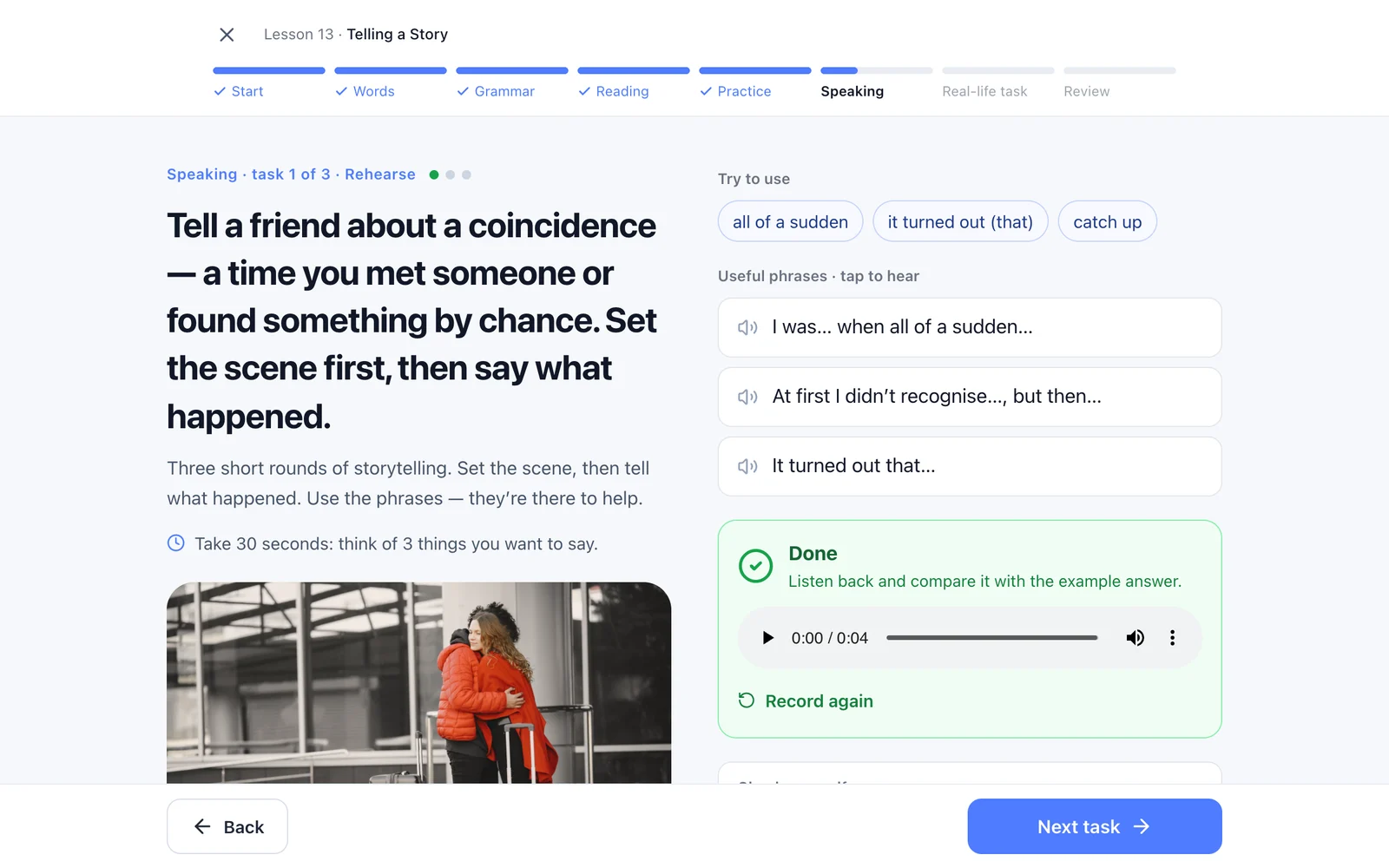
How to Speak English Fluently: A 30-Day Practice Plan
You understand English but freeze when you speak. That gap is normal, and it closes with the right kind of practice. Here's what builds fluency, and a plan for the next 30 days.