Upper-Intermediate English (B2)
Use English independently at work and in life: negotiate, persuade, handle problems and follow real conversations without a script.

- B2CEFR level · Upper-Intermediate
- 24lessons in 6 modules
- about 16 hof lessons
- Every lessonhas homework
What you'll be able to do
- Take an active part in meetings, negotiations and difficult conversations
- Understand longer articles and the writer’s point of view
- Explain, compare and defend your ideas at length
What every lesson includes
- Warm-up — A few questions to get you thinking about the topic.
- Words and phrases — Clear meanings, real examples and audio. Save anything to My Words.
- Grammar — Small steps with examples and a quick check.
- Reading and listening — A text that uses the new language — read it or listen to it.
- Practice — Mixed questions with feedback on the exact answer you chose.
- Speaking — Record your answer, play it back and compare it with an example.
- Real-life task — Put it together in a situation you'll actually meet.
- Review — A quick recap before you move on to the next lesson.
After every lesson there's homework with vocabulary, grammar, writing and speaking tasks.
Skills you practise
- Vocabulary
- Grammar
- Reading
- Listening
- Speaking
- Writing
Modules and lessons
All 24 lessons, grouped into 6 modules. Each lesson has one clear goal.
Module 1Confident Communication
Make a strong first impression, explain things you don’t have the words for, reason from clues and say difficult things tactfully.
- Lesson 1 Free previewFirst Impressions
By the end of this lesson, you can introduce yourself professionally, talk about what you’ve been working on and keep a networking conversation natural.
Present Perfect Continuous vs Present Perfect Simple · Networking small talk that goes somewhere · Talking about recent work and projects · Moving a conversation on politely
- Lesson 2 Free previewFinding the Words
By the end of this lesson, you can explain something when you don’t know the exact word, and check that people have understood you.
Paraphrasing and describing (it’s a kind of…, the thing you use to…) · Defining and non-defining relative clauses · Checking and clarifying meaning · Reformulating when you get stuck
- Lesson 3Putting Two and Two Together
By the end of this lesson, you can make confident guesses about what is happening or has happened, based on the clues you have.
Modals of deduction: must / might / can’t (be) · Past deduction: must have / can’t have / might have · Reasoning from evidence · Showing how sure you are
- Lesson 4Saying It Tactfully
By the end of this lesson, you can soften criticism, requests and bad news so that you sound direct but kind.
Softening language (a bit, slightly, I’d say, it might be worth…) · Distancing with would, could and past forms · Turning a complaint into a request · Giving honest but kind feedback to friends and colleagues
Module 2Working Life
Manage workload and deadlines, run and report on meetings, handle feedback and pitch an idea.
- Lesson 5Juggling Deadlines
By the end of this lesson, you can talk about workload, set realistic deadlines and explain where a project will be by a certain point.
Future Continuous and Future Perfect · Workload and time-management collocations · Negotiating a deadline · Being realistic without sounding negative
- Lesson 6Who Said What
By the end of this lesson, you can report what people said in a meeting accurately and summarise the decisions.
Reported speech with tense changes · Reporting verbs: suggest, recommend, insist, point out · Summarising a discussion · Action points and follow-ups
- Lesson 7Feedback That Helps
By the end of this lesson, you can give and receive feedback constructively and talk about what you would change.
wish / if only for present and past regrets · Constructive feedback language · Responding to criticism without getting defensive · Setting goals for improvement
- Lesson 8Pitching an Idea
By the end of this lesson, you can pitch a proposal clearly and give people a reason to say yes.
Cleft sentences for emphasis (What we need is…, The reason… is…) · Structuring a short proposal · Anticipating objections · Persuasive but credible language
Module 3Problems & Solutions
Complain effectively, negotiate a deal, explain what went wrong and think through hard decisions.
- Lesson 9Complaints That Work
By the end of this lesson, you can make a complaint that gets results and choose the right level of formality.
Past modals of criticism: should have / shouldn’t have / could have · Formal vs neutral register · Stating what you want as an outcome · Escalating a problem politely
- Lesson 10Striking a Deal
By the end of this lesson, you can negotiate terms, make conditional offers and reach an agreement both sides accept.
Conditional linkers: provided that, as long as, unless, on condition that · Making and responding to offers · Bargaining language · Closing a deal
- Lesson 11Getting It Fixed
By the end of this lesson, you can explain a technical or practical problem clearly and arrange for someone to fix it.
Causative have / get something done · Describing faults and symptoms · Explaining the steps you’ve already tried · Arranging repairs and services
- Lesson 12Tough Decisions
By the end of this lesson, you can talk through a difficult decision, including what would have happened if you had chosen differently.
Third conditional and past hypotheticals · Weighing options and trade-offs · Talking about consequences · Explaining why you chose what you chose
Module 4Society & Ideas
Compare viewpoints, describe trends, judge what you read and talk about the choices we make as consumers.
- Lesson 13Two Sides of the Story
By the end of this lesson, you can compare two viewpoints fairly and explain where you stand.
Contrast linkers: whereas, while, although, despite, even though · Presenting both sides · Balanced opinions · Work–life balance vocabulary
- Lesson 14A Changing City
By the end of this lesson, you can describe trends and changes in a place using facts and figures.
Present Perfect passive and continuous for trends · Describing change: rise, fall, level off, a sharp increase · Quantity expressions: the vast majority, a growing number · Urban life vocabulary
- Lesson 15Can You Believe It?
By the end of this lesson, you can report claims with the right distance and judge whether a source is reliable.
Distancing passives: it is said that…, is believed to… · Evaluating sources and evidence · Media and misinformation vocabulary · Questioning a claim politely
- Lesson 16What We Buy
By the end of this lesson, you can discuss spending habits and advertising, and explain the reasons behind buying decisions.
Verb patterns: -ing vs to-infinitive (stop, remember, try, regret) · Consumer and advertising vocabulary · Comparing products and value · Talking about habits you want to change
Module 5People & Culture
Navigate cultural expectations, handle conflict, tell a story people remember and follow informal English.
- Lesson 17Unwritten Rules
By the end of this lesson, you can explain cultural expectations and what is or isn’t acceptable in different places.
be supposed to / be expected to / be allowed to · Social norms and etiquette vocabulary · Explaining customs without stereotypes · Adapting to a new culture
- Lesson 18Clearing the Air
By the end of this lesson, you can talk about a conflict calmly, say what bothers you and find a way forward.
wish + would for annoying habits · Expressing feelings precisely · Acknowledging the other person’s view · Agreeing on a way forward
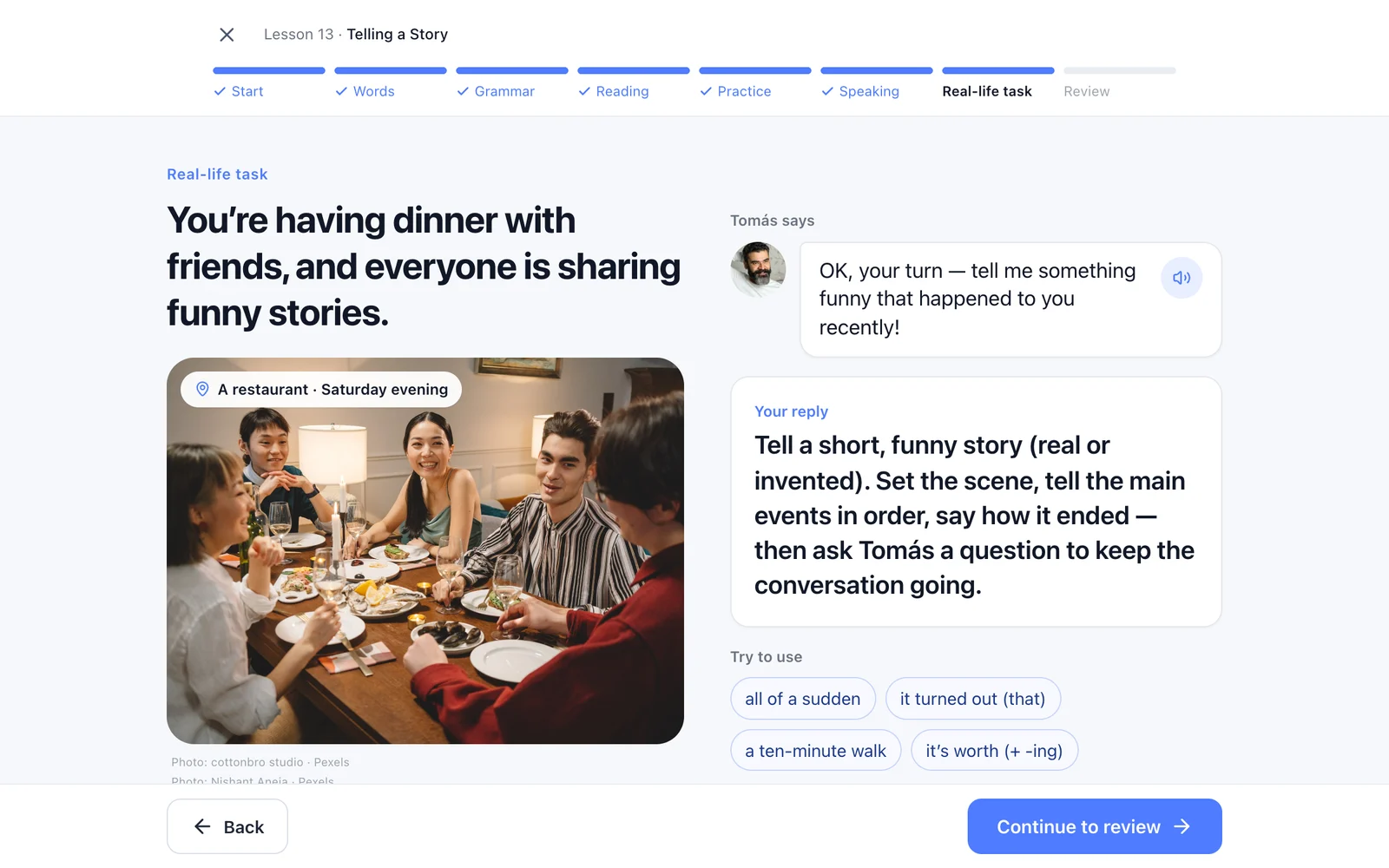
- Lesson 19Stories That Stick
By the end of this lesson, you can tell a story with good pacing, background and a strong ending.
Past Perfect Continuous in narratives · Narrative linkers: just as, by the time, eventually · Building suspense · Reacting to other people’s stories
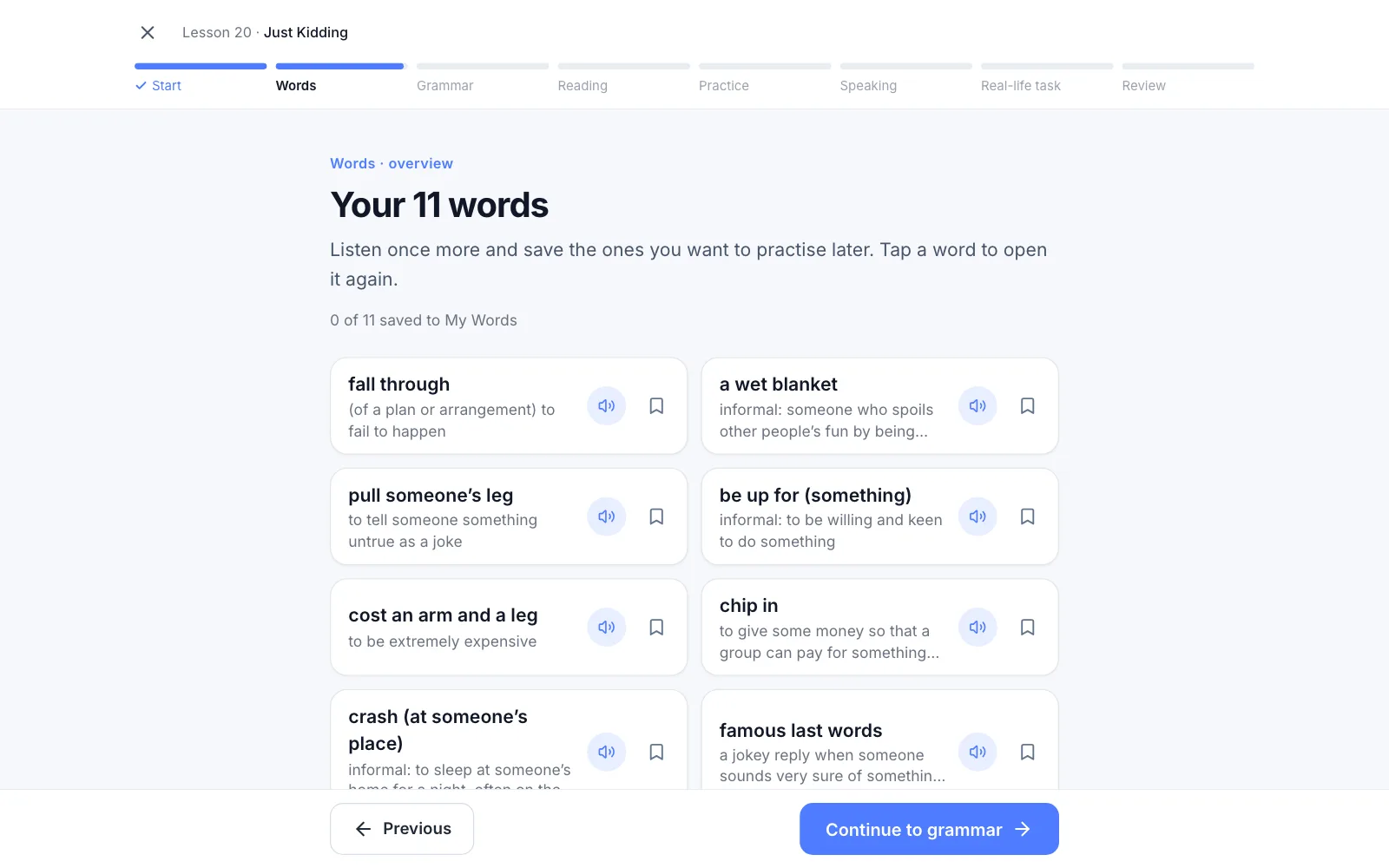
- Lesson 20Just Kidding
By the end of this lesson, you can follow informal conversation, understand common idioms and use them naturally.
Common idioms in everyday conversation · Informal phrasal verbs · Recognising light irony and teasing · Knowing when informal language fits
Module 6Independent B2
Present an idea, reach a compromise, talk about risk and uncertainty — then prove your B2 English.
- Lesson 21Presenting With Confidence
By the end of this lesson, you can give a short, well-structured presentation and handle a question at the end.
Signposting language · Emphasis with do / does / did · Opening and closing a talk · Handling questions
- Lesson 22Meeting Halfway
By the end of this lesson, you can discuss alternatives in a group and steer the discussion towards a compromise.
Mixed conditionals · Suppose / What if / Imagine for alternatives · Proposing and accepting compromises · Summarising where a group has got to
- Lesson 23Risk & Uncertainty
By the end of this lesson, you can talk about risks and likely outcomes, and say how confident you are.
Probability: bound to, likely to, there’s a good chance · Future forms for predictions and plans · Assessing risk · Contingency planning language
- Lesson 24B2 Challenge
By the end of this lesson, you can combine everything from this course to summarise, argue and negotiate in one real situation.
Integrated review · Summarising a longer text · Making and defending a case · Negotiating an outcome
How access works
Lessons 1 and 2 of every course are a free preview for anyone signed in to Fluentra — creating an account is free. From Lesson 3, a course needs full access: choose Request full access in the app, and once your access is active you can continue through the rest of the course.
Vocabulary in your language
The vocabulary in every lesson can be translated into your own language — Fluentra supports 20 languages, including Armenian. The courses themselves are taught in English; words without a written translation are translated automatically.
Related guides
Direct and Indirect Speech: Rules, Tense Changes and Examples
She said, “I'm tired.” — She said she was tired. Reporting what someone said follows a few clear rules, and once you know them you can report statements, questions and requests without thinking twice.
Common English Idioms and Phrases: 45 You'll Actually Hear
"It cost an arm and a leg" has nothing to do with arms. Here are 45 idioms native speakers really use, what they mean, when they fit — and how to stop them sounding forced.