Intermediate English (B1)
Build confident everyday English through real situations, vocabulary, grammar, listening and speaking.
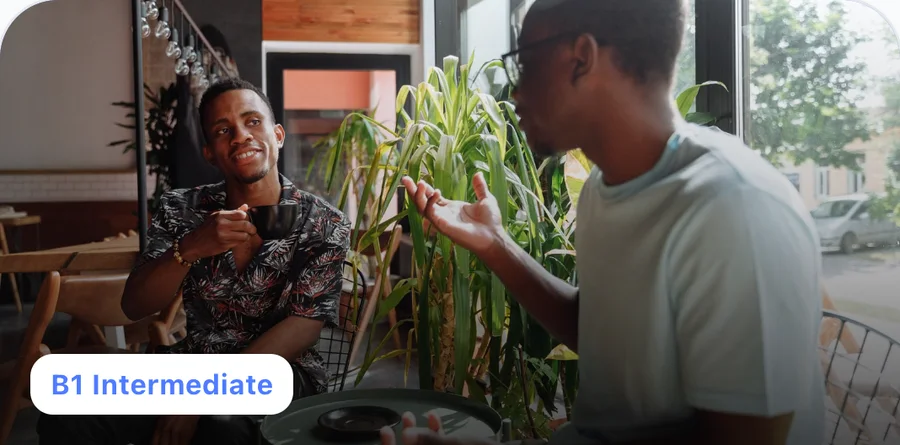
- B1CEFR level · Intermediate
- 24lessons in 6 modules
- about 14 hof lessons
- Every lessonhas homework
What you'll be able to do
- Talk about your life, work and experiences
- Handle travel problems and real situations
- Tell stories and give your opinion clearly
What every lesson includes
- Warm-up — A few questions to get you thinking about the topic.
- Words and phrases — Clear meanings, real examples and audio. Save anything to My Words.
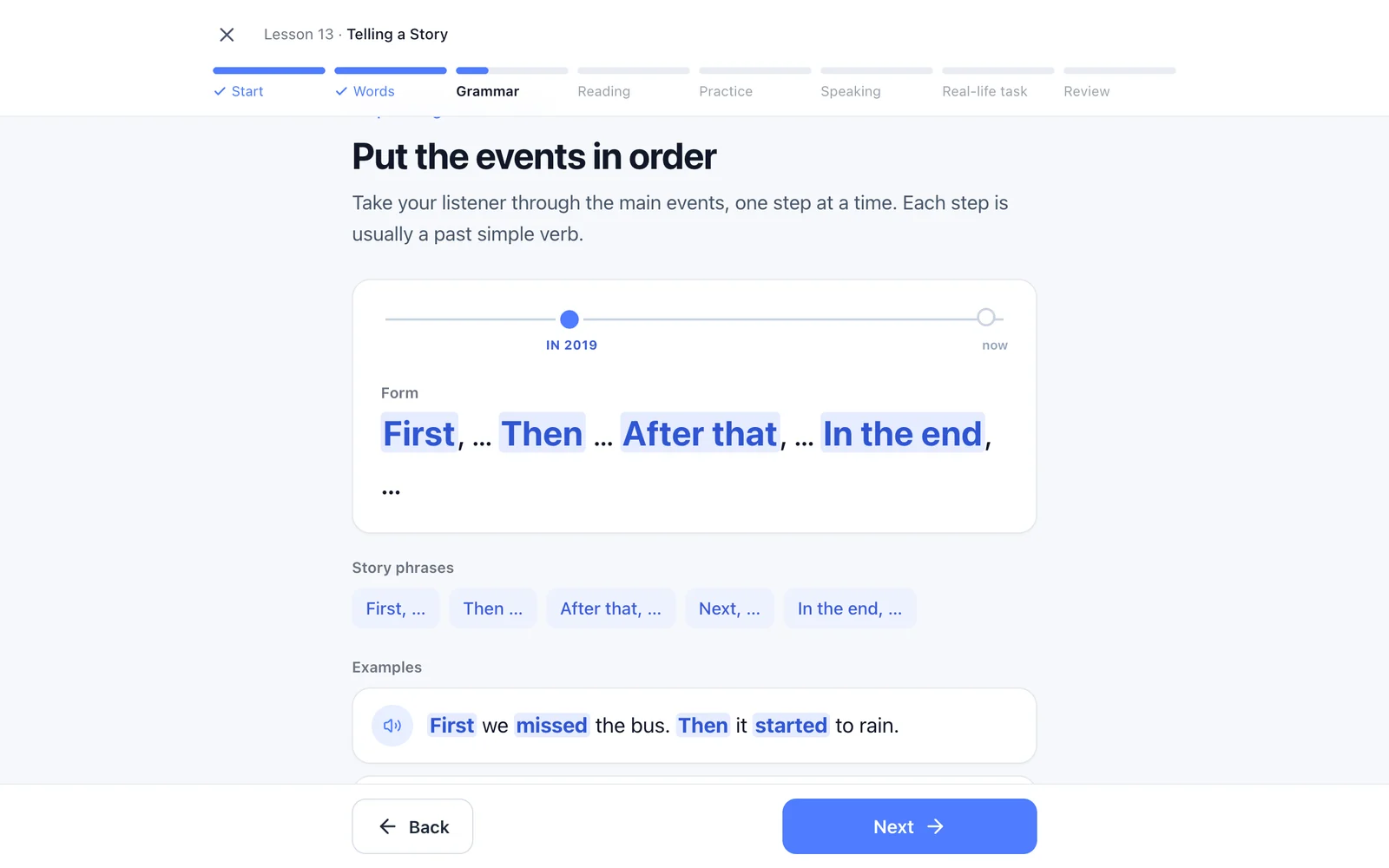
- Grammar — Small steps with examples and a quick check.
- Reading and listening — A text that uses the new language — read it or listen to it.
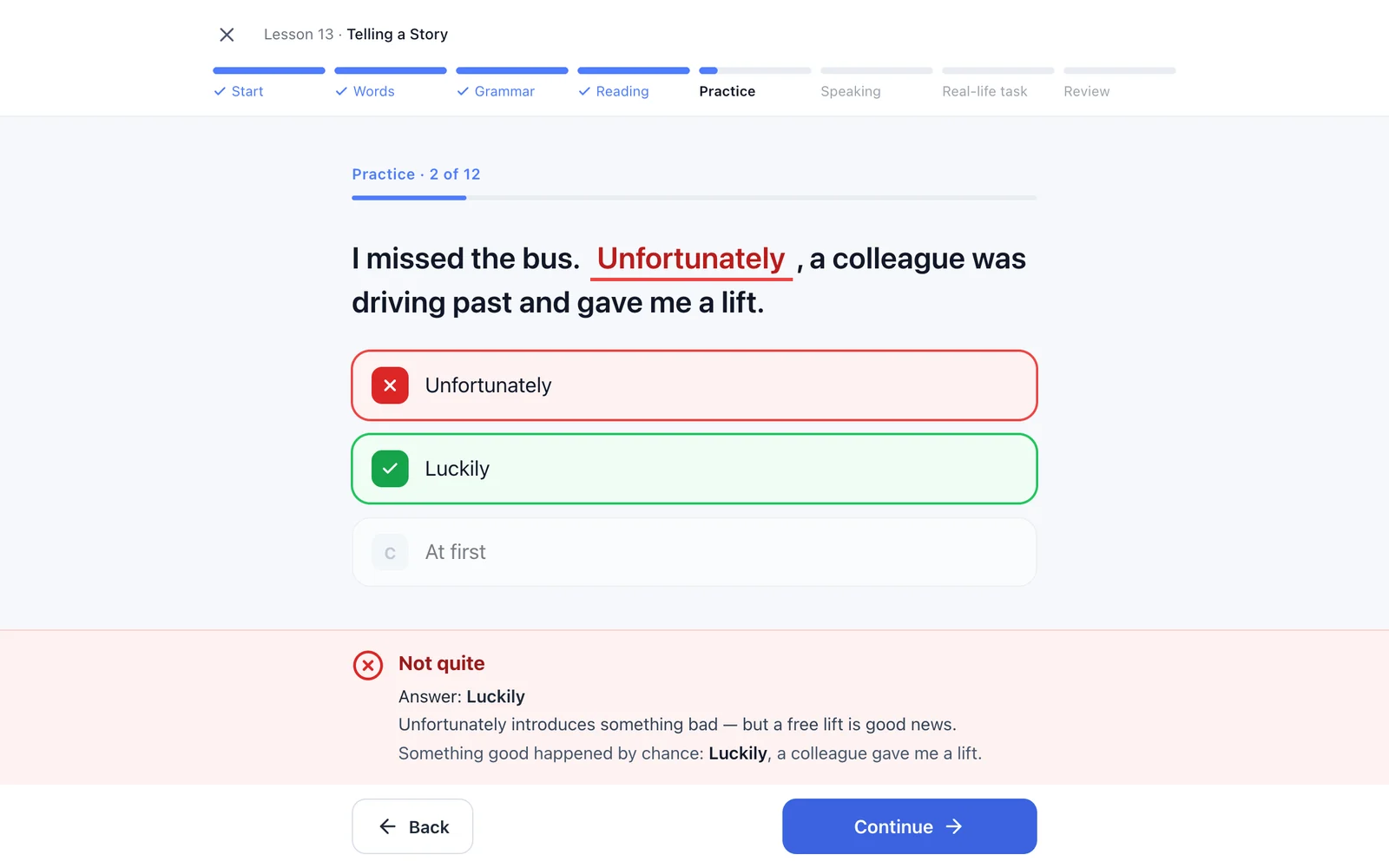
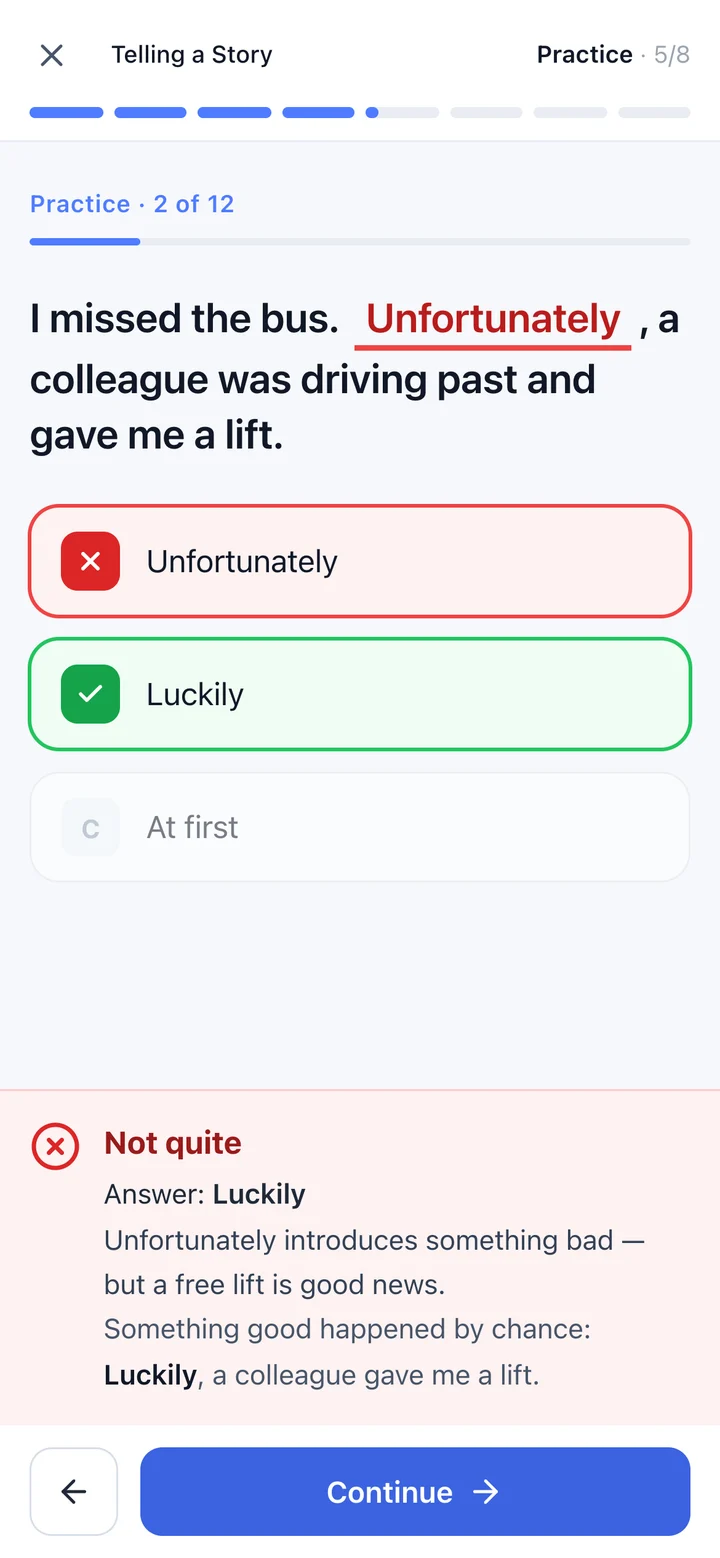
- Practice — Mixed questions with feedback on the exact answer you chose.
- Speaking — Record your answer, play it back and compare it with an example.
- Real-life task — Put it together in a situation you'll actually meet.
- Review — A quick recap before you move on to the next lesson.
After every lesson there's homework with vocabulary, grammar, writing and speaking tasks.
Skills you practise
- Vocabulary
- Grammar
- Reading
- Listening
- Speaking
- Writing
Modules and lessons
All 24 lessons, grouped into 6 modules. Each lesson has one clear goal.
Module 1Everyday Communication
Talk about your life, your experiences and the people around you — and keep a conversation going.
- Lesson 1 Free previewMy Life Now
By the end of this lesson, you can describe your usual routine and explain what is different in your life right now.
Present Simple vs Present Continuous · Routines and current situations · Talking about your everyday life
- Lesson 2 Free previewExperiences
By the end of this lesson, you can talk about your life and travel experiences and say when things happened.
Present Perfect vs Past Simple · Life and travel experiences · ever / never / already / yet
- Lesson 3People & Personality
By the end of this lesson, you can describe what people are like in a natural, balanced way.
Personality and behaviour vocabulary · Adjective modifiers · Describing people naturally
- Lesson 4Better Conversations
By the end of this lesson, you can keep a conversation going with follow-up questions and natural reactions.
Follow-up questions · Showing interest · Natural reactions · Keeping a conversation going
Module 2Work, Study & Goals
Talk about responsibilities, skills and plans, and give useful advice.
- Lesson 5Work & Responsibilities
By the end of this lesson, you can explain your responsibilities and the rules at work or school.
must / have to / should · Workplace vocabulary · Responsibilities and rules
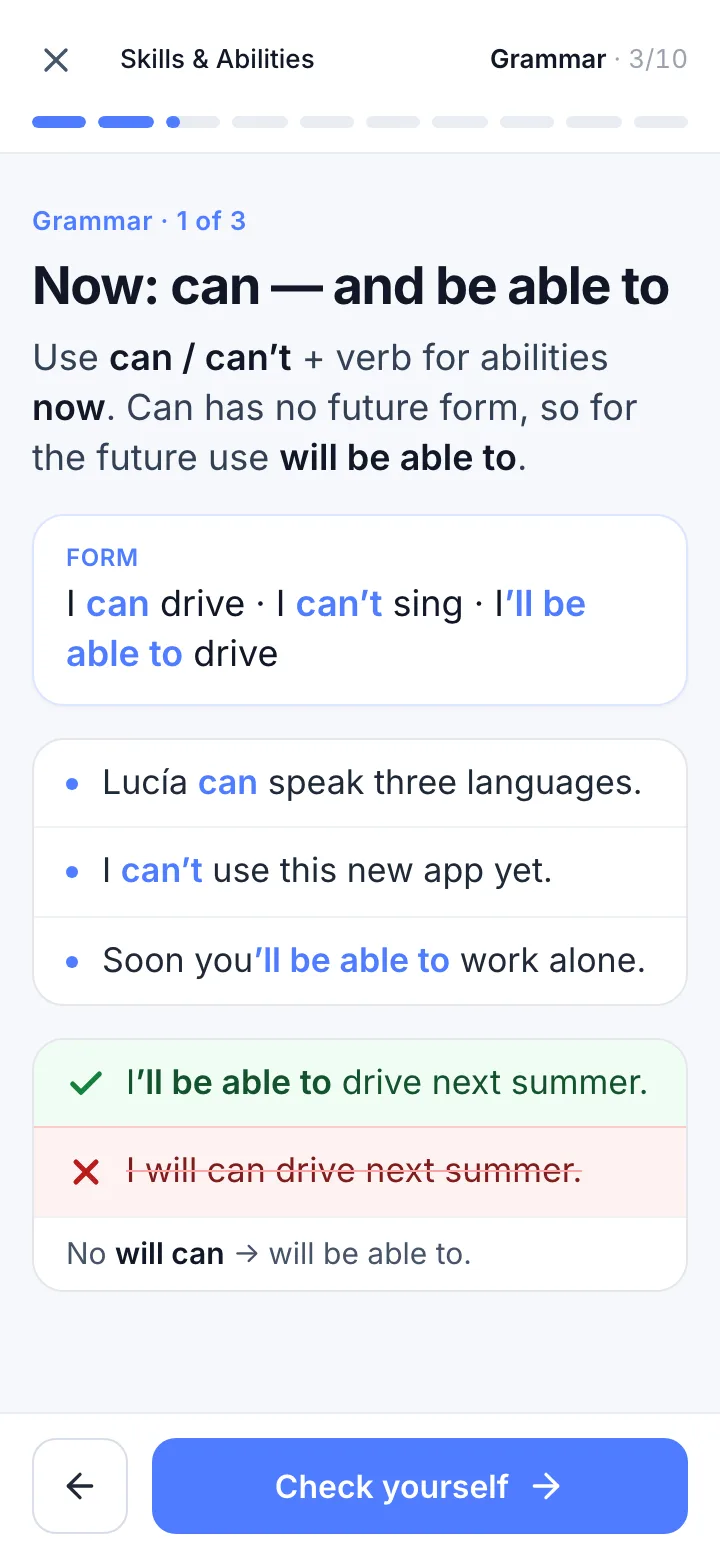
- Lesson 6Skills & Abilities
By the end of this lesson, you can talk about your strengths and skills — now, in the past and in the future.
can / could / be able to · Strengths, skills and learning
- Lesson 7Goals & Plans
By the end of this lesson, you can talk about your intentions, decisions and arrangements for the future.
will / going to / Present Continuous · Intentions and future arrangements
- Lesson 8Advice & Problem Solving
By the end of this lesson, you can ask for, give and respond to advice about real problems.
should / could / if I were you · Giving and responding to advice
Module 3Travel & Real Situations
Handle real travel situations: problems, polite questions and directions.
- Lesson 9Travel Experiences
By the end of this lesson, you can talk about places you have been and recommend travel experiences.
Travel vocabulary · Present Perfect review in real contexts
- Lesson 10When Things Go Wrong
By the end of this lesson, you can explain a travel problem clearly and say what was happening when it started.
Travel problems · Past Simple / Past Continuous · Delays, cancellations and lost items
- Lesson 11Asking for Information
By the end of this lesson, you can ask for information politely and check that you have understood.
Polite and indirect questions · Clarification strategies
- Lesson 12Getting Around
By the end of this lesson, you can ask for and give directions and describe where places are.
Directions and places · Relative clauses · Explaining locations
Module 4Stories & Experiences
Tell clear stories and explain feelings and relationships.
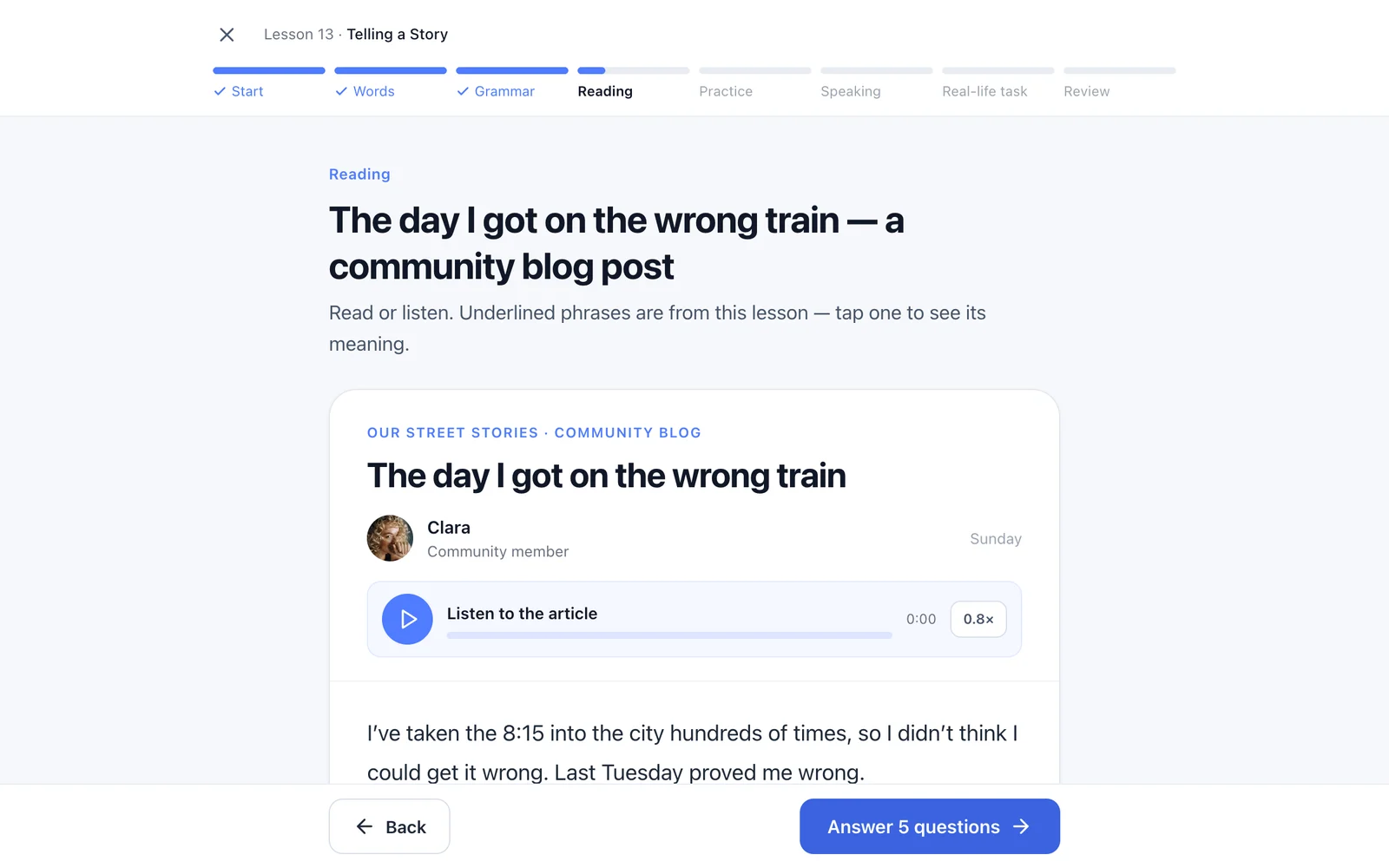
- Lesson 13Telling a Story
By the end of this lesson, you can tell a short story with a clear order of events.
Past Simple / Past Continuous · Sequencing events
- Lesson 14What Happened Before?
By the end of this lesson, you can build a story that goes back in time to explain what had happened.
Past Perfect · Building more complex narratives
- Lesson 15Feelings & Reactions
By the end of this lesson, you can describe how situations make you feel and react to other people’s news.
Emotion vocabulary · -ed / -ing adjectives
- Lesson 16Relationships & Communication
By the end of this lesson, you can explain a situation between people and how everyone feels about it.
Friendship, family and conflict · Explaining feelings and situations
Module 5Opinions & The World
Give and defend opinions, discuss the news and explain causes and results.
- Lesson 17Giving Your Opinion
By the end of this lesson, you can give a clear opinion and support it with reasons and examples.
Opinion phrases · Reasons and examples · Expressing a clear point of view
- Lesson 18Agreeing & Disagreeing
By the end of this lesson, you can agree and disagree politely in a discussion.
Polite disagreement · Discussion language
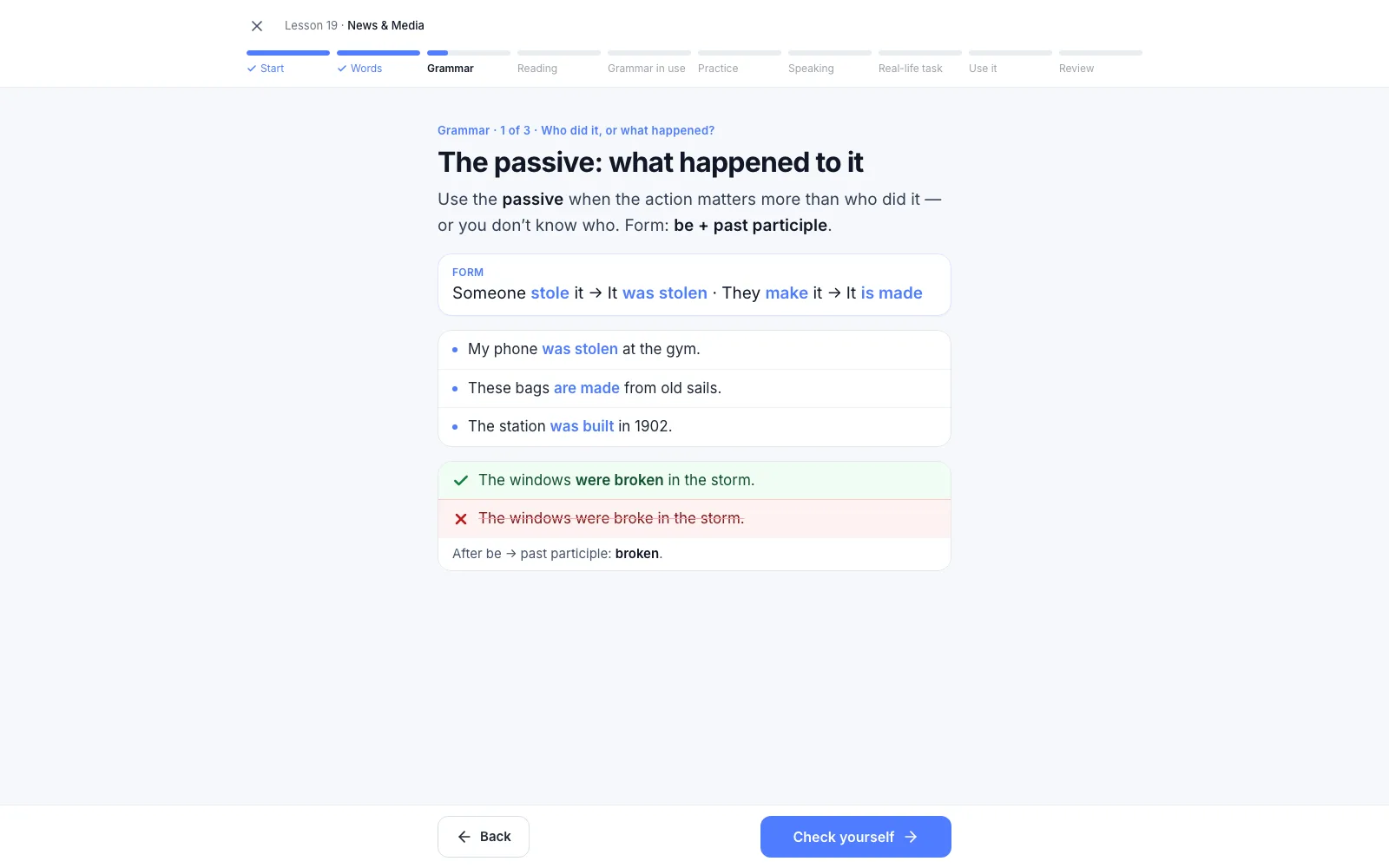
- Lesson 19News & Media
By the end of this lesson, you can understand and report simple news stories.
Passive voice · News and media vocabulary
- Lesson 20Cause & Effect
By the end of this lesson, you can explain why things happen and what their results are.
because / since / therefore / as a result · Explaining consequences
Module 6Independent English
Talk about change, imagined situations and the future — then prove your B1 English.
- Lesson 21Life Changes
By the end of this lesson, you can talk about past habits and how you adapt to change.
used to · be used to · get used to
- Lesson 22Possibilities & Hypotheticals
By the end of this lesson, you can talk about imagined situations and what you would do.
Second Conditional · Imagined situations
- Lesson 23Predictions & Possibility
By the end of this lesson, you can make predictions and say how sure you are.
will / may / might / probably · Future predictions
- Lesson 24Final B1 Challenge
By the end of this lesson, you can show that you can use B1 English confidently in a real-life situation.
Integrated review · Reading · Listening · Vocabulary · Grammar · Speaking · Short writing · Real-life scenario
How access works
Lessons 1 and 2 of every course are a free preview for anyone signed in to Fluentra — creating an account is free. From Lesson 3, a course needs full access: choose Request full access in the app, and once your access is active you can continue through the rest of the course.
Vocabulary in your language
The vocabulary in every lesson can be translated into your own language — Fluentra supports 20 languages, including Armenian. The courses themselves are taught in English; words without a written translation are translated automatically.
Related guides
Present Perfect Tense: Rules, Examples and When to Use It
I've seen it or I saw it? The present perfect connects the past to now — and once you see the four ways it does that, choosing between it and the past simple gets much easier.
Past Perfect Tense: Rules, Examples and Past Simple vs Past Perfect
When I arrived, the film started — or had started? The past perfect tells your listener which past event came first. Here's how it works, and when you can skip it.
Conditional Sentences in English: Zero, First, Second and Third
If it rains, we'll stay in. If I won the lottery, I'd travel. If I'd known, I would have called. Here's how each type of if-sentence works — and how to choose the right one.
English Tenses: All 12 Tenses With a Chart and Examples
Twelve tenses sounds like a lot. It's really three times (past, present, future) and four ways of looking at an action — and once you see that pattern, the chart reads itself.
Active and Passive Voice: Rules, Examples and When to Use Each
“Someone stole my bike” or “My bike was stolen”? Both are correct. The difference is what you put first — and knowing when to choose each one makes your English sound natural.
Modal Verbs in English: Meanings, Rules and Examples
Modal verbs are small words that change the whole meaning of a sentence: you can go, you must go, you should go, you might go. Here's what each one does, and how to choose.