Looking for a Duolingo Alternative for English? How to Choose
Most people who look for a Duolingo alternative want one specific thing that a streak can't give them. Name that thing first, and the choice gets much easier.

On this page
Duolingo describes itself as the world's most popular language learning app, and it's easy to see why: short lessons, a clear next step and a habit that is easy to keep. If it's working for you, you may not need anything else. But if you're searching for an alternative, something has probably stopped working, and the useful question isn't "which app is best?" It's "what do I need that I'm not getting?"
This guide helps you answer that honestly, including the cases where the right move is to stay. A note on fairness: we make Fluentra, so we're not neutral. We've kept to what you can check for yourself, and we describe where Fluentra is the wrong choice too. Features and prices change, so confirm the details of any app on its own site before you pay.
First, find out what is actually missing
People leave language apps for a handful of different reasons, and each one points to a different kind of tool.
| What you notice | What it usually means | Look for |
|---|---|---|
| "I have a long streak, but I can't hold a conversation." | You need more speaking time | Speaking practice, or a tutor |
| "I don't know what level I am." | You need a measure | A placement test tied to the CEFR |
| "I forget the words I learn." | You need spaced review of your own words | A personal word list with review |
| "The grammar feels random." | You need explanations in a planned order | A structured course |
| "I can't follow real English." | You need longer listening and reading | Graded texts and recordings |
| "I just stopped opening it." | Your goal has gone vague | A concrete goal, whatever the tool |
The main kinds of alternative
Structured CEFR courses
These follow a fixed path through a level: grammar, vocabulary, reading, listening and speaking in a planned order, with lessons that build on one another. They suit you if you want to finish a level and know what you covered. The trade-off is that a lesson usually takes longer than a game-style exercise, so they ask for more focus. If you're not sure what the levels mean, our guide to CEFR levels explains them.
Live tutors and classes
Nothing replaces another person reacting to you in real time. Tutors are the strongest option for speaking and for getting mistakes corrected, and they're the most expensive per hour. They also work best when you do your own practice between lessons, so they combine well with almost everything else here.
Speaking-focused apps
If speaking is the gap, look for a tool that makes you produce whole sentences and gives feedback on them. Be realistic about what the feedback covers. Our guide to practising speaking alone has methods that work with no app at all.
Reading and listening tools
Graded readers, podcasts for learners and subtitled video build the comprehension that short exercises can't. They're often free. They work best with a way to keep the new words you meet, or those words disappear within days.
Flashcard apps
Spaced-repetition flashcards are very effective for memorising vocabulary and very easy to overuse. Words learned only as cards can stay hard to use in a sentence, so pair them with reading or speaking.
When Duolingo is still the right choice
Stay if you're happy, if you mainly want a light daily habit, or if you're learning a language other than English for fun. A habit you keep beats a better method you abandon. Many learners also keep Duolingo for a few minutes a day and add something else for the skill it doesn't cover. You don't have to choose only one.
Questions to ask about any alternative
- Does it tell you your level? Look for a placement test, and for honest wording: a short online test gives an estimate, not a certificate.
- What happens to words you meet? Do they come back later, or are they gone after the lesson?
- How much do you produce? Count how often you speak or write your own sentences, not just tap answers.
- Can you see what's next? A visible path helps when motivation drops.
- What can you try before paying? Do a real lesson first, not just the sign-up screens.
- Does it fit your week? Twenty focused minutes most days will take you further than an ambitious plan you drop.
Where Fluentra fits, and where it doesn't
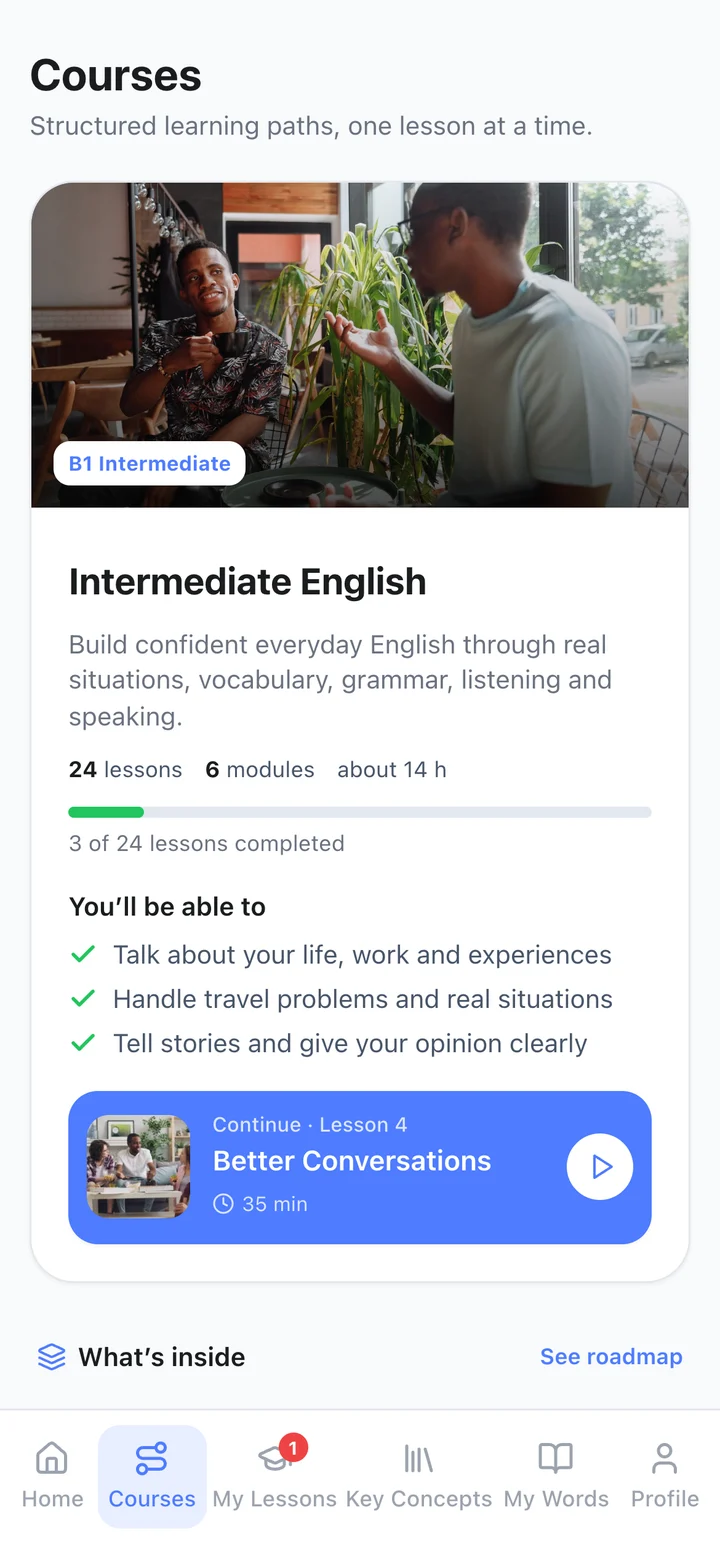
A Fluentra course page: one level, in a set order.
Fluentra English is for adults who want structure. It has five CEFR courses from A1 to C1, each with 24 lessons. Words you save go into My Words, with audio and translation, and come back in your daily practice. In every course lesson you record a spoken answer and compare it with an example. Creating an account is free, and Lessons 1 and 2 of every course are a free preview once you sign in. Later lessons need full access, which you can request in the app.
It's the wrong choice if you want live lessons, because there are no video calls or classes with a teacher. It's also the wrong choice if you need an official qualification, because finishing a course doesn't give you one, and there's no C2 course. And it only teaches English, so it won't help with Spanish or French.
A simple way to decide this week
- Name the gap. Pick one line from the table above.
- Find your level. Take a free level test, so you start in the right place.
- Try one alternative for a week. Do real lessons, ideally five short sessions.
- Judge it by what you can do. Can you say or understand something you couldn't a week ago?
For a wider plan, our guide to learning English efficiently shows how to combine the skills once you've chosen your tools.
Questions people ask
What is the best alternative to Duolingo for English?
It depends on what's missing. For speaking, a tutor or a speaking tool. For a clear path through a level, a structured CEFR course. For remembering words, a personal word list with spaced review. Name the gap first, then try one option for a week.
Can Duolingo alone make you fluent in English?
A short daily app is good for habit and basic vocabulary, but fluency needs a lot of listening, reading and speaking in full sentences. Most learners need to add those, whichever app they use.
Is Fluentra free?
Creating an account is free, and Lessons 1 and 2 of every course are a free preview once you sign in. Later lessons need full access, which you can request in the app.
Should I stop using Duolingo if I start a course?
Not necessarily. If you enjoy it, keeping a few minutes a day alongside a course is fine. Just make sure most of your study time goes to the skill you actually need.