How to Remember English Vocabulary: Practice That Actually Sticks
Forgetting a word a few days after you learn it is normal. Two simple habits change that: testing yourself instead of rereading, and coming back at the right time.
On this page
You look up a word, it makes perfect sense, and three days later it's gone. That isn't a problem with your memory. It's what happens to almost anything we meet once and don't use again. The good news is that the methods that fix it are simple, and they're well supported by research.
This guide covers the practice that works, what to do about the words that won't stick, and how to set up a routine that takes only a few minutes a day.
Test yourself instead of rereading
The most useful change you can make is to stop looking at a word and start trying to recall it. Rereading a list feels productive because the words look familiar, but recognising a word isn't the same as being able to find it when you need it.
In a well-known study of vocabulary learning, Karpicke and Roediger (2008) found that repeatedly trying to recall words helped long-term memory far more than repeatedly studying them. The students themselves didn't realise this, which is why so many people keep rereading.
In practice, it's easy:
- Look at the meaning and try to produce the English word before you check.
- Cover the English column of your list and test yourself.
- Say the word aloud, because you also need to recognise it when it's spoken.
- When you get one wrong, look at the answer and try again later in the same session.
It should feel a little difficult. That effort is what makes the word stay.
Come back at the right time
The second habit is spacing. Reviews spread over days work better than the same amount of study all at once. A large review of the research by Cepeda and colleagues (2006) found this effect again and again. Ten minutes a day beats an hour on Sunday.
You don't need a perfect schedule. A simple pattern is enough:
| Review | When |
|---|---|
| First | The day after you learn it |
| Second | About three days later |
| Third | About a week later |
| Then | Every few weeks, until it comes without effort |
If you forget a word, bring it back to the start. If it's easy, wait longer. An app can handle this for you, but a notebook with dates works too.
Learn the phrase, not just the word
A word on its own is hard to use. "Decision" doesn't tell you that in English you make a decision. So save the small group of words that usually travel together.
| Instead of | Save |
|---|---|
| decision | make a decision |
| heavy | heavy rain, heavy traffic |
| interested | interested in something |
| depend | it depends on |
This matters even more for phrasal verbs, where the whole meaning sits in the combination. It also makes you sound more natural, because you're building on what speakers actually say. Our list of daily English sentences is a good source of ready-made phrases.
Write one sentence that's true for you
A word connected to your own life is easier to remember than a dictionary example. When you save a word, write one short sentence about something real: "My sister makes every decision in about ten seconds." It takes half a minute, and you'll also find out whether you really know how to use the word.
Then use it in your next speaking practice. Words you've said out loud tend to be easier to find in a real conversation.
Choose fewer words
Lists of 100 words a day look impressive and rarely last. Most learners do better with five to ten new words a day that they actually need. Good choices are words you've met more than once, words for your work or hobbies, and words you wanted just now and didn't have.
It's fine to skip a word that seems rare. If it matters, you'll meet it again.
What to do when a word won't stick
- Make a picture. Link the word to a strange mental image, especially if it's hard to pronounce or spell.
- Separate similar words. If you keep mixing up two words, study them together and write a sentence showing the difference.
- Find it in context. Search for the word in a video or an article to see how people really use it.
- Let it go for now. Some words just aren't useful to you yet. Removing them leaves more room for those that are.
A five-minute daily routine
- Two minutes: test yourself on the words due today.
- Two minutes: add a few new words from what you read or heard, as phrases.
- One minute: say one new sentence aloud using a word from this week.
How to tell it's working
The real test isn't whether you can recognise a word in a list. It's whether the word comes to you when you need it. Once a week, pick five words you learned a few weeks ago and try to use each one in a new sentence without looking anything up. If you can, those words are yours.
Choosing a vocabulary app
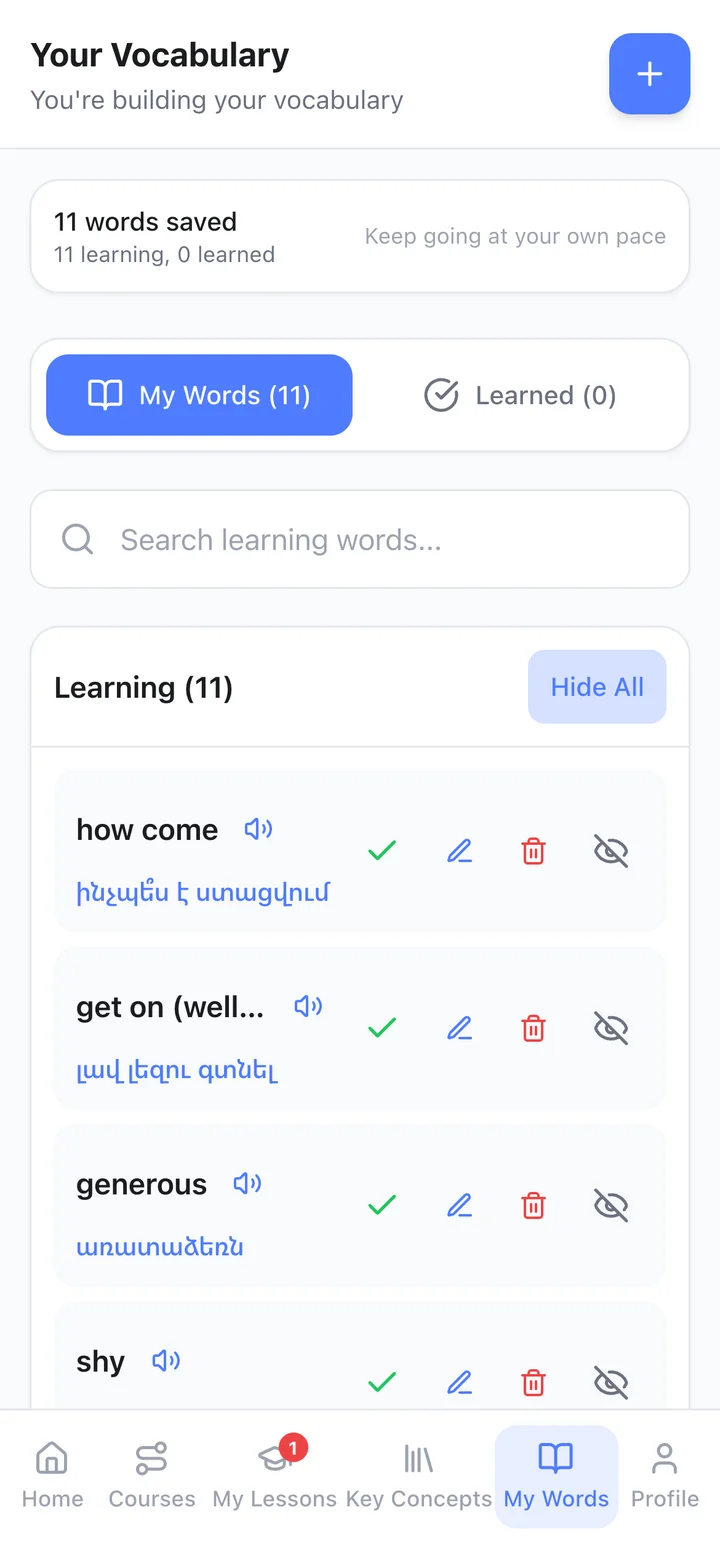
My Words in Fluentra: the words you saved, ready to review.
Any good tool should do three things: let you save words from what you're really reading, make you recall them rather than just look at them, and bring them back over time. Be wary of apps that only ask you to pick the right answer from four options, since that trains recognition rather than recall.
In Fluentra, you can save a word from a lesson or an article and it goes into My Words, with audio and translation. It then comes back in your daily practice until you mark it as learned. Each CEFR course also teaches the words for that level in context. Creating an account is free, and Lessons 1 and 2 of every course are a free preview once you sign in.
Questions people ask
How many English words should I learn a day?
Five to ten new words a day is plenty for most learners, as long as you also review old ones. Fewer words that you can really use are worth more than a long list you forget.
What is the best way to practise vocabulary?
Test yourself rather than rereading, space your reviews over days, and use each word in a sentence of your own. Saving phrases instead of single words makes them easier to use.
Why do I keep forgetting English words?
Forgetting is normal when you meet a word once and don't use it again. Words stay when you try to recall them several times, with gaps between attempts, and use them in real sentences.
Are flashcards good for learning vocabulary?
Yes, because they make you recall words and can be spaced over time. Add a phrase or a sentence to each card, because words learned only as single cards can be hard to use when speaking.