Fluentra vs Babbel for Learning English: How They Differ
Both give you structured lessons. Babbel has spaced-repetition review, course certificates and a store app. Fluentra has A1 guidance in 20 languages and a clear A1 to C1 path.

On this page
Fluentra and Babbel can both be your main English course. Choose Babbel if your language is one of its eight display languages for English, and you want a store app or several languages in one plan. Choose Fluentra if your language isn't covered there, if you want your whole path laid out from A1 to C1, or if you want to find your level before making any account.
A note on fairness: we make Fluentra, so we aren't neutral. We've stuck to things you can check. What we say about Babbel comes from its website, its prices page and its support pages, checked on 13 November 2026, and every source is listed at the end. Plans and prices can differ by country and platform, so confirm the details before you pay.
The short comparison
| Fluentra | Babbel | |
|---|---|---|
| Languages you can learn | English only | Several, with English offered in other display languages |
| Levels | Five CEFR courses from A1 to C1, with 24 lessons each. No C2 | Its help centre lists CEFR levels for the other languages it teaches, but not for English |
| Help in your own language | In A1, instructions, explanations, word meanings and feedback in your choice of 20 languages. English instructions from A2 | English courses with the app set to Ukrainian, Polish, German, French, Swedish, Italian, Spanish or Portuguese |
| Finding your level | Free level test with no account | A placement quiz for Spanish, French, Italian and German, but not English |
| Speaking | Record your answer, play it back and compare it with an example, with an optional check | Speaking exercises with speech recognition. Its AI partner, Babbel Speak, isn't offered for English |
| Certificates | A certificate of completion when you finish every lesson of a course | A certificate for each completed course, which Babbel says isn't formally recognised |
| Trying it first | Lessons 1 and 2 of every course are free once you sign in | Free sign-up, the first lesson of every course, and up to 80 free lessons depending on the language |
| Price | $12 a month or $89 a year in the US, Canada and most of Europe. Set by country | $45.75 for 3 months, $107.40 for 12 months, or $299.99 lifetime, for all 14 of its languages |
| Where it runs | In your browser, on a phone, tablet or computer | Web and mobile apps |
Learning in your own language
Babbel's support pages say its English courses appear when the app is set to another language, and list Ukrainian, Polish, German, French, Swedish, Italian, Spanish and Portuguese. If you speak one of those, that's a real strength: Babbel can work from your own language.
Fluentra's Beginner English (A1) offers its guidance in 20 languages, from Arabic to Ukrainian, including languages such as Japanese, Korean, Hindi, Persian, Turkish and Chinese. The English you read, hear and say stays in English. From A2 upwards, instructions and explanations are in English, so this helps most at the very start. You can try part of a real lesson in any of the 20 with no account.
Lessons and structure
Babbel presents its lessons as short, and says they're created by a team of language experts. Its own page gives more than one figure for how long they take, so try a few to see how they fit your day.
Fluentra is a longer format: five courses from A1 to C1, each with 24 lessons in six modules. A lesson moves through new words and grammar, reading or listening, practice, speaking and a real-life task, with homework afterwards. Before you begin, each course page shows its lessons and goals, so you can see the whole path. It suits people who want depth more than a very quick session. If your time is limited, see our guide to learning English efficiently.
Finding your level
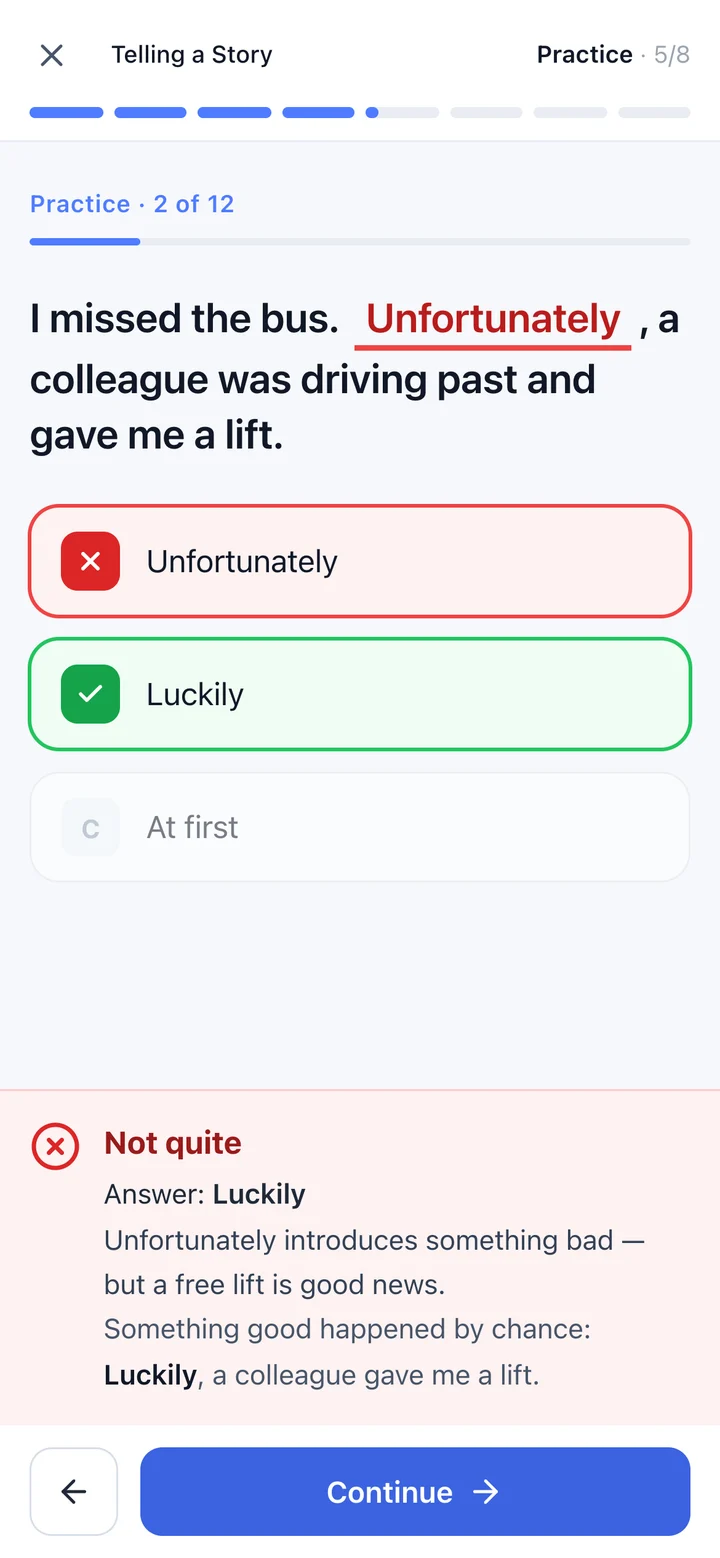
Finding your level first is worth it. Babbel's placement quiz covers Spanish, French, Italian and German, not English, so with Babbel you choose your starting course yourself. Fluentra's free level test takes about 12 to 15 minutes and needs no account. It gives you an estimated CEFR level from A1 to C1 and suggests a course. It covers grammar and vocabulary, reading and listening, but not speaking or writing, and it isn't a certificate. Our guide to CEFR levels explains what the result means.
Speaking practice
Babbel builds speaking exercises into its lessons, with speech recognition for pronunciation feedback. Babbel also has Babbel Speak, an AI conversation partner in beta, but its help centre lists it only for learners of Spanish, French, German, Italian and Mexican Spanish, not English.
In Fluentra, every course lesson has you record your answer, play it back and compare it with an example answer. If you tap Check my answer, your recording is sent for transcription so you can get feedback, and we don't keep the audio. There are no live teachers. Whichever app you choose, real conversation still matters, and our guide to speaking English more fluently covers how to build up to it.
Remembering new words
In Fluentra, you can tap a word in lesson text to see its translation and hear it, then save it to My Words. Saved words come back in a short daily practice, so review is part of the routine. For a method that works with any course, read how to remember English vocabulary.
What each one costs
On 13 November 2026, Babbel's prices page showed $45.75 for 3 months ($15.25 a month), $107.40 for 12 months ($8.95 a month) and a one-time $299.99 for lifetime access, with a Black Friday offer on the lifetime plan. Every Babbel plan includes all 14 of its languages, which is good value if you want more than English. Babbel says prices vary by location, plan length and platform.
Fluentra teaches only English. Creating an account is free, and Lessons 1 and 2 of every General English course are free once you sign in. After that, Full Access to General English is $12 a month or $89 a year in the US, Canada and most of Europe. Fluentra sets its price by country, and you see yours before you pay.
See the price for your country on Fluentra's pricing page.
Certificates
Babbel gives you a downloadable certificate for each course you complete, and its help centre says these certificates aren't formally recognised. That can be a nice record of progress, but check what your school or employer accepts. Fluentra gives you a certificate of completion when you finish every lesson of a course, with a link anyone can use to check it. It’s a Fluentra certificate, not an official qualification. If you need an official result, take a recognised exam.
Which one should you choose?
Babbel is likely the better fit if:
- You speak one of its eight display languages for English, and want that support throughout.
- You want spaced-repetition review in several modes: flashcards, writing, speaking and listening.
- You like earning a certificate for each course you complete.
- You want to install the app from an app store.
- You'd like other languages too: every plan includes all 14 of Babbel's.
Fluentra is likely the better fit if:
- You're starting from zero, and your language is one of Fluentra's 20 but not one of Babbel's eight.
- You want a clear course all the way from A1 to C1, with the lessons visible up front.
- You want to check your level before creating an account.
- You want to save words as you read and review them in daily practice.
Try the free lessons of each, and keep the one you go back to without forcing yourself. If neither feels right, compare more options in the best English learning apps by goal.
Looking at more than these two? See Babbel alternatives for adults learning English.
Sources
Checked on 13 November 2026 unless marked otherwise.
- Babbel: prices, how Babbel works (speaking and review), its help centre on the placement quiz, Babbel Speak and course certificates (all rechecked 13 November 2026) and available languages (the eight display languages for English, and CEFR levels for its other courses). Free lessons: read on babbel.com on 4 November 2026.
- Fluentra: its course catalogue, the A1 languages page and its prices, as in the app on 13 November 2026.
Questions people ask
Is Fluentra better than Babbel?
It depends on what you need. Babbel has spaced-repetition review, a certificate for each completed course and a store app, and offers English in eight display languages. Fluentra offers A1 guidance in your choice of 20 languages, five courses from A1 to C1, and a free level test with no account.
Can I learn English on Babbel in my language?
Babbel's support pages say English courses appear with the app set to Ukrainian, Polish, German, French, Swedish, Italian, Spanish or Portuguese. If your language isn't there, you'd study through one of those.
Does Fluentra have an AI conversation partner?
No. In Fluentra you record your answer, play it back and compare it with an example, and you can ask for a check on your answer. There's no back-and-forth AI conversation and no live teacher in the courses.
Do Fluentra or Babbel give certificates?
Babbel gives a downloadable certificate for each course you complete, and its help centre says these certificates aren't formally recognised. Fluentra gives a certificate of completion when you finish every lesson of a course. For an official result, take a recognised exam.
Can I try Fluentra for free?
Yes. The level test needs no account, and Lessons 1 and 2 of every course are a free preview once you sign in. Later lessons need full access.
How much do Fluentra and Babbel cost?
On 13 November 2026, Babbel's prices page showed $45.75 for 3 months, $107.40 for 12 months or $299.99 for lifetime access, for all 14 of its languages. Fluentra's Full Access to General English is $12 a month or $89 a year in the US, Canada and most of Europe, and its price is set by country.