The Best English Learning Apps, Compared by What You Need
No single app is best for everyone. Here are eight good options, matched to the job you need done, with what each one is weak at and where Fluentra fits.
On this page
- How we compared
- The eight options at a glance
- Levels, speaking, review and price
- If you want a daily habit: Duolingo
- If you want a full structured course: Busuu, Babbel or Fluentra
- If speaking is the problem: ELSA Speak or a tutor
- If you keep forgetting words: Anki or a personal word list
- If you want good free material: BBC Learning English
- How to choose in one week
- Where Fluentra isn't the right choice
- Sources
The best English learning app is the one that fixes what is holding you back right now. For a daily habit, that might be Duolingo. For a structured course, Busuu, Babbel or Fluentra. For pronunciation, ELSA Speak. For real conversation, a tutor on italki. Most people do best with one main course and one tool for the skill it covers least.
A note on fairness: we make Fluentra, so we aren't neutral, and this isn't a ranking. Nobody paid to be listed. We didn't run a controlled test either. We read each product's own pages in November 2026, and we link to them so you can check. Plans and features change, so confirm the details before you pay.
How we compared
We looked at each tool against the questions people ask before they choose one:
- Levels: how far the English course goes on the CEFR scale, in the provider's own words.
- Speaking: whether you speak at all, and what answers you back: speech recognition, AI, or a person.
- Word review: whether the words you learn come back for review.
- Free access: what you can use before paying.
- Price: what the provider's own page showed us on 13 November 2026, in US dollars. Prices change, vary by country and are often on sale, so treat them as a guide.
Every fact about another product links to the page it came from, in the sources at the end. We didn't score or rank the apps, because the right one depends on your goal.
The eight options at a glance
| Tool | Best for | Keep in mind |
|---|---|---|
| Duolingo | Building a daily habit and basic vocabulary | Short exercises won't replace long listening and real conversation |
| Busuu | A course from A1 to C1, with feedback from fluent speakers | Some speaking features are limited to its top plan |
| Babbel | Short structured lessons with speech recognition | English courses are offered in eight display languages |
| Fluentra | Adults who want a clear A1 to C1 path, with A1 guidance in 20 languages | No live teachers; its certificate is for completing a course, not an exam |
| ELSA Speak | Pronunciation feedback and AI role-plays | A speaking coach more than a full course |
| italki | One-to-one lessons with a real person | You pay per lesson, and quality varies by teacher |
| Anki | Remembering words with flashcards you control | You choose or make the cards, and it won't teach you grammar |
| BBC Learning English | Free listening and grammar material | A library more than a guided path |
Levels, speaking, review and price
| Tool | Levels | Speaking | Word review | Free to try | Price we saw (13 Nov 2026) |
|---|---|---|---|---|---|
| Duolingo | English through B2, it says | Speaking and listening exercises | Review built into the course | Free with ads | Super is paid; the price is shown in the app and varies |
| Busuu | A1 to C1 for English | Speaking assessments; AI conversations on Premium Plus, in some languages | Vocabulary and grammar review on Premium | A free plan | Premium $51.09 a year on offer (list $149.88); Premium Plus $61.53 |
| Babbel | Not stated for English in its help centre | Speech recognition. Its AI partner, Babbel Speak, isn't offered for English | Spaced-repetition review | The first lesson of every course | $45.75 for 3 months, $107.40 for 12 months, $299.99 lifetime |
| Fluentra | Five courses, A1 to C1 | Record your answer and compare it with an example, with an optional check | Saved words come back in daily practice | Lessons 1 and 2 of every course, and the level test | $12 a month or $89 a year in the US, Canada and most of Europe; set by country |
| ELSA Speak | A speaking coach, not a full course | AI pronunciation feedback and role-plays | Not its focus | Check in the app | Paid plans; we couldn't open its pricing page |
| italki | Depends on your teacher | Real conversation with a person | Up to you and your teacher | Depends on the teacher | Pay per lesson; each teacher sets a price |
| Anki | Not a course | None | Spaced-repetition flashcards | Free on computers and Android | The iPhone app, AnkiMobile, is paid |
| BBC Learning English | Material for many levels | None you're marked on | None built in | Free | Free |
Fluentra's own price is the one in its app on the same day. Its pricing page shows the price for your country.
Fluentra's 20 A1 languages, with a real example from a lesson, are on learning English in your language.
If you want a daily habit: Duolingo
Duolingo describes itself as the world's most popular language learning app. Its strength is that it's easy to come back tomorrow: short lessons, a clear next step and a streak you don't want to lose. That habit has real value, especially if you've quit other courses.
The limit is what short exercises can train. Long listening, reading and speaking in full sentences need more room. If your streak is long but conversation still feels hard, our guide to choosing a Duolingo alternative helps you find out what's missing.
If you want a full structured course: Busuu, Babbel or Fluentra
All three give you a planned order, which helps when you don't want to decide what to study each day. The differences are in what surrounds the lessons.
- Busuu says its lessons run from A1 to C1, and its community lets fluent speakers give you feedback. It also gives you a downloadable certificate when you finish a level and pass the end-of-level test. That's a Busuu certificate, not an official exam result. We compare it in more detail in Fluentra vs Busuu.
- Babbel offers speaking exercises with speech recognition and spaced-repetition review. Its placement quiz and its AI partner, Babbel Speak, aren't offered for English. Its support pages say English courses are available with the app set to Ukrainian, Polish, German, French, Swedish, Italian, Spanish or Portuguese. More in Fluentra vs Babbel.
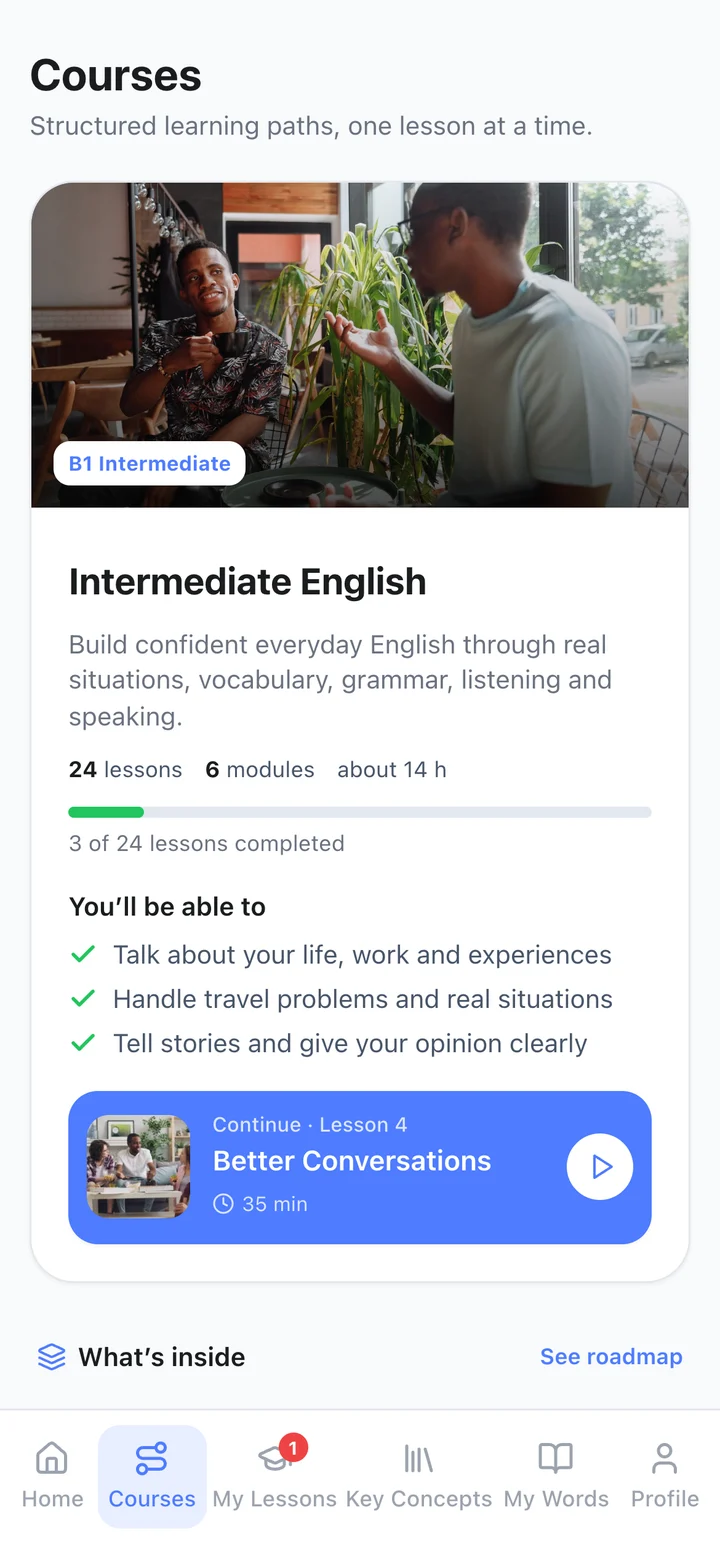
- Fluentra has five CEFR courses from A1 to C1, each with 24 lessons in six modules. In Beginner English (A1), instructions, grammar explanations, word meanings and feedback appear in your choice of 20 languages, while the English you read, hear and say stays in English. From A2 upwards, instructions are in English.
If you aren't sure which level to start at, take a free level test first. It gives you an estimated CEFR level, so you don't pay for a course that's too easy or too hard. Our guide to CEFR levels explains what each level means.
If speaking is the problem: ELSA Speak or a tutor
Speaking improves when you speak, so the question is who or what is on the other side.
ELSA Speak focuses on how you sound. It gives AI feedback on your pronunciation and offers role-play conversations. It's a good add-on if people often ask you to repeat yourself. It won't teach you a whole level of English on its own.
italki connects you with community tutors and professional teachers for one-to-one lessons. There's no subscription: teachers set their own prices and you pay per lesson. Nothing else here gives you a real person reacting to what you say, but it costs more per hour and you have to find a teacher who suits you.
Inside Fluentra, every course lesson asks you to record your answer, play it back and compare it with an example. You can also ask for a check on your answer. There are no live teachers, so if you need real conversation, add a tutor. Our guide to choosing a speaking app goes further, and practising speaking alone covers what you can do with no app at all.
If you keep forgetting words: Anki or a personal word list
Anki is a flashcard program that schedules each card for around when you're likely to forget it. The computer version and AnkiDroid for Android are free. It's powerful, but you have to choose or make the cards, and that takes discipline.
Many course apps include a lighter version. In Fluentra, you can tap a word in lesson text to see its translation and save it to My Words, and saved words come back in daily practice. See how to remember English vocabulary for a method that works with any tool.
If you want good free material: BBC Learning English
BBC Learning English is a long-running free resource, and it often appears in recommendations for listening and grammar. It suits people who are happy to choose their own material, or who want extra listening alongside a course. If you'd like a plan for using it, try our English listening practice guide.
How to choose in one week
- Name your biggest problem. Is it habit, structure, speaking, memory or listening? Choose one.
- Find your level. A placement test stops you from starting too low or too high.
- Try before you pay. Do real lessons, not just the sign-up screens. On Fluentra, Lessons 1 and 2 of every course are a free preview once you sign in.
- Keep it to two tools. One main course, and one tool for the skill it covers least. More than that usually means less time actually studying.
- Judge by what you can do. After a week, can you say or understand something you couldn't before?
If you already use one of these and want a change, see Babbel alternatives, Busuu alternatives or Fluentra vs Duolingo. To compare level tests before you start, read free English level tests compared.
Where Fluentra isn't the right choice
Choose something else if you want live lessons, because Fluentra has no video calls or classes with a teacher. Choose something else if you need an official qualification. Finishing a Fluentra course gives you a certificate of completion, not an exam result. For that, take a recognised exam. Fluentra also has no C2 course, and it currently runs in your browser on a phone, tablet or computer rather than from an app store.
Sources
Checked on 13 November 2026 unless marked otherwise. Product pages change, so check before you pay.
- Duolingo: courses teaching through B2 (Duolingo blog) and duolingo.com.
- Busuu: Premium plans and prices and how its courses work.
- Babbel: prices, how Babbel works and available languages.
- ELSA Speak: elsaspeak.com (read 4 November 2026).
- italki: italki.com (read 4 November 2026).
- Anki: apps.ankiweb.net.
- BBC Learning English: bbc.co.uk/learningenglish (its site couldn't be fetched from here).
- Fluentra: its course catalogue and prices, as in the app on 13 November 2026.
Questions people ask
What is the best app to learn English?
It depends on what you need. Duolingo suits a daily habit, Busuu, Babbel and Fluentra suit a structured course, ELSA Speak suits pronunciation, and italki gives you a real tutor. Most people do best with one main course and one tool for the skill it covers least.
What is the best free app to learn English?
BBC Learning English is a free resource for listening and grammar, and Anki is free on computers and Android for flashcards. Most course apps let you try some lessons for free. On Fluentra, Lessons 1 and 2 of every course are a free preview once you sign in.
Can I learn English with only an app?
An app can take you a long way on vocabulary, grammar, reading and listening. Speaking needs more: at some point, real conversation with a person makes a big difference.
Which English app is best for complete beginners?
Look for one that explains things in a language you already understand. Fluentra's Beginner English (A1) gives instructions, grammar explanations, word meanings and feedback in your choice of 20 languages. Babbel's English courses are available in eight display languages.
Do these apps give you an official English certificate?
Not in the sense of a recognised exam like IELTS or TOEFL. Busuu gives a certificate for each level you pass, Babbel gives one for each course you complete (and says these aren't formally recognised), and Fluentra gives a certificate of completion when you finish a course. None of these is an official exam result. If a school or employer needs proof, take a recognised exam.